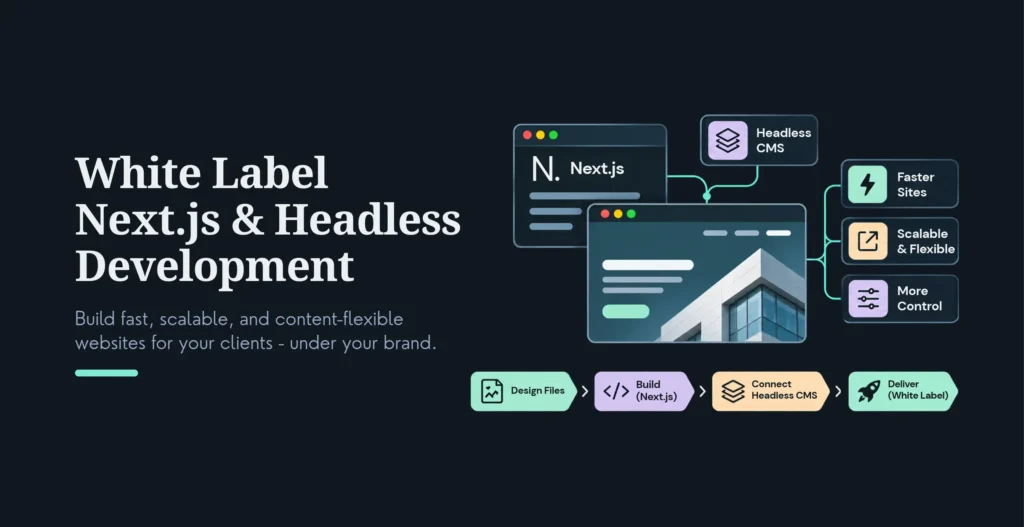
Your clients have seen what a fast, modern site feels like, and they’re asking for it: sub-second loads, headless content editing, an app-like front end. Delivering that means Next.js, React Server Components, a headless CMS, and edge rendering, and hiring a senior front-end team to do it well is expensive, slow, and hard to keep busy between projects. White label Next.js and headless development is how agencies say yes to that work without building the team.
White label Next.js and headless development is branded engineering: a specialist partner builds a high-performance Next.js site or headless-CMS product under your agency’s brand, and your client never knows a subcontractor exists. The partner owns the technical execution, architecture, build, CMS integration, performance, deployment; you keep the client relationship, strategy, design sign-off, pricing, and brand. It’s the right offer specifically when the engineering model is the product, when components, measurable performance, and a git-based delivery path are what the client is actually buying, not just a page that looks nice. Done properly, it’s invisible: the partner works in your repos, your project tools, and your email domain, with no co-branding, no attribution, and no trace in the code, the repo, or the invoice.
This is a decision playbook for agency CTOs and technical leads: when Next.js is the right sell (and when it isn’t), exactly what the partner owns versus what you keep, how the workflow and invisibility actually work, real pricing, the performance bar, and how to vet a partner so you don’t get burned. Front-end capacity is one of the bottlenecks that stall agency growth, and this is a clean way past it. It’s the model behind our own white label web design and development (web development and ReactJS development).
Key Highlights
What it is: A specialist builds high-performance Next.js / headless-CMS sites under your brand. You keep the client, strategy, and margin; the partner owns the engineering, invisibly.
When to sell Next.js: When the engineering model is the product, speed, search (SSR), headless editing, app-like UI, headless commerce, multi-market content. When it’s a simple brochure or visual-builder site, sell Webflow or WordPress instead and say so.
The ownership split: You own the client relationship, discovery, design, sign-off, pricing, and QA. The partner owns schema, CMS config, the Next.js front end, performance, and deployment. Content modelling is shared.
The invisibility rule (CTO version): The partner works in your GitHub org, your Slack/Linear, and your email domain, with deploy hooks you can revoke and hosting you (or the client) own. No partner name in code, commits, repo, or invoice.
Pricing (vendor-reported ranges): per project from ~$750 for small builds (headless-CMS builds often ~$4,000+); monthly capacity ~1,000–2,100 for 30-60 hours; a dedicated developer ~3,000–3,500/month; a dedicated team from ~$8,000/month. Mark up 30-100% on your added value.
The performance bar is the deliverable: sub-second loads, passing Core Web Vitals, SSR/edge rendering, preview deploys on every PR. Verify with a live URL and a real CMS editor session, not just a Lighthouse screenshot.
Vet hardest on: proven App-Router/headless depth, NDA + non-solicitation, repo/hosting control staying with you, clean IP transfer, and a backup plan for launch week.
Table Of Contents
Table Of Contents
What White Label Next.js & Headless Development Actually Is
It’s custom, branded engineering, not a product you resell. A partner builds the real thing (a marketing site, a content-heavy site on a headless CMS, a dashboard or client portal, sometimes a thin product UI) under your agency’s name, and hands it over as your work. The output is unique to each client; only the delivery process is standardized. Critically, “white label Next.js” is not a plugin or a template, it’s custom delivery where the code, the component architecture, and the performance tuning are built for that client.
The scope covers what modern clients ask for: Next.js marketing sites and landing pages, custom web apps and portals, headless-CMS builds (Sanity, Payload, Contentful, Storyblok, or a headless WordPress), headless commerce (Next.js storefronts on the Shopify Storefront API, on Shopify’s redesigned Hydrogen (currently in developer preview and framework-agnostic; the classic Hydrogen is React Router-based), or composable backends), API integrations (payments, CRMs, marketplaces), and increasingly AI features, all delivered with handover documentation written for your team. The stack is the current standard: Next.js App Router, React Server Components, TypeScript, Tailwind, a headless CMS, deployed to Vercel or the edge. The distinction worth drawing for a client: a headless build means the content lives in an editing back end (the CMS) that feeds a separate, fast React front end, so editors update pages without touching code, and the front end stays fast because it’s decoupled.
When to Sell Next.js, and When Not To
This is the decision a CTO actually needs help with, and the honest version wins trust. Sell Next.js when the engineering model is the product, when the client is really buying performance, a component system, SSR for search, headless editing, or app-like interactivity. Concretely, Next.js is the right call when speed and search matter (server-side rendering means crawlers get full HTML on first request), when the client needs headless CMS with a fast front end, when it’s a SaaS, startup, or genuinely app-like site, when it’s a custom web app, dashboard, or portal, when it’s headless commerce, or when it’s a multi-market, content-heavy site that needs editorial independence after handover.
Equally important, and more credible, is naming when not to sell it. A simple brochure site, a client who wants to edit everything in a visual builder, basic ecommerce, or a low-maintenance site are all better served by Webflow, WordPress, or Shopify, and a CTO who says that plainly to a client earns the right to be believed when they do recommend Next.js. The quick heuristic: if the value is in how it’s engineered, performance, components, git-based delivery, sell Next.js; if the value is in how easily a non-technical person can edit it visually, or in keeping costs and maintenance minimal, point them to a hosted platform. Pushing Next.js at a five-page brochure site is the fastest way to an over-engineered, over-priced project that underperforms on the thing the client actually cared about. (For the fuller platform comparison, WordPress, Webflow and a custom buildis its own decision we cover separately.)
What the Partner Owns vs What You Keep
The working model only succeeds when the split is explicit, and for a CTO this is the part that determines whether the engagement feels like an extension of your team or a loss of control. You keep everything client-facing and strategic: the client relationship, discovery, design direction, final sign-off, pricing, brand presentation, and QA: the work ships under your name, so the last check is yours. The partner owns the technical execution: schema design, CMS/Studio configuration, the Next.js front end, performance, deployment, and the architecture-code-testing-deployment chain. Content modelling sits in the middle, shared, because that’s precisely where design intent and engineering reality meet, and the best outcomes come from deciding it together.
Underneath that split is the control layer that keeps you safe, and it’s non-negotiable for a technical buyer: the repository lives in your GitHub or GitLab organization with the partner added as a collaborator (never the partner’s org), deploy hooks are yours to revoke, and the hosting organization is owned by you or the client. Get those three right and the partner can do all the engineering while you retain the ability to walk away with everything intact, which is the whole point of white label rather than a referral.
How the Workflow and Invisibility Work
The delivery flow is four steps and should feel like working with your own senior engineer. You send the brief (Figma, requirements, or a rough idea); the partner reviews the designs, defines the component architecture, selects the headless CMS, sets up the repo in your org, and returns a technical spec and a fixed quote agreed before any work begins. They build in Next.js, dynamic templates, CMS integration, forms wired to the client’s CRM, using the full modern toolkit (App Router, React Server Components, streaming, ISR), working inside your repos, your project tools, and your communication channels. You review and QA against preview deployments generated on every pull request, with a real CMS editor session so you can see the non-engineer experience, not just a performance score. Then you deliver it as your own: zero-downtime deployment, domain cutover, and a written handoff (architecture notes, environment variables, deployment steps) for your team.
Invisibility is engineered, not promised, and for a CTO the specifics matter more than the reassurance. The partner commits code to your GitHub or GitLab using your corporate email addresses, works in your Slack, Teams, Linear, or Jira, uses an @youragency.com alias, and, if they join a client channel at all, appears under your banner. There is no co-branding, no attribution, and no partner name, credit, or link anywhere in the code, comments, public repos, or the invoice, the project is credited entirely to your agency. Locked around it: an NDA signed before the brief is shared, plus non-solicitation so the partner can’t approach your client directly. The combination of working-in-your-systems plus the contractual backstop is what makes the invisibility real rather than a trust exercise.
Pricing and Margin
Treat these as vendor-reported planning ranges that vary with scope and seniority, and price from the client’s outcome and your own risk, not from the partner’s hourly rate. Agencies typically engage in one of a few models. Fixed-price per project suits defined builds and migrations, small builds start around $750, a Sanity-plus-Next.js build commonly runs from ~$4,000, a migration ~$3,000, an audit ~$800, with the risk being scope-creep disputes if the brief is loose (fix it with a written spec and re-quote changes in writing). Reserved monthly capacity (a block of hours, roughly 1,000–2,100/month for 30-60 hours) suits a steady pipeline of smaller jobs, with the risk of paying for idle time in slow months. Hourly or ad hoc suits overflow and one-off fixes but doesn’t guarantee availability. A dedicated developer (~3,000–3,500/month) suits regular work with the same person each time, and a dedicated team (from ~$8,000/month) suits outsourcing most of your delivery. At the top end, white-label headless-commerce pods report wholesale costs in the tens of thousands against agency sell prices well into six figures.
On margin, the workable rule is to take the partner’s price and add 30-100% depending on how much design, strategy, and account management you contribute, the more of the client-facing value you own, the more markup you can justify. In margin terms, a 30% markup is roughly a 23% gross margin and a 100% markup is 50%. The two caveats worth stating to protect your actual profit: that markup is before your own management and QA time, which is real and should be priced in; and the fixed-price model only holds its margin if the spec is tight, so invest in the brief. If you’re weighing this against building the capability in-house, our agency vs in-house cost breakdown runs the comparison.
The Performance Bar
With Next.js, performance isn’t a nice-to-have, it’s the deliverable the client is paying for, so it’s also the thing to verify hardest. The modern standard is a decoupled, headless architecture on the Next.js App Router, rendered at the edge (Vercel’s edge network or Cloudflare Pages), tuned for sub-second loads and passing Core Web Vitals. Server-side rendering means search crawlers get full HTML on the first request, headless decoupling keeps the front end fast as content scales, and preview deployments on every pull request let you (and the client) see real performance before launch. Accessibility and performance QA should be part of the partner’s process, not an afterthought. For more on front-end performance at scale, see our guide to enterprise front-end performance.
One honest note for the vetting stage: don’t accept a Lighthouse screenshot as proof. Ask for live URLs of shipped, deployed products and run them through PageSpeed Insights on mobile yourself, and ask to see a real CMS editor session so you can judge the editorial experience your client will actually live in. A beautiful Lighthouse score on a demo page tells you little; a fast live site plus a clean editor experience tells you the partner can actually deliver the thing you’re selling.
How to Choose a Partner, and the Risks to Manage
Vet a Next.js/headless partner like the senior hire they’re replacing. The non-negotiables: a signed NDA and non-solicitation; demonstrable App-Router/RSC/headless depth across the CMSs you sell (Sanity, Payload, Contentful, Storyblok); transparent fixed or clearly-defined pricing agreed before work starts; accessibility and performance QA as standard; a named delivery lead you can reach; clean IP transfer with complete source code you own; and the control layer above, repo in your org, revocable deploy hooks, hosting you or the client own. The questions that cut through: How do you structure App Router projects for agency handoff? Who owns the hosting org at the end of week one? Can you show me live URLs and a CMS editor session, not just a Lighthouse score? Will you work in our repos, tools, and email domain and sign our NDA before the brief? And, the one most agencies forget, what happens if you’re ill or unavailable during a launch week? Timezone overlap of at least a few hours with your team matters too.
The risks are the familiar ones, each with a clean mitigation: scope creep (fix the price from a written spec and re-quote changes in writing), idle capacity in slow months (use ad hoc or per-project instead of a retainer), unguaranteed availability on hourly (use dedicated capacity for anything launch-critical), a single-person dependency with no backup (ask the question above and price in a backup plan), and lock-in (the repo/hosting/deploy-hook controls eliminate it). None should stop you using white label; all should shape the contract. Apply the same rigor a client would when choosing a web design agency, you’re making the same bet on someone else’s engineering.
What is white label Next.js and headless development?
It’s branded engineering: a specialist partner builds a high-performance Next.js site or headless-CMS product under your agency’s brand, and your client never knows a subcontractor exists. The partner owns the technical execution, architecture, build, CMS integration, performance, deployment, while you keep the client relationship, strategy, design sign-off, pricing, and brand. The output is custom to each client; only the delivery process is standardized. It lets an agency offer modern, high-performance front-end work without hiring and keeping busy a senior Next.js team.
When should I sell Next.js to a client instead of WordPress or Webflow?
Sell Next.js when the engineering model is the product, when the client is really buying performance, SSR for search, headless editing, app-like interactivity, headless commerce, or a multi-market content site that needs editorial independence. Sell WordPress, Webflow, or Shopify instead when the client wants a simple brochure site, visual-builder editing, basic ecommerce, or low maintenance. The heuristic: if the value is in how it’s engineered, Next.js; if the value is in easy visual editing or minimal cost and upkeep, a hosted platform. Being honest about the second case is what makes clients trust your Next.js recommendation.
What does the partner own, and what do I keep?
You keep everything client-facing and strategic: the client relationship, discovery, design direction, final sign-off, pricing, brand, and QA (since it ships under your name). The partner owns the technical execution: schema design, CMS configuration, the Next.js front end, performance, deployment, and the architecture-code-testing chain. Content modelling is shared, it’s where design and engineering meet. Underneath, keep the control layer: the repo in your GitHub org (partner as collaborator), deploy hooks you can revoke, and hosting owned by you or the client. That’s what makes it white label rather than a referral you can’t control.
How does it stay invisible to my client?
By engineering, not just promises. The partner commits code to your GitHub/GitLab using your corporate email, works in your Slack/Teams/Linear/Jira, uses an @youragency.com alias, and appears under your banner if they’re ever in a client channel. There’s no co-branding, no attribution, and no partner name, credit, or link anywhere in the code, comments, repo, or invoice, the project is credited entirely to you. It’s locked with an NDA signed before the brief and non-solicitation so the partner can’t approach your client. The combination of working-in-your-systems plus the contract is what makes invisibility real.
How much does it cost, and what margin can I make?
Vendor-reported ranges: per project from ~$750 for small builds (headless-CMS builds often from ~$4,000, migrations ~$3,000, audits ~$800); reserved monthly capacity ~1,000–2,100 for 30-60 hours; a dedicated developer ~3,000–3,500/month; a dedicated team from ~$8,000/month; hourly roughly 20–45 depending on seniority. Mark up 30-100% depending on how much design, strategy, and account management you add. Two caveats: that markup is before your own management and QA time, so price it in; and fixed-price margin only holds if the spec is tight. Price from the client’s outcome and your risk, not the partner’s rate.
What performance should I expect, and how do I verify it?
Expect sub-second loads, passing Core Web Vitals, server-side rendering (so crawlers get full HTML), edge rendering, and preview deployments on every pull request, with accessibility and performance QA built into the process. To verify it, don’t accept a Lighthouse screenshot: ask for live URLs of shipped, deployed sites and run them through PageSpeed Insights on mobile yourself, and ask to see a real CMS editor session so you can judge the editorial experience your client will actually use. A fast live site plus a clean editor experience is real proof; a demo-page score is not.
How do I choose a white label Next.js partner?
Vet them like a senior hire. Require a signed NDA and non-solicitation, demonstrable App-Router/RSC/headless depth across the CMSs you sell, transparent fixed or defined pricing agreed upfront, accessibility and performance QA, a named delivery lead, clean IP transfer with source code you own, and the control layer (repo in your org, revocable deploy hooks, hosting you own). Ask how they structure projects for handoff, who owns the hosting org after week one, for live URLs and a CMS editor session, and, crucially, what happens if they’re unavailable during a launch week. Confirm a few hours of timezone overlap with your team.
Can I start white label and build an in-house Next.js team later?
Yes, and it’s often the smart sequence. Start white label to meet client demand immediately, without the cost and ramp of hiring senior Next.js engineers, and to learn which kinds of builds your pipeline actually produces. White label capacity flexes up and down like an extension of your team. Then, once demand is steady and predictable enough to keep a senior hire busy, bring the core capability in-house while still white-labeling overflow and specialized work (headless commerce, complex integrations). Most agencies land on that hybrid rather than an all-or-nothing choice.
Conclusion
Clients now expect the performance and polish that Next.js and headless architecture deliver, and the agencies that win the work aren’t necessarily the ones who hired a front-end team, they’re the ones who can deliver it reliably under their own brand. White label Next.js and headless development is how you do that: a specialist owns the engineering invisibly while you keep the client, the strategy, and the margin.
The model rewards a CTO who gets three things right. Sell Next.js only when the engineering model is genuinely the product, and be honest when a hosted platform fits better, that candor is what makes your recommendations trusted. Keep the control layer firmly yours, repo, hosting, deploy hooks, clean IP, so white label never becomes lock-in. And vet the partner on proven App-Router and headless depth, real live-site performance, and a launch-week backup plan, not a slick deck. Do that, and you can confidently resell the high-performance sites your clients are asking for, today, instead of turning the work away or spending a year building a team to chase it.
Ready to resell high-performance Next.js and headless sites under your brand?
Book a consultation to talk through your Next.js and headless pipeline and get a scoped proposal.
Nirav Panchal
Lead – Custom Development
Lead of the Custom Development team at KrishaWeb, holds AWS certification and excels as a Team Leader. Renowned for his expertise in Laravel and React development. With expertise in cloud solutions, he leads with innovation and technical excellence.




 KrishaStudio
 KrishaStore