AI can scaffold a working app in a weekend, and that’s exactly the problem. The weekend build demos beautifully and then, under real users, it leaks secrets, fails authorization, and turns into a codebase nobody can safely change. Building an MVP with AI and building one you can actually launch and extend are two different skills, and the gap between them is entirely process.
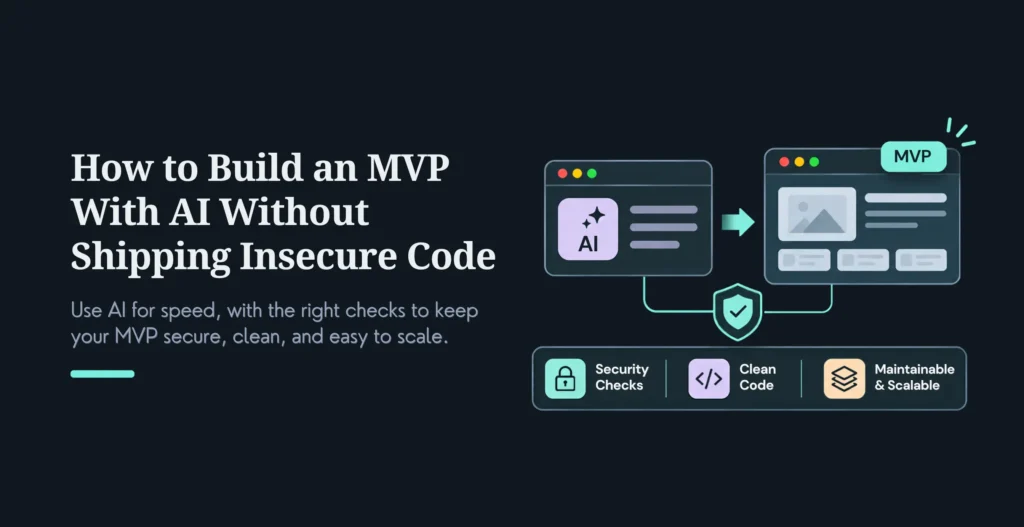
You can build an MVP with AI fast and keep it secure and maintainable, but the quality comes from the process around the AI, not the AI itself. The safe path: validate the problem with real users, scope ruthlessly to one problem, one workflow, one user type, write a one-page spec, build with AI coding tools, then put it in front of real users and ask for a meaningful commitment. The two non-negotiable gates are security (run a static-analysis scan and have an experienced engineer review sign-in, payments, and data access before launch, and test adversarial inputs like prompt injection and malformed data) and maintainability (keep a human reviewing every AI output, make small reviewable changes, document decisions, and automate CI/CD). The research is consistent that AI-generated code ships vulnerabilities and duplication by default, so the discipline isn’t optional. As planning ranges, a simple API-wrapper MVP runs ~5K–20K, a RAG/document-AI build ~25K–60K, and a custom-model build into six figures, over roughly 8-16 weeks for most.
This is the quality-first playbook: why AI-built MVPs fail, the step-by-step build process with the gates built in rather than bolted on, real cost and timelines, and how to launch and learn. It’s for the founder, product lead, or technical lead who wants AI’s speed without the mess it usually leaves. That’s exactly what AI-assisted development is about, and the playbook below is the one we run.
Key Highlights
The core truth: AI builds fast; quality comes from the process around it. The weekend demo and the launchable MVP differ almost entirely in validation, security gates, and review, not in the AI.
Scope is the first discipline: one problem, one workflow, one user type, one primary AI capability, and 3-5 features maximum. AI can build anything, which is exactly why ruthless scoping matters more, not less.
Validate before you build: talk to 10+ real users, and ideally sell before you build (a deposit or LOI) so you’re building something someone will pay for, not just something AI made easy.
The two security gates (non-negotiable): a static-analysis scan, plus an experienced engineer reviewing sign-in, payments, and data access, before launch. Plus adversarial testing (prompt injection, malformed and oversized inputs).
The maintainability rules: a human reviews every AI output, changes stay small and reviewed, decisions get logged, CI/CD gates every commit, and you track AI-specific metrics from day one.
Test what’s AI-specific: not just “does it work,” but output quality across 100+ diverse inputs, p95 latency under load, and real token cost per session, cost and latency surprise teams at scale.
Cost and timeline (vendor-reported ranges): API wrapper ~5K–20K, RAG ~25K–60K, custom/fine-tuned ~100K–150K+; most focused AI MVPs ship in 8-16 weeks, not a weekend. Start with the simplest tier that proves value.
Table Of Contents
Table Of Contents
Why AI-Built MVPs Fail
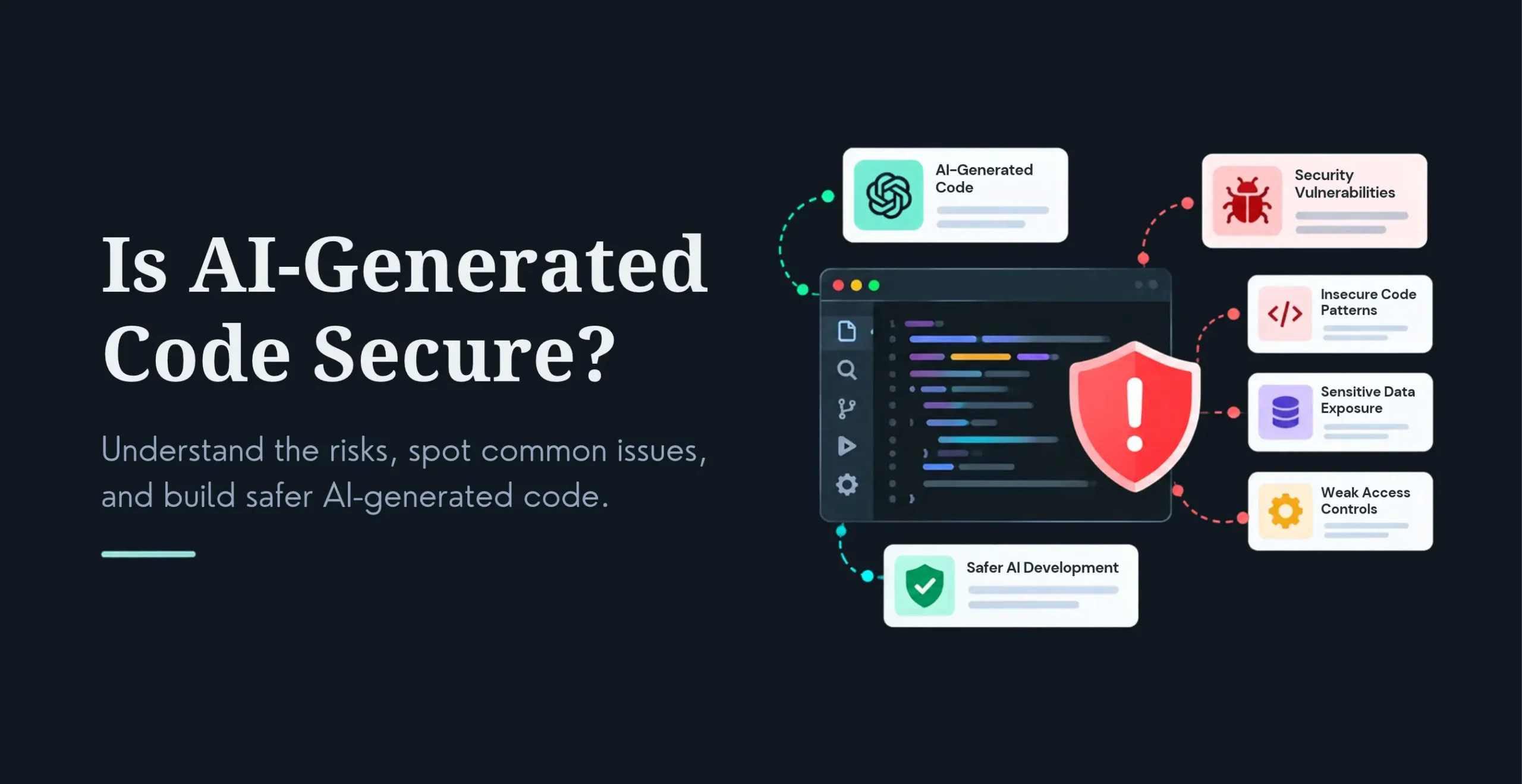
They don’t fail because the AI writes code that doesn’t run, it almost always runs. They fail in the places that don’t show in a demo. Login, payments, and data access are where these builds break: AI-generated code routinely ships improper input validation, hardcoded credentials, weak cryptography, and injection vulnerabilities, and client-side-only authentication that’s trivially bypassed. (In Veracode’s 2026 report, the average security pass rate for AI-generated code was 56%, roughly 44% of code-generation tasks introduced a known vulnerability when the prompt gave no security instruction; IOActive’s 2026 testing found a 59% average and 31.6% of samples fully exploitable. Both tested models without human review, so these are rates of generated flaws, not of flaws reaching production, which is why the security gates below aren’t paranoia.) None of that surfaces when you click through the happy path yourself; all of it surfaces when a real user, or an attacker, arrives.
The second failure is slower but just as costly: unmaintainability. AI generates rather than consolidates, so you get duplicated logic, business rules buried in the wrong layer, generic helper names that hide intent, and tests that cover only the happy path, and because the code was generated and never really read, nobody on the team actually made (or remembers) the decisions it embodies. The result is the familiar spiral: every new feature takes longer than the last, runtime errors slip past a TypeScript layer that’s half any, one unhandled error blanks the whole app, and eventually “we have a diligence call and don’t want them reading this code” becomes a real sentence. The encouraging part is that both failure modes are entirely preventable, and the prevention isn’t slower AI, it’s a disciplined process around it. The most successful AI MVPs aren’t weekend hacks; they’re built by small teams over roughly 8-12 weeks that relentlessly focus the scope and refuse to skip the gates.
The Build Process, With the Gates Built In
Here’s the end-to-end process. The security and maintainability gates aren’t a separate phase at the end, they’re woven into the steps, which is the whole point.
Scope to one thing, and validate it first
Before any building, define a single clear problem, one user type, one workflow, and one primary AI capability, each written as a single sentence. AI’s ability to build almost anything is precisely why you must be ruthless here: pick 3-5 features maximum (MoSCoW works, ship only the Must-Haves plus one or two cheap Should-Haves) and cut everything else. Then validate with real people, talk to at least 10 potential users, ask what their biggest frustration actually is rather than whether they’d use your idea, and record their exact words (they improve both the product and the copy). The strongest validation is commercial: sell before you build. A landing page, a Figma clickthrough, or a demo plus a request for a deposit or signed LOI tells you in days whether you’re building something people will pay for, or just something AI made easy to build. Write a one-page spec and a one-sentence hypothesis (“target user will use core feature to solve specific problem; we’ll know it works when success metric”) and set one or two primary KPIs that directly measure whether the AI delivers value.
Build with AI tools, then prove it with real users
Turn the spec into screens and then into a working app using AI coding tools (Cursor, Claude Code, and the like); a sensible 2026 stack is Next.js with TypeScript, the Vercel AI SDK or LangChain for the AI layer, and PostgreSQL with pgvector if you need retrieval, on managed hosting. For choosing tools more broadly, see our guide to choosing the right AI stack for your website. Describe the workflow to the AI the way you’d brief a new hire, who touches what data, on which screens, and expect the first build to be wrong; correcting it by describing what’s off is the process working, not failing. Use an API-based model (OpenAI, Anthropic) in the MVP phase unless a hard privacy or cost constraint forces otherwise, custom and fine-tuned models are rarely worth it until paying customers demand them. Build in two-week sprints with a demo at the end of each, and the moment you have something working, put it in front of 10-50 real users who have the problem (not friends being nice), watch at least one of them use it, and ask for the meaningful commitment that proves real demand.
Gate it before and after launch
This is where quality is won or lost, and it’s two gates. The security gate runs before launch: a static-analysis scan (SAST tuned for AI failure patterns, as a blocking CI step, not an advisory report), an experienced engineer manually reviewing the three things AI gets wrong most and that matter most, sign-in, payments, and data access (including authorization: can user A reach user B’s data?), and adversarial testing with malformed input, oversized input, and prompt-injection attempts, plus PII handling if you touch personal data. The maintainability gate runs continuously: a human reviews every AI output (code, copy, and design) to the same standard as a new contributor’s first pull request, changes stay small and reviewed rather than giant AI-generated rewrites, decisions get captured in a lightweight log so the team remembers why, and CI/CD gates every commit through the same checks human code would face. When the code has already drifted, our restructure AI code service cleans it up. Then launch to the controlled cohort and instrument it from day one, tracking the AI-specific metrics generic analytics miss: output acceptance rate (which AI outputs users keep vs discard or re-run), which queries the system handles poorly, p95 latency, error rate, and token spend per session. Build an evaluation loop, collect real user examples, write the correct answer for each, score the AI against that set, and re-run it every time you change a prompt or model, so you catch quality regressions instead of shipping them. That post-launch data, not a dashboard nobody reads, is what drives the roadmap. If you are moving an AI-built prototype toward production, see our AI prototype to production service.
Testing an AI MVP: What’s Different
Testing an AI MVP isn’t just “does it work,” because a system that works on your inputs can fail badly on a user’s. Five layers matter. Functional testing confirms the product works end to end. AI output-quality testing is the one teams skip and shouldn’t, manually review 100+ AI outputs across deliberately diverse inputs (ordinary, ambiguous, and should-decline cases) and catalog the failure modes, because a demo of five good outputs tells you nothing about the distribution. Adversarial testing throws malformed input, very long input, and prompt-injection attempts at the system, this is security testing as much as quality testing. Latency testing measures p95 under realistic concurrent load, not a single request on an idle server. And cost testing measures actual token spend per user session, then models it at 10x and 100x volume, because inference cost is the surprise that quietly kills otherwise-working AI products at scale. Only after those five, plus the static scan and the human review of auth/payments/data, is an AI MVP genuinely ready to meet real users. If a build has already shipped without these and is misbehaving, that’s rescue territory, AI build rescue and a code security audit are the recovery paths.
Cost and Timeline
Treat these as vendor-reported 2026 planning ranges that vary widely with scope and complexity; scope a real quote. The cleanest way to think about cost is by how much AI the MVP actually needs. An API-wrapper MVP, a product layer over OpenAI or Anthropic with prompt engineering and no custom data, commonly runs ~5K–20K over 2-6 weeks. A RAG / document-AI build, grounding the model in your own data with a vector database, runs ~25K–60K over 4-10 weeks. A custom or fine-tuned model build, with its own training pipeline and often compliance needs, runs into six figures (100K–150K+) over 10-20 weeks, and a multi-step agentic build higher still. By delivery route, a technical founder using AI tools can get something live for very little (fragile, but real), a no-code-plus-contract-engineer build runs ~5K–15K, and a full agency build ~35K–100K+. The near-universal advice: start with the simplest tier (API wrapper or RAG) that can prove value, not a custom model, you can always deepen the AI once paying customers ask for it.
On timeline, most focused AI MVPs ship in 8-16 weeks, not the mythical weekend, with the successful ones clustering around 8-12. The tier durations above and the 8-16 weeks measure different things: the tiers are build estimates by AI complexity, while 8-16 weeks is what vendors report for a launch-ready MVP that includes data prep, testing and the gates. A workable phase breakdown: discovery and scoping (1-2 weeks), data audit and prep (1-3 weeks), model selection and prototyping (1-2 weeks), core build and integration (3-6 weeks), testing and the security/quality gates (1-2 weeks), then an ongoing launch-and-feedback loop. And budget for ongoing costs the build price hides: LLM API usage (which can run a few hundred to a few thousand dollars a month depending on volume), hosting, and maintenance (commonly 10-25% of the build cost annually), AI products need continuous care, especially as models and prices change. For the deeper build-vs-partner economics, our agency vs in-house cost breakdown runs the comparison.
How do I build an MVP with AI without shipping insecure or unmaintainable code?
Build fast with AI tools, but wrap two non-negotiable gates around it. The security gate (before launch): run a static-analysis scan, have an experienced engineer manually review sign-in, payments, and data access (including authorization), and test adversarial inputs, malformed data, oversized input, and prompt injection. The maintainability gate (continuous): keep a human reviewing every AI output to the standard of a new contributor’s first PR, make small reviewed changes rather than giant rewrites, log your decisions, and run CI/CD on every commit. AI provides the speed; these gates provide the quality, and the research shows they’re essential, not optional.
What’s the actual process for building an MVP with AI?
Scope to one problem, one workflow, one user type, and one primary AI capability (3-5 features max). Validate with 10+ real users, and ideally sell before you build (a deposit or LOI). Write a one-page spec, a one-sentence hypothesis, and 1-2 KPIs. Build with AI coding tools in two-week sprints. Put it in front of 10-50 real users who have the problem and watch them use it. Run the security and maintainability gates. Then launch to the cohort, instrument AI-specific metrics, and build an evaluation loop so you improve deliberately rather than guessing.
Why do AI-built MVPs fail even when the code runs?
Because they fail in the places a demo never exercises. Security: AI routinely ships hardcoded secrets, missing input validation, weak crypto, and client-side-only authentication, so login, payments, and data access break under real users. Maintainability: AI generates rather than consolidates, leaving duplicated logic, misplaced business rules, and happy-path-only tests, and since the code was never really read, nobody made or remembers the decisions in it. The code running is the easy 80%; the security and maintainability are the 20% that decides whether the MVP survives contact with real users.
How do I test an AI MVP properly?
Five layers. Functional (end to end). AI output quality, manually review 100+ outputs across diverse inputs (ordinary, ambiguous, should-decline) and catalog failure modes; a handful of good demo outputs proves nothing. Adversarial, malformed, oversized, and prompt-injection inputs. Latency, p95 under realistic concurrent load, not one idle request. And cost, real token spend per session, modeled at 10x and 100x volume, because inference cost is the surprise that kills products at scale. Add the static-analysis scan and the human review of auth, payments, and data access, and the MVP is genuinely launch-ready.
How much does it cost to build an MVP with AI?
Vendor-reported ranges: an API-wrapper MVP ~5K–20K (2-6 weeks), a RAG/document-AI build ~25K–60K (4-10 weeks), a custom/fine-tuned-model build 100K–150K+ (10-20 weeks), and agentic/multi-step builds higher. By route, a founder with AI tools can ship for very little (fragile), no-code-plus-engineer ~5K–15K, a full agency build ~35K–100K+. Budget ongoing costs too: LLM API usage (hundreds to thousands per month by volume), hosting, and maintenance (~10-25% of build cost annually). Start with the simplest tier that proves value, deepen the AI only when paying customers ask.
How long does it take to build an AI MVP?
Most focused AI MVPs ship in 8-16 weeks, with the successful ones around 8-12, the weekend build is a prototype, not a launchable MVP. A realistic phase breakdown: discovery and scoping 1-2 weeks, data audit and prep 1-3 weeks, model selection and prototyping 1-2 weeks, core build and integration 3-6 weeks, testing and the security/quality gates 1-2 weeks, then an ongoing launch-and-feedback loop. API-based builds are faster; fine-tuned-model builds take longer. The variable that most affects the timeline is scope discipline, every feature beyond the core 3-5 extends it.
What should I include in an AI MVP, and what should I skip?
Include one job done genuinely well, one user type, a simple way in (sign-up, login, reset), a way to take real money from day one, an evaluation set (real examples with expected answers), usage instrumentation (who uses it, how often, cost per user), and a human check wherever a mistake is costly. Skip extra features, extra user roles, and custom or fine-tuned models until paying customers specifically ask. Be ruthless: pick one primary AI capability and cut everything outside the critical path to first value. Scope creep is the single biggest killer of AI MVP timelines and budgets.
Should I start with an API wrapper, RAG, or a custom model?
Almost always start with the simplest that can prove value. An API wrapper (prompt engineering over a frontier model) is cheapest and fastest and is enough for many MVPs. RAG is the next step up when the product needs to answer from your own data. A custom or fine-tuned model is rarely justified at MVP stage, it’s expensive, slow, and usually solves a problem you can’t yet prove you have. Validate the use case on an API or RAG build first; if paying customers then need capabilities only a custom model delivers, you’ll have the evidence (and revenue) to justify it.
Conclusion
The promise of building an MVP with AI is real, and so is the trap. The weekend demo and the launchable product look identical in a screen recording and are worlds apart underneath, and the difference is entirely the process you wrap around the AI. AI gives you speed for free; security and maintainability you have to build in deliberately.
The playbook is not complicated, it’s just disciplined. Scope to one problem and validate it with real users before you build. Use AI to build fast, in small reviewed pieces. Then gate it: a static scan plus a human review of sign-in, payments, and data access before launch, and a human reviewing every AI output, small changes, logged decisions, and CI/CD throughout. Test what’s AI-specific, output quality, adversarial inputs, latency, and cost, not just the happy path. Launch to a small cohort, instrument the AI metrics, and let real usage drive the roadmap. Do that and you get the best of both: AI’s speed and engineering quality that survives real users, real attackers, and real growth. Skip it and you ship a demo that breaks the moment it leaves your laptop.
Building an MVP with AI and want it secure and maintainable from day one?
Book a consultation to talk through your MVP idea and get a scoped build plan, including the gates that keep it launchable.
Nirav Panchal
Lead – Custom Development
Lead of the Custom Development team at KrishaWeb, holds AWS certification and excels as a Team Leader. Renowned for his expertise in Laravel and React development. With expertise in cloud solutions, he leads with innovation and technical excellence.




 KrishaStudio
 KrishaStore