Every vendor promises “AI transformation.” Very few will tell you, in plain terms, what you actually receive for your money. You get a deck full of possibility and a proposal light on deliverables, and you’re left guessing whether you’re buying software, advice, or an outcome.
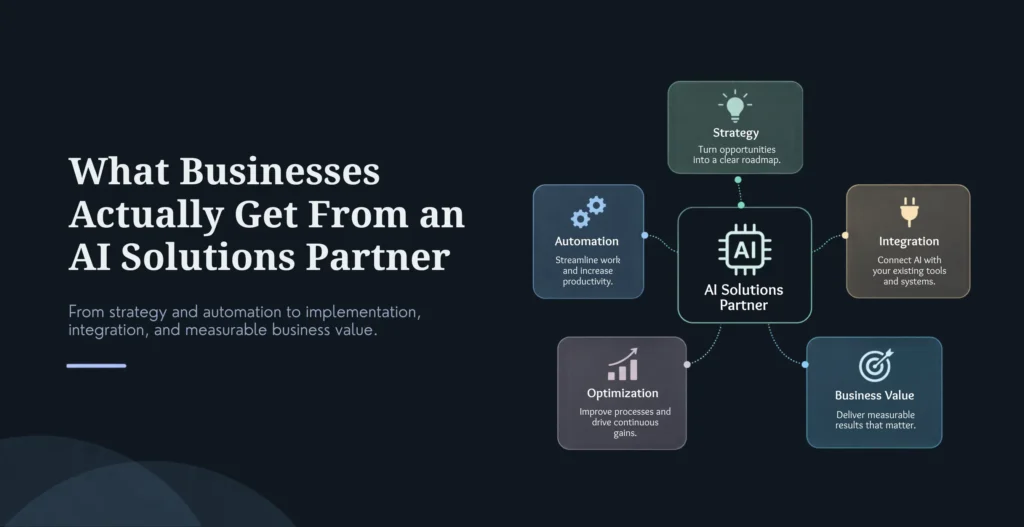
Here’s the plain answer. A real AI solutions partner delivers five concrete phases: a readiness assessment that audits your data, processes, and AI maturity; a strategy roadmap that prioritizes use cases and plans governance; an AI build that produces working pilots and production systems; integration that connects that AI to the tools you already use; and ongoing support that monitors, optimizes, and scales it over time. Not a slogan, five phases with documents, systems, and metrics attached to each.
This guide walks through exactly what those five phases contain, what each one should produce, what it costs (with the honest caveat that pricing in this market is wide and moves fast), how to evaluate a partner, and the red flags that signal hype over substance. It’s written for the business owner, CTO, or operations leader who’s tired of vague promises and wants to know what a grounded engagement actually looks like before signing anything.
That grounded, no-hype approach is exactly how we run AI solutions engagements at KrishaWeb, so you’ll see the model described the way we’d actually deliver it.
Table Of Contents
Table Of Contents
What Is an AI Solutions Partner?
An AI solutions partner is a company that helps you adopt AI end to end, from readiness assessment and strategy through building, integrating, and supporting the AI systems themselves. The distinction that matters: unlike an AI tool vendor (who sells you software) or a pure consultant (who advises but doesn’t build), a solutions partner delivers working AI that plugs into your existing tools and workflows, and stays to support it.
Here’s how the four types of AI provider actually differ:
Provider Type
What They Do
You Get
Best For
AI tool vendors
Sell AI software
A license and basic setup
A specific tool you’ll run yourself
AI consultants
Advise on strategy
Documents and recommendations
Guidance when you have your own build team
AI development agencies
Build custom AI
Custom code and APIs
A build when you already know what you need
AI solutions partners
End-to-end adoption
Readiness, strategy, build, integration, and support
Complete adoption without an internal AI team
The reason this category exists is simple: most businesses don’t just need a chatbot or a strategy doc. They need someone to figure out what’s worth building, build it, wire it into their systems, and keep it working, without the business having to hire a full AI team to manage the process. For SMBs and mid-market companies especially, a single partner covering all five phases is far more practical than coordinating a handful of specialists.
The Five Phases, and the Honest Timeline
Before the detail, here’s the whole engagement at a glance, because seeing the shape upfront tells you what a real proposal should contain.
Phase
Focus
Typical Duration
1. Readiness assessment
Audit data, processes, AI maturity, risk
1–2 weeks
2. Strategy roadmap
Prioritize use cases, KPIs, governance, plan
2–4 weeks
3. AI build
Pilots, then production systems
8–16 weeks
4. Integration
Connect AI to tools and workflows
4–8 weeks
5. Support and maintenance
Monitor, optimize, scale
Ongoing
A full first engagement typically runs four to six months from readiness to a supported production system, then continues as an ongoing support relationship. One honest caveat before we go deeper: every timeline and price in this article varies widely with scope, data quality, and the firm’s tier. Treat these as planning ranges for an SMB-to-mid-market engagement, not fixed quotes, and expect the data and integration work (not the AI itself) to be where most timelines and budgets actually stretch.
Phase 1: Readiness Assessment
You can’t build AI that works on data and processes you haven’t examined, which is why a serious partner starts here rather than jumping to the fun part. This phase answers one question: is your business actually ready to get value from AI, and where are the gaps?
What happens. The partner audits your data (quality, accessibility, governance), maps your existing workflows to find automation opportunities and pain points, assesses your current AI maturity and skills, reviews your technology stack for integration potential, and classifies the risks (compliance, security, ethical) by level. Most of this comes from stakeholder interviews, a data audit, and a few process-mapping workshops.
What you get. A readiness report you can act on, not a generic scorecard. At this tier it should include: a scored maturity assessment across data, infrastructure, governance, and skills; process maps with automation opportunities flagged; a risk matrix classifying use cases low, medium, and high; and, most usefully, a shortlist of three to five high-impact, low-effort quick wins to start with. A good assessment names 5 to 10 ranked use cases, not thirty, and flags for each whether the smart path is build or buy.
What it costs. For SMB and mid-market, a packaged readiness (often combined with the strategy phase below) commonly runs in the low thousands to around $15,000 depending on depth. Enterprise readiness engagements run far higher (frequently $25,000 to $75,000), because the data and governance surface is larger. The output is the foundation everything else builds on, so underinvesting here is a false economy. We break the budgeting logic down further in our guide to the AI readiness assessment as a budgeting tool.
Phase 2: Strategy Roadmap
A readiness report tells you where you stand. The strategy phase turns that into a plan the business will actually fund and follow. This is where AI stops being a science experiment and becomes a set of prioritized, measurable bets.
What happens. The partner prioritizes the use cases from Phase 1 by business impact and feasibility, defines measurable KPIs for each (time saved, cost reduced, revenue influenced), establishes a governance framework (who owns AI decisions, what the policies are, how oversight works), builds a scaling plan across the next twelve months, and estimates the budget and resources to get there. Crucially, it secures an executive sponsor, because AI initiatives without one stall.
What you get. An AI strategy document tied to three to five real business priorities; a use-case prioritization matrix; a KPI framework with baselines and targets (so ROI can actually be proven later); a governance charter; and a costed twelve-month scaling plan. The governance piece matters more than it sounds, only about a fifth of organizations have mature governance for agentic AI, and its absence is a leading cause of stalled or risky deployments.
What it costs. Strategy work often sits in the same engagement as readiness for SMB and mid-market clients, in that combined low-thousands-to-$15,000 range, or higher as a standalone enterprise roadmap. Strategy and roadmap work sits at the lower end of consulting pricing; it’s the hands-on build and change management that costs more.
Phase 3: AI Build
This is the phase people picture when they think “AI project,” and it’s where the roadmap becomes working software. A grounded partner builds in two stages, pilots first, then production, so value is proven before big money is committed.
What happens. The partner builds two or three pilots (typically four to eight weeks) to validate the highest-priority use cases against their KPIs with real users. What proves out graduates to a production-grade system (typically eight to twelve weeks), properly tested, documented, and reviewed by the governance committee before it goes live.
What you get. Working pilots deployed and measured, not slideware; production AI systems for the use cases that earned it; validation reports showing the systems actually hit their KPIs; technical documentation and user guides; and a 90-day ROI report comparing baseline to result. That ROI report is the single most important artifact of the whole engagement, it’s the proof the investment paid off, and a partner who doesn’t plan for it from the start is a warning sign.
What it costs. This is the widest range in the whole engagement, because “AI build” spans a simple automation to a multi-agent system:
Build Type
Typical Range
Pilot / MVP
~$5,000–$15,000
Single-workflow automation
~$3,000–$15,000
Custom AI development
~$10,000–$60,000
Integrated agentic systems
~$50,000–$150,000
Enterprise deployment
$250,000+
Maintenance typically runs 15 to 20% of the build cost per year. As a feel for real projects: a customer-service AI agent or an SDR/prospecting agent commonly lands in the low tens of thousands to build with a few-week deployment, while an enterprise conversational-AI system with complex workflows and multiple integrations runs into six figures. The biggest cost variable is rarely the model, it’s the data preparation and integration around it.
Phase 4: Integration
An AI system that isn’t wired into your actual tools is a demo, not a solution. This phase is where the build stops being a standalone thing and starts living inside how your team already works, and it’s where a lot of “successful” AI projects quietly fail to deliver, because they were never properly connected or adopted.
What happens. The partner connects the AI to your existing systems (CRM, ERP, communication platforms), embeds it into real workflows rather than bolting it on the side, sets up the data pipelines it needs to run, trains your end users, and runs a change-management program to drive actual adoption. That last part is easy to skip and expensive to skip, technology that no one adopts returns nothing.
What you get. AI genuinely integrated with your tools and workflows; operational data pipelines; user training materials and sessions; a change-management plan; and adoption metrics so you can see whether people are actually using it. The deliverable that matters most here isn’t technical, it’s adoption: usage climbing toward the workflow you designed.
What it costs. Integration is often folded into the build project price, or scoped as its own automation-build engagement (commonly a few thousand to low five figures for defined scope). Where costs balloon is legacy or unusual systems and heavy data-plumbing, which is exactly why the readiness audit checks your stack early.
Phase 5: Support and Maintenance
AI is not “build it and forget it.” Models drift, data changes, usage patterns shift, and what worked at launch degrades without attention. This phase is the ongoing relationship that keeps the systems performing and expands them over time, and it’s usually where the long-term value (and the recurring revenue for the partner) actually lives.
What happens. The partner monitors model performance, accuracy, and drift; optimizes continuously; applies updates and upgrades; resolves issues; and scales the AI to new use cases and departments as it proves out. Regular reviews with your stakeholders keep it tied to business outcomes rather than running in the background unexamined.
What you get. Monitoring dashboards showing real-time performance and KPIs; monthly optimization reports; issue-resolution logs; and an updated scaling plan as new use cases come online. The point is continuous improvement, the system should be better and broader at month twelve than at launch.
What it costs. Ongoing retainers vary widely with scope. For SMBs running one or two automations, roughly $1,000–$3,500/month is typical. Mid-market with a multi-workflow stack and reporting commonly runs $4,000–$12,000/month. Enterprise with dedicated teams runs $15,000/month and well up from there. Across the market, the median SMB-to-mid-market retainer sits somewhere around $2,800–$7,000/month.
Pricing Benchmarks (and How to Read Them)
Pulling it together, here’s the honest shape of what an AI solutions engagement costs, with the standing caveat that this market is wide and moving, so treat these as planning ranges and always get a scoped quote.
What drives the number: complexity (a single chatbot versus multi-agent orchestration), the number and difficulty of integrations, how much custom development versus off-the-shelf, scale, compliance requirements (HIPAA, SOC 2, GDPR add cost), and, above all, the state of your data. Common pricing models are project-based for defined builds, monthly retainers for ongoing work, and increasingly value-based or hybrid (a core monthly fee plus per-workflow pricing). Hourly is fading, because AI made delivery fast enough that billing by the hour punishes efficiency.
A rough picture of a full mid-market first year: readiness and strategy in the low five figures, a build in the tens of thousands, integration folded in or lightly extra, and a support retainer of a few thousand a month. Many mid-market programs with implementation land somewhere in the $35,000–$150,000 range for year one, then a support retainer ongoing. Your number depends entirely on scope, which is exactly why the readiness phase exists.
How to Evaluate an AI Solutions Company
Use this as a checklist when you’re comparing partners, because the difference between a grounded partner and a hype merchant shows up in these answers.
Look for genuine end-to-end capability (all five phases, not just the build), real industry and use-case experience with case studies and references, actual governance and compliance expertise, transparent pricing with clear deliverables and honest timelines, DevOps and MLOps capability for real production deployment (not just demos), knowledge transfer and training so you’re not left with a black box, and firm contractual protections on IP ownership, data handling, performance, and exit.
The questions that surface all of this quickly: What have you done in my industry, and can I talk to those clients? What exactly are the deliverables and timelines for each phase? How do you handle governance and compliance? What’s your pricing model and what drives it? Do you transfer knowledge and train my team? Who owns the IP and the data, and how do I exit if I need to? And how will you measure and report ROI? A partner who answers these crisply is a different proposition from one who retreats to “AI transformation.”
Red Flags to Avoid
The warning signs of a hype-led vendor are consistent, and any one of them is worth pausing on:
Vague deliverables, timelines, or pricing
Overpromising (“AI transformation in two weeks”, real engagements run months)
No mention of governance, compliance, or risk
Black-box solutions with no knowledge transfer
No DevOps or MLOps capability, which means it may demo well and fail in production
A greenfield-only mindset that ignores integrating with the tools you already run
Hidden costs where a low headline price hides steep usage or maintenance
No plan to measure ROI
No references or case studies
A one-size-fits-all solution pitched identically to every client
The through-line: hype sells a destination and stays vague about the road. A grounded partner is specific about deliverables, honest about timelines and costs, insistent on measuring results, and comfortable showing you production work and references. If a proposal reads like a vision statement instead of a plan, that’s your signal.
What does an AI solutions company actually deliver?
Five concrete phases, not a slogan: a readiness assessment (auditing data, processes, and AI maturity), a strategy roadmap (prioritized use cases, KPIs, governance, a scaling plan), an AI build (working pilots and production systems), integration (connecting AI to your CRM, ERP, and workflows), and ongoing support (monitoring, optimization, and scaling). Each phase produces specific artifacts, from a readiness report and risk matrix to production systems, a 90-day ROI report, and monitoring dashboards.
What is the AI solutions engagement process?
Five phases over roughly four to six months for a first engagement: readiness (1–2 weeks), strategy (2–4 weeks), build (8–16 weeks, pilots then production), integration (4–8 weeks), and then ongoing support on a monthly basis. Timelines vary with scope and data quality, the data and integration work, not the AI itself, is usually what stretches a schedule.
How much does an AI solutions partner cost?
It varies widely by scope and firm tier, so treat these as planning ranges: a readiness-and-strategy audit roughly $1,500–$15,000 for SMB/mid-market (more at enterprise), a pilot/MVP $5,000–$15,000, custom development $10,000–$60,000, integrated agentic systems $50,000–$150,000, and enterprise deployments $250,000+. Ongoing retainers run from about $1,000/month (SMB) to $15,000+/month (enterprise). Always get a scoped quote, since data and integration complexity move the number most.
What is an AI readiness assessment?
It’s the first phase, a structured audit of whether your business can actually get value from AI. It covers data quality and governance, existing processes and their automation potential, your AI maturity and skills, your technology stack, and your risk exposure. It delivers a readiness report with a maturity score, process maps, a risk matrix, and a shortlist of high-impact quick wins, the foundation the rest of the engagement builds on.
How do I evaluate an AI solutions company?
Check for genuine end-to-end capability (all five phases), relevant experience with references and case studies, real governance and compliance expertise, transparent pricing and deliverables, DevOps/MLOps capability for production (not just demos), knowledge transfer so you’re not left with a black box, and solid contractual protections on IP, data, performance, and exit. Ask how they measure ROI, a partner who can’t answer that clearly isn’t one to trust with a budget.
What are the red flags in AI solutions proposals?
Vague deliverables and pricing, overpromising on time or cost, no governance or compliance discussion, black-box solutions with no knowledge transfer, no DevOps/MLOps, a build-from-scratch-only mindset that ignores your existing tools, hidden usage or maintenance costs, no ROI measurement plan, no references, and identical solutions pitched to every client. Hype sells a destination and stays vague about the road; a grounded partner is specific about the plan.
When should I hire an AI solutions partner?
When you need end-to-end adoption rather than just a tool or a strategy doc, when your use cases require real integration with existing systems, when you need governance and compliance handled properly, when you want ongoing support and optimization rather than a one-off build, or, most commonly, when you lack the internal AI team to do all of this yourself. If you only need a single off-the-shelf tool, a partner may be more than you need; if you need AI woven into how the business runs, it’s exactly the right fit.
How do I measure AI ROI from an engagement?
Define KPIs upfront (time saved, cost reduced, revenue influenced), measure a baseline before deployment, track the same metrics after, and calculate ROI as (net benefit minus total cost) divided by total cost. A good partner builds this in from the readiness phase and delivers a 90-day ROI report comparing baseline to result. If success isn’t defined before the build starts, you won’t be able to prove it afterward, which is why measurement is a phase-one concern, not an afterthought.
Conclusion
A real AI solutions partner delivers far more than a built tool. The five phases, readiness, strategy, build, integration, and support, exist to make sure AI produces measurable business value instead of becoming expensive technology nobody uses. That’s the difference between an engagement and a slogan.
The thing to look for is a grounded, no-hype partner: transparent deliverables, honest timelines and pricing, real governance, and a plan to measure results. Everything in this guide is a lens for spotting that partner, and for walking away from the ones selling a vision with no plan attached.
If you’d rather start with the substance than the sales pitch:
Founder & CEO of KrishaWeb, leads an Enterprise Web Agency. With contributions to WordPress and organization of WordCamps, he pioneers innovation and community engagement in the digital realm.




 KrishaLabs
 KrishaStudio
 KrishaStore