AI-assisted coding ships features fast and quietly accumulates a mess underneath them, duplicated logic, business rules buried in the wrong layer, generic helper names, tests that only cover the happy path. Eventually someone has to clean it up, and the fear is always the same: refactor the wrong thing and break the app that’s currently paying the bills. It doesn’t have to be a gamble. There’s a disciplined way to do it.
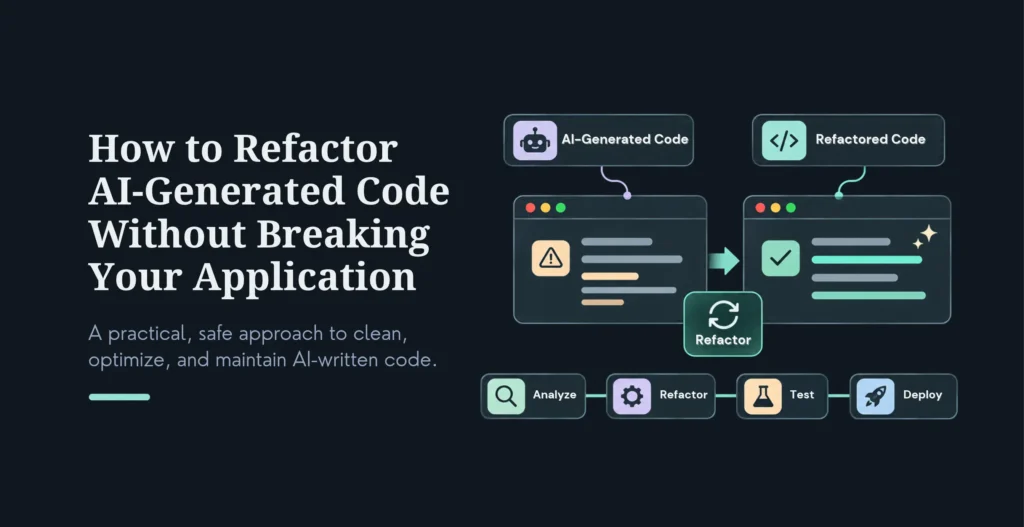
Refactoring AI-generated code safely comes down to one principle: make small, tested, reversible changes that a human reviews before they reach production. The workflow is: map the blast radius (does this carry business logic, what depends on it, can you verify it today), build a safety net first (characterization tests that pin current behavior, plus contracts, telemetry, and rollback controls), then refactor in small steps (one seam at a time, diffs under ~200 lines, mechanical cleanups before anything structural), verify every step (run tests, gate on CI, have a human check for behavior drift), and merge as small single-purpose commits kept separate from feature work. The golden rule underneath it all: if you can’t prove behavior is preserved, you’re not refactoring, you’re gambling.
This matters more than it used to. GitClear’s 2026 analysis of 623 million code changes found refactoring has collapsed, from 21% of changed lines in 2022 to just 3.8% in 2026, while duplicated code blocks rose 81%, as AI tools generate volume but rarely consolidate. The debt is real, and this guide is the safe way to pay it down. It covers why AI code needs this, the five-step workflow, the hard rules, what AI can and can’t be trusted to refactor, and real costs and timelines. It’s the work we do in restructuring AI-generated code.
Key Highlights
The one principle: small, tested, reversible changes with a human reviewing before production. If a change is too big to review, it’s too big to trust.
The five-step workflow: map blast radius → build a safety net (characterization tests first) → refactor in small steps → verify every step → merge as small single-purpose commits.
The hard rules: diffs under ~200 lines, one seam at a time, characterization tests before you touch anything, structure changes in separate commits from behavior changes, a named human owns the merge, and CI gates every change like human-written code.
Why now: GitClear’s 623M-change study found refactoring down to 3.8% of changed lines (from 21% in 2022) and duplication up 81%, AI generates fast but doesn’t consolidate, so the debt piles up.
What AI can refactor: mechanical work, renames, dead-code removal, long-method extraction, naming consistency, multi-file pattern changes. What it can’t: authentication, business rules, permissions, and architecture, those stay human-owned.
Refactor vs rewrite: if you can prove behavior is preserved (it’s verifiable and the logic is salvageable), refactor in place. If you genuinely can’t verify it, that’s a rescue/rebuild question, not a refactor.
Cost (vendor-reported ranges): focused AI-code cleanup commonly ~ 4,000–15,000+ over 2-4 weeks; larger legacy or architectural refactors run much higher and longer. Measure code health before and after, or you can’t prove it worked.
Table Of Contents
Table Of Contents
Why AI-Generated Code Needs Refactoring
The problem isn’t that AI writes broken code, it usually writes code that works. The problem is what it does to a codebase over time, and the data on this is now substantial. GitClear’s 2026 “Maintainability Gap” study analyzed 623 million code changes from 2023 through mid-2026 and found every maintainability signal moving the wrong way at once as AI-assisted commits grew to roughly a quarter of all commits: duplicated code blocks up 81% (the highest on record), within-commit copy/paste up 41%, error-masking constructs up 47%, cross-file reuse down 35%, and, most tellingly, genuine refactoring, “moved” code, collapsing from 21% of changed lines in 2022 to 3.8% in 2026. Legacy-code maintenance fell 74% since 2023; old code sits untouched while new, duplicated code piles up beside it. (One honest caveat GitClear itself makes: this is correlational, it shows what AI-era codebases look like, not a proof that AI alone caused it, and at least one peer-reviewed study found no general churn rise. But the direction is consistent across the data.)
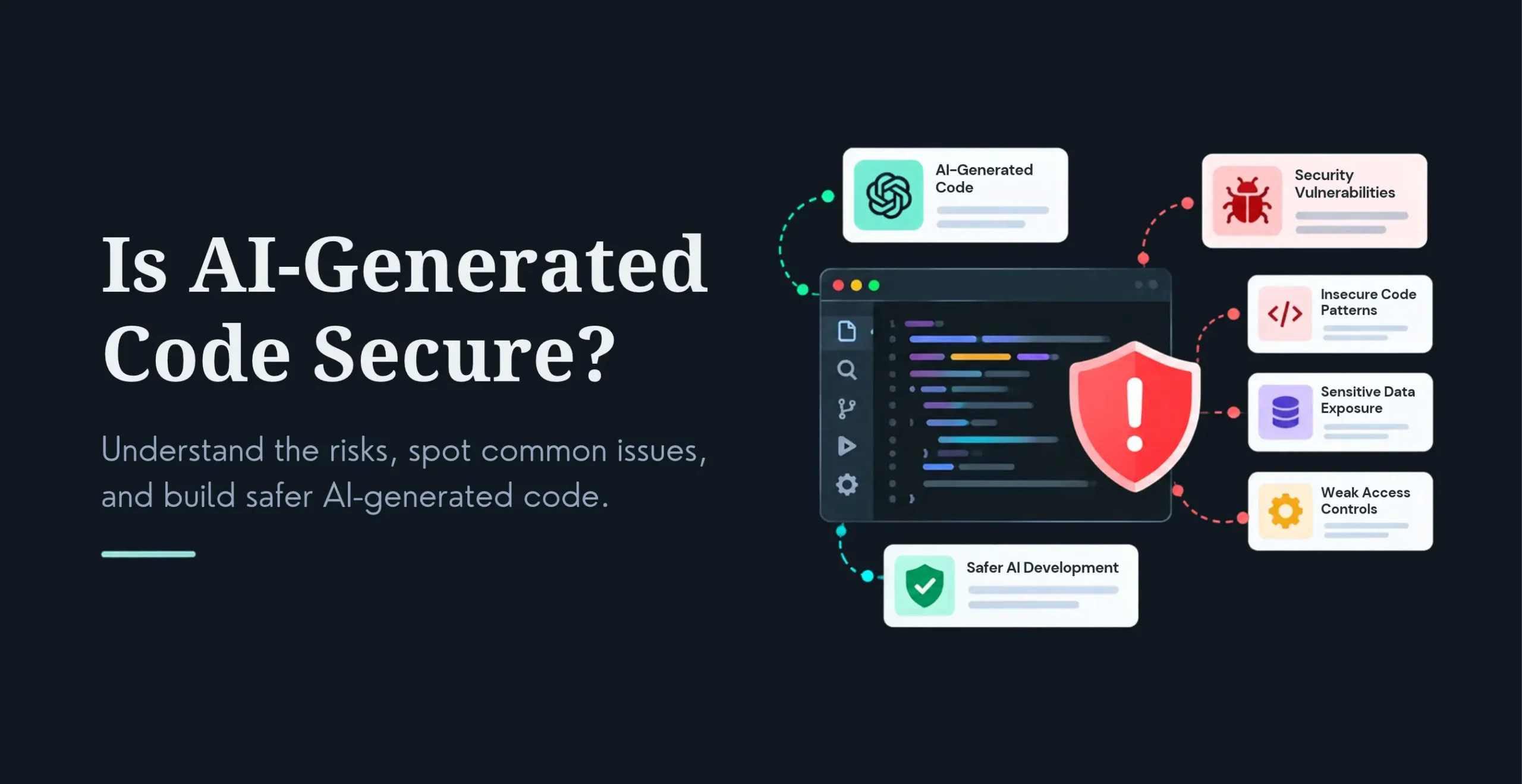
The reason is structural, not a flaw you can prompt away. Adding code to a new file takes almost no understanding of a repo’s architecture, so that’s what AI tends to do, it generates rather than consolidates. The specific smells follow a pattern: changes that cross module boundaries the architecture meant to keep separate; business policy written into controllers and handlers instead of the domain layer; generic helper names that hide intent and force future guesswork; small tasks that pull in fresh, unjustified dependencies; and tests that cover only the happy path, leaving failure, edge, and rollback cases untested. Individually, none of these breaks anything. Together, they’re why every new feature starts taking longer than the last, why runtime errors slip past a TypeScript layer that’s half any, and why “we don’t want the acquirer’s engineers reading this code” becomes a real sentence in a real diligence process. Refactoring is how you reverse that, and done right, AI can actually help do it rather than just cause it.
The Five-Step Safe Refactoring Workflow
The whole workflow exists to answer one question at every moment: can I prove I haven’t changed what this code does? Here’s how it runs.
Step 1, map the blast radius. Before touching anything, answer three questions about the code you want to change. Does it carry business logic that must survive exactly as-is? Then it needs behavior-preserving treatment, not a confident rewrite. Does anything else depend on it? Duplicated logic means a fix in one place can leave the same bug alive in five others, so build a call-site map first. And, the decisive one, can you verify its behavior today? If there’s no way to prove behavior is preserved, cleanup is a gamble, verification capability, not code prettiness, is what separates “safe to refactor” from “needs a rescue.” Measure first with a code-health tool to find the modules with the highest bug correlation and change-failure rate; those entropy-rich, actively-changed, under-tested modules are the highest-ROI targets. Refactoring stable, well-tested code nobody is touching is rarely worth the risk.
Step 2, build the safety net before you change a line. This is the step that makes the rest safe. Pin current behavior with characterization tests, tests that capture what the code does today, including behavior that looks wrong, because your job in refactoring is to preserve behavior, not fix bugs (that’s a separate, later commit). Cover at least the happy path and the two most common error paths, and make those tests fail if behavior changes. Around that, establish the four safety nets: clear contracts (APIs, events, schemas), tests at the boundaries, telemetry tied to the invariants that matter, and rollback controls (feature flags, canary releases, reversible migrations). And give whoever (or whatever) is doing the work the institutional context, why the code exists, what was tried and rejected, pulled from PRs and tickets, so a “cleanup” doesn’t delete a guard clause that’s there for a reason.
Step 3, refactor in small, reversible steps. One seam, one extraction at a time, running the characterization tests after each. Keep diffs around 200 lines, small enough that a reviewer can hold the whole change in their head. Start narrow and low-risk: a single structural problem in a low-business-logic area, ideally a unit under ~300 lines with no external callers and tests you trust. Begin with mechanical transforms (renames, type changes, dead-code removal) before anything that touches business logic. The trigger for refactoring at all is “change is already happening here”, rename ambiguous methods to domain language, extract methods to cut cognitive load, simplify tangled conditionals, remove duplication near the change, and make invariants explicit with guards and types, as you work in an area, not as a separate crusade.
Step 4, verify every step. This is the discipline the data rewards. Run the tests after each small change, so problems surface while they’re still cheap to undo. Before any human looks at it, the diff goes through the full pipeline, linting, type checks, unit and integration tests, static analysis, dependency scanning, as a blocking gate, not an advisory report. Then a human reviews specifically for behavior drift, not just style: silently altered edge cases, swapped defaults, a removed guard clause. AI-generated refactors pass the exact same checks as human-written code, and a named engineer approves the merge, with the approval logged. For a security-focused review of AI-generated code, see our AI code security audit.
Step 5, merge as small, single-purpose commits. Each approved change merges as a small commit that references its plan, which makes bisecting a future regression practical. Keep refactoring commits separate from feature work, and keep structural changes in separate commits from behavioral ones, mixing them makes the result far harder to validate and far harder to revert cleanly. Finally, track the outcome, not just the output: measure code health (complexity, duplication, coverage) before and after. If you’re not measuring it, you can’t actually tell whether the refactor improved anything.
The Hard Rules
Strip the workflow to its enforceable rules and six remain, each one a guardrail against the specific way refactors go wrong.
Diffs under ~200 lines. Small enough to hold in your head; if a change is too big to review, it’s too big to trust. One seam at a time. One extraction or one rename per step, tested in between, never a whole-module rewrite in a single shot. Characterization tests first. Pin current behavior before you touch anything, that test suite is your evidence that behavior didn’t change. Separate structure from behavior. Structural refactors and behavioral changes live in separate commits; mixing them destroys your ability to validate or revert either one. A named human owns the merge. An engineer reads every changed line and signs off, scanners and AI assist, they don’t approve. Gate with CI. AI-generated refactors clear the same linting, type, unit, and integration checks as human code, as blocking gates. Follow these and most refactors are boring and safe, which is exactly what you want them to be.
What AI Can and Can’t Be Trusted to Refactor
AI is genuinely useful for refactoring, within limits, and knowing the line is what keeps it safe. Trust it with the mechanical, pattern-level work: decomposing long methods into single-responsibility helpers, removing dead code and obvious duplication, enforcing naming consistency across many files, applying a repetitive multi-file pattern change, generating test scaffolding, and the renames and type changes that make up most day-to-day cleanup. This is where AI’s speed is a real multiplier and the risk is low, because the changes are local and verifiable.
Keep a human firmly in charge of anything design- or policy-level: authentication, authorization, business rules, permissions, and architecture. Be cautious, too, with code that integrates deeply with the existing system, handles domain-specific data, or touches infrastructure configuration, those need human judgment about consequences AI can’t see. The useful mental model: AI accelerates the investigation, planning, and execution of a refactor, which genuinely lowers the cost of paying down technical debt, but engineers own the architectural decisions, the validation, and the risk. A quick diagnostic for the common AI smells and the right response: a change that crosses more than one system boundary → split it into smaller modules before merge; business policy inside a controller → move it to the domain layer; a generic helper name → rename with a domain term; a new dependency added for a small task → remove it or document why it’s justified; happy-path-only tests → add failure, edge, and rollback tests before approval. Each of those is a human decision the AI can then execute, not the other way around.
Treat costs as vendor-reported planning ranges that vary with codebase size and scope. A focused AI-generated-code cleanup, the “make this messy-but-working app maintainable” tier most teams need, commonly runs from roughly $4,000 to $15,000+ over about 2-4 weeks, often starting with a short paid audit that rolls into the work. At the larger end, a substantial legacy or architectural refactor runs into the tens or hundreds of thousands and spans months, a focused refactor engagement is typically measured in weeks, while an architectural refactor using a pattern like Strangler Fig (replacing a system gradually, in monthly increments) can run 6-18 months. AI acceleration genuinely compresses these, hybrid AI-assisted refactors of large codebases are reported to run substantially faster than fully manual ones, but the compression is largest on narrow, mechanical campaigns (framework upgrades, naming) and smallest on the architectural judgment calls, which AI doesn’t speed up because they were never the bottleneck.
The decision that sits underneath all of it is refactor versus rewrite, and the test is the one from Step 1: can you prove behavior is preserved? If the code is verifiable and the logic is salvageable, refactor in place, it’s cheaper, lower-risk, and keeps the app running. If you genuinely cannot verify behavior, or the duplication is so structural that fixing one thing breaks five others, you’ve crossed out of refactoring territory into rescue-or-rebuild territory, a different decision with its own playbook. Refactoring is for code that’s messy but sound. When the foundation itself is the problem, no amount of careful, small-step refactoring fixes it, and the honest move is to say so.
Frequently Asked Questions
How do I refactor AI-generated code without breaking my application?
Follow a safety-first workflow built on one principle, small, tested, reversible changes a human reviews before production. Map the blast radius (does it carry business logic, what depends on it, can you verify it today), build a safety net first (characterization tests that pin current behavior, plus contracts, telemetry, and rollback controls), refactor in small steps (one seam at a time, diffs under ~200 lines, mechanical cleanups before structural ones), verify every step (tests, CI gates, human review for behavior drift), and merge as small single-purpose commits separate from feature work. The rule underneath: if you can’t prove behavior is preserved, you’re gambling, not refactoring.
What are characterization tests, and why do they come first?
Characterization tests capture what the code does today, before you touch anything, including behavior that looks wrong. They exist to prove that your refactor preserved behavior, which is the entire goal of refactoring (fixing bugs is a separate, later step). You write them first because they’re your safety net and your evidence: with them, you can make structural changes and instantly see if anything shifted; without them, every change is a guess. On AI-generated or legacy code with little existing coverage, writing characterization tests around the happy path and the main error paths is the non-negotiable first move.
What are the hard rules for safe AI code refactoring?
Six. Keep diffs under ~200 lines (small enough to review fully). Change one seam at a time, testing between each. Write characterization tests before touching anything. Keep structural changes in separate commits from behavioral changes. Have a named human read every changed line and own the merge. And gate every change through the same CI checks (lint, types, unit, integration) as human-written code, as blocking gates, not advisory reports. The connecting idea: if a change is too big to review, it’s too big to trust, so keep every change small, tested, and reversible.
What can AI safely refactor, and what should stay human?
Trust AI with mechanical, pattern-level work: decomposing long methods, removing dead code and duplication, enforcing naming consistency across files, applying repetitive multi-file pattern changes, generating test scaffolding, and routine renames and type changes. Keep humans firmly in charge of design- and policy-level decisions: authentication, authorization, business rules, permissions, and architecture, plus anything touching domain-specific data or infrastructure config. The model: AI accelerates the investigation, planning, and execution of a refactor; engineers own the architectural decisions, the validation, and the risk.
Should I refactor or rewrite my AI-generated code?
The deciding test is whether you can prove behavior is preserved. If the code is verifiable and the underlying logic is salvageable, refactor in place, it’s cheaper, lower-risk, and keeps your app live. If you genuinely cannot verify its behavior, or duplication is so structural that fixing one thing breaks several others, you’ve moved from refactoring into rescue-or-rebuild territory, a different decision. Refactoring is for code that’s messy but sound; when the foundation itself is broken, careful small-step refactoring won’t save it, and the honest answer is a controlled rebuild.
How much does it cost and how long does it take?
Vendor-reported ranges, so verify against a scoped quote: a focused AI-code cleanup commonly runs ~4,000–15,000+ over about 2-4 weeks, often starting with a short paid audit. Larger legacy or architectural refactors run much higher and longer, a focused engagement in weeks, an architectural refactor (e.g. Strangler Fig, replacing a system gradually) potentially 6-18 months in monthly increments. AI acceleration compresses timelines most on narrow mechanical campaigns and least on architectural judgment. Whatever the scope, measure code health (complexity, duplication, coverage) before and after, or you can’t prove the refactor worked.
Why is AI-generated code harder to maintain in the first place?
Because AI generates rather than consolidates. Adding code to a new file takes almost no understanding of a repo’s architecture, so AI tends to paste a variation instead of reusing what’s there. GitClear’s 2026 study of 623 million changes documents the result: duplicated code blocks up 81%, within-commit copy/paste up 41%, and genuine refactoring down from 21% of changed lines in 2022 to 3.8% in 2026, with legacy maintenance down 74%. The code usually works; the maintainability bill just arrives later, as duplication, buried business logic, and happy-path-only tests make every subsequent change slower.
How do I measure whether a refactor actually improved the code?
Track outcomes, not output. Before you start, baseline code-health metrics, cyclomatic complexity, duplication rate, test coverage, and ideally change-failure and rework rates, on the modules you’re touching, using a tool like CodeScene or a complexity reporter. After the refactor, measure the same things. A real improvement shows lower complexity, less duplication, and better coverage with no behavior change (your characterization tests confirm the last part). If the numbers don’t move, the refactor didn’t achieve its goal, no matter how much cleaner the code looks, and “looks cleaner” alone isn’t worth the risk you took to get there.
Conclusion
Refactoring AI-generated code feels risky because the usual approach, dive in and start tidying, genuinely is. The safe approach removes the risk by making it boring: prove you can verify behavior before you change it, pin that behavior with characterization tests, change one small thing at a time, verify after each step, and let a human own the merge. Done that way, refactoring isn’t a gamble, it’s a controlled, reversible process where the worst case is a quick revert of a 200-line commit.
The need for this is only growing. The data is clear that AI-era codebases accumulate duplication and lose refactoring discipline, which means the teams that stay fast are the ones who pay the maintainability bill deliberately instead of letting it compound. Start with the highest-entropy, actively-changed modules, build the safety net first, keep changes small and human-reviewed, and measure code health before and after so you know it worked. Keep the app running, make it maintainable, and don’t trust any refactor you can’t prove. If you are moving an AI-built prototype toward production, see our AI prototype to production service.
Sitting on AI-generated code that’s getting harder to change?
Explore our Restructure AI Code service to see how we make AI-generated code clean, maintainable, and safe to extend, behavior-preserving, commit-by-commit, with the safety net built first.
Book a consultation and send us the repo, we’ll assess code health and scope a safe refactor (and tell you honestly if it’s a rebuild instead).
Nirav Panchal
Lead – Custom Development
Lead of the Custom Development team at KrishaWeb, holds AWS certification and excels as a Team Leader. Renowned for his expertise in Laravel and React development. With expertise in cloud solutions, he leads with innovation and technical excellence.




 KrishaStudio
 KrishaStore