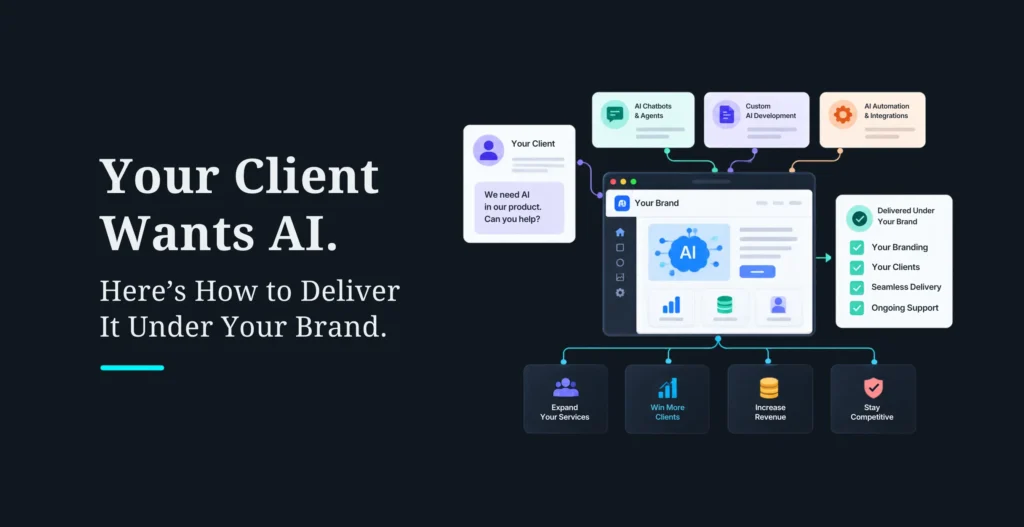
The email lands: “We’ve been hearing a lot about AI, can you help us use it in our business?” You want to say yes, you should say yes, but you don’t have AI engineers, and hiring one costs 150K-250K+ a year and takes months. Here’s the good news: you can say yes today, deliver real AI under your own brand, and keep the margin, without building an AI team at all.
The playbook: partner with a white label AI development agency that builds custom AI agents, workflow automation, chatbots, dashboards, and readiness audits behind the scenes, invisible to your client. You own the relationship, the pricing, and the margin (commonly a 2-3x markup). The partner never appears, no logos, no mention, no direct client contact. AI implementation projects typically run 3,000-15,000+, with ongoing retainers from roughly 1,000-5,000+/month. The one discipline that makes it work: build a documented review workflow before you sell a single AI engagement, treat it like QA on a dev project, and never overpromise.
This is a scenario-led, five-step playbook: qualify the opportunity, choose the partner, scope and price it, deliver it invisibly under your brand, and avoid overpromising. It’s written for the agency owner or account manager who has a live AI request right now and wants to convert it. Not being able to say yes to AI is fast becoming one of the bottlenecks that stall agency growth, and this closes it.
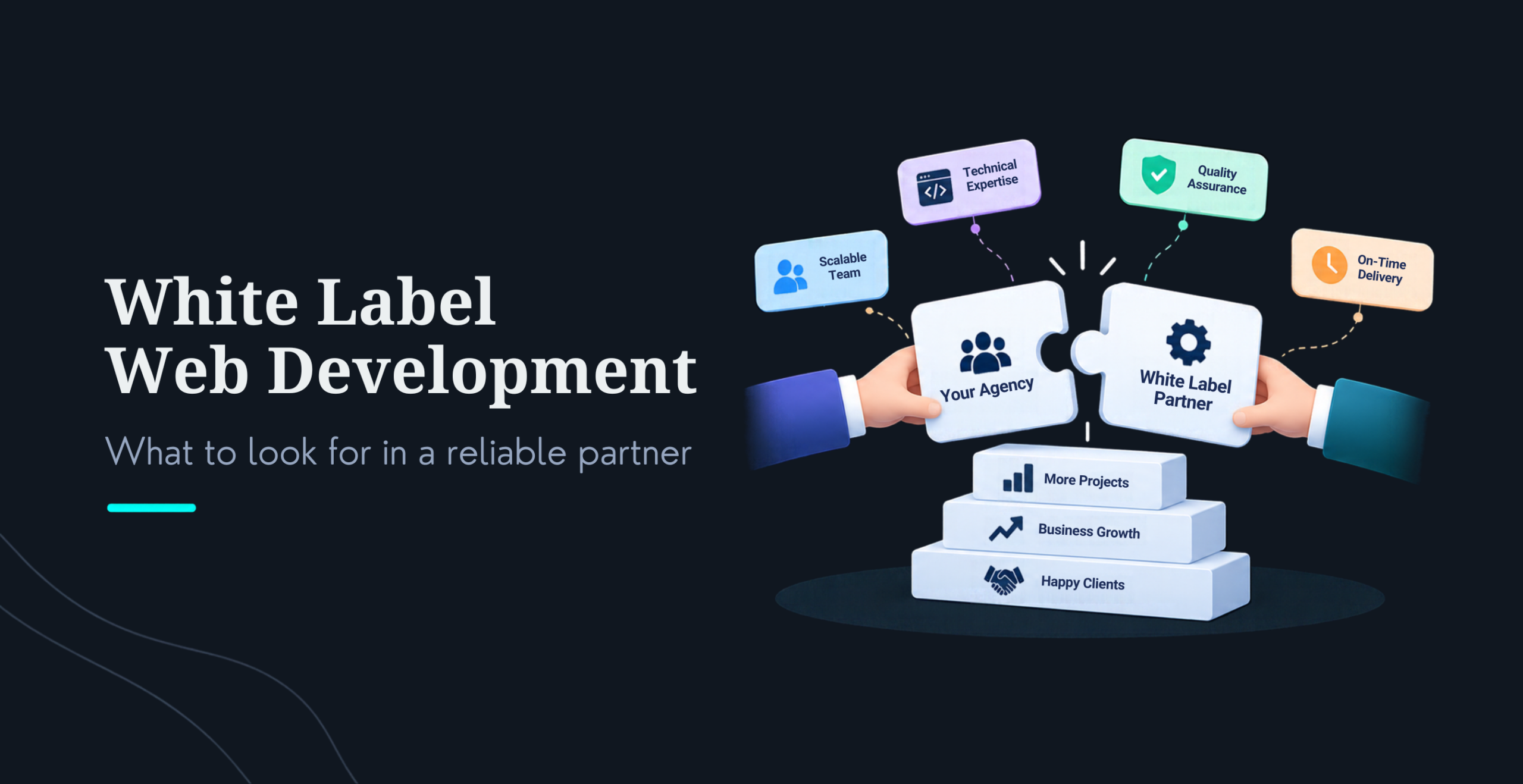
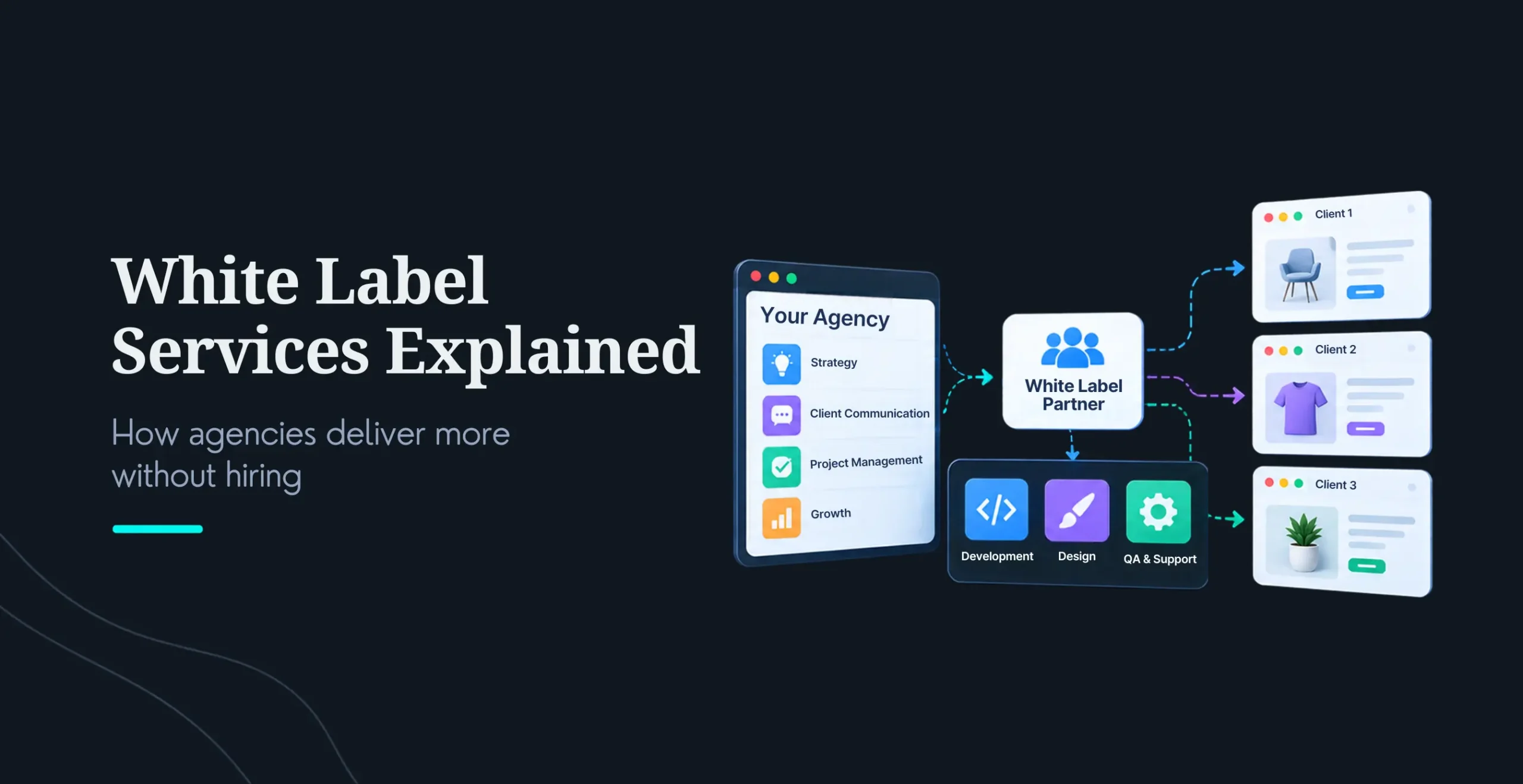
The move: Say yes to the AI request, then hand the build to an invisible white label AI partner. You keep the client, the brand, and the margin; they supply the engineering.
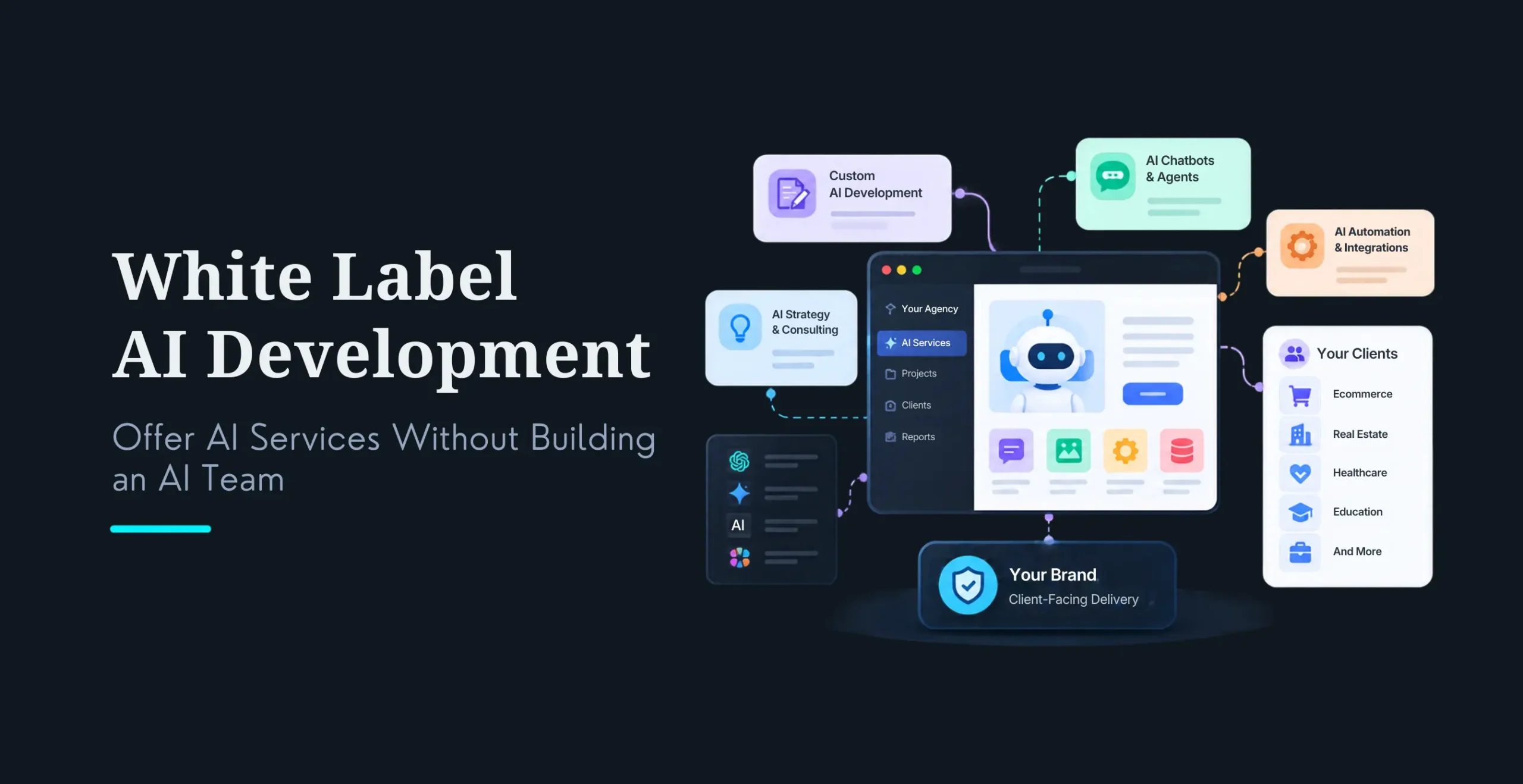
What you can sell: AI readiness audits (the easy first yes), custom AI agents, workflow automation, chatbots, dashboards, and knowledge bases, matched to the client’s actual problem.
The 5 steps: Qualify the need → choose a vetted partner → scope and price (2-3x markup) → deliver invisibly under your brand → protect quality with a documented review workflow.
Pricing (vendor-reported ranges): Implementation 3,000-15,000+; retainers roughly 1,000-5,000+/month. Verify with your partner, AI pricing isn’t standardized.
Margins: A 2-3x markup lands roughly 50-67% gross, strong, but net is lower once you count your own scoping, review, and account-management time.
The invisibility rule: Your brand on every screen and document, partner off every client call, backed by NDA and non-solicitation, and a deliberate plan for whose name shows up in repos, dashboards, and docs.
The one non-negotiable: A documented review workflow before you sell, plus honest scoping. Overpromised AI that underdelivers damages your brand, not the invisible partner’s.
The Scenario: Client Asks for AI, You Say Yes
Agencies freeze on the AI request for understandable reasons: no AI engineers in-house, a 150K-250K+ hiring cost per engineer, a 6-12 month ramp, bench-time risk if demand is uneven, and a real fear of promising AI they can’t deliver. Any one of those is enough to make an agency hedge and lose the opportunity to a competitor who said yes faster.
White label AI removes all of them at once. You partner with a specialist that builds the AI behind the scenes, and you deliver it under your brand. The client buys an AI service from you; the engineering happens invisibly. You keep the relationship, set the price, and take the margin, while the partner carries the technical risk, the tooling, and the maintenance. The right first move in almost every one of these conversations isn’t to quote a build, it’s to qualify what the client actually needs, because “help us with AI” can mean ten different things at ten different price points.
Step 1: Qualify the Opportunity
Before you scope anything, run the request through six questions: What business problem are they actually trying to solve? Which of their workflows are repetitive and high-volume (that’s where AI pays)? What data do they have, and is it clean, current, and accessible? What systems does it need to touch (CRM, ERP, helpdesk)? What’s their budget and timeline? And how AI-ready are they, do they even know where to start? The answers turn a vague request into a scoped opportunity.
Then match the need to a service. “We don’t know where to start” points to a readiness audit. “Automate repetitive tasks” points to workflow automation. “A chatbot for support” or “AI for lead qualification” points to a chatbot or custom agent. “AI reporting,” “AI content,” “AI outreach,” and “AI analytics” each map to their own build. The highest-leverage move when a client is unsure: sell an AI readiness audit first. It’s a structured engagement that maps their operations, identifies the workflows where AI will deliver measurable ROI, and hands you (and them) a prioritized roadmap, which you then sell implementation against. It’s a low-risk first yes, it’s delivered under your brand, and it de-risks everything that follows by replacing guesswork with a scoped plan. It’s also the single best antidote to overpromising, because you’re recommending AI where it actually fits, not where the client imagined it might.
Step 2: Choose the Right Partner
Your partner choice is the whole ballgame, because their work ships under your name and their behavior touches your client. Vet on the non-negotiables: a signed NDA and non-solicitation, genuine AI engineering depth (real builds, not thin wrappers on someone else’s API), a documented QA process for reviewing AI outputs, clean IP transfer (and with AI, that specifically means ownership of prompts, fine-tuned models, data pipelines, and outputs, not just “the code”), compliance capability for regulated data, full white-label branding with no direct client contact, agency references you can call, and a willingness to prove it on a paid pilot.
The questions that surface the truth fast: Can you work entirely behind our brand, or do you need direct client access? Whose name appears in repositories, dashboards, documentation, and demos? How do you handle a build touching regulated data? Who owns the prompts, models, and data pipeline? And what happens to us if a platform you depend on changes its API or pricing? Walk away from anyone who won’t sign protections, is vague on IP, needs direct client access, or can’t speak credibly to compliance, on AI work, those gaps are expensive and they land on you. Apply the same scrutiny a client would when choosing an agency; you’re making the same kind of decision.
Step 3: Scope and Price the Engagement
Three pricing models work, and most agencies use all three depending on the build: project-based (a fixed price for a one-off build), monthly retainers (for ongoing, optimized systems, the stickiest revenue), and value-based (anchored to a measurable client outcome like leads, cost savings, or hours returned). Value-based is the most profitable when you can tie the AI to a number the client cares about, “this agent books X more qualified calls a month” justifies far more than a cost-plus quote.
As planning ranges (vendor-reported, so verify with your partner and scope tightly): workflow automation runs roughly 5,000-20,000+ to set up with a 2,000-6,000/month retainer; AI content systems ~4,000-12,000 setup, 1,500-4,000/month; AI reporting ~3,000-8,000 setup, 1,000-3,000/month; AI outreach ~5,000-15,000 setup, 2,000-5,000/month; and general AI implementation 3,000-15,000+ with 1,000-5,000+/month ongoing. Simple systems sit at the low end, multi-system builds at the high end.
The pricing method is simple: take your partner’s delivery cost and mark it up 2-3x. A $5,000 build becomes 10,000-15,000 to the client, a 50-67% gross margin. One honest caveat that protects you: that’s gross, not net. AI projects are iterative and oversight-heavy, so your own time, scoping, reviewing outputs, managing expectations, QA, is a real cost that pulls net margin below gross. And because “make it smarter” is not a spec, scope ambiguity erodes AI margins faster than any other service. Price for the oversight, define scope in writing, and the margins are excellent. For the deeper build-vs-partner economics, our agency vs in-house cost breakdown runs the numbers.
Step 4: Deliver Invisibly Under Your Brand
Invisibility is the promise you’re selling, and with AI it takes deliberate setup because the work has more touchpoints than a design or content project. The principle: the build partner stays invisible, no logos, no mention, no direct client contact, while you keep the relationship, the pricing, and the markup. They handle build, maintenance, and escalation behind the scenes; you’re the face on every call and your name is on every screen and document.
To make it hold in an AI engagement specifically: decide up front who attends discovery, who answers the client’s technical questions, and whose name appears in the places AI work actually lives, repositories, dashboards, documentation, demos, and support channels. A partner’s name surfacing in a Git repo or a dashboard footer is the classic leak, so confirm full invisibility is practical for every client-facing tool before work starts. Run delivery through your own Slack or Discord and your own project tools so the work feels in-house rather than bolted on. Give the partner access by role, and remove it when the engagement ends. Back all of it with the NDA and non-solicitation from Step 2. The client should experience one team, yours, start to finish.
Step 5: Avoid Overpromising
This is the step that protects everything else, because AI is over-hyped and an over-promised build that underdelivers damages your brand, not the invisible partner’s. The core discipline: build a documented review workflow before you sell a single AI engagement, and treat it exactly like QA on a development project, defined stages, named owners, and consistent pass/fail criteria.
A workable workflow runs: discovery (understand the need), scoping (define explicitly what the AI can and can’t do, and set the client’s expectations there), build (the partner delivers), review (you check outputs against your criteria), approval (nothing reaches the client until you sign off), delivery (under your brand), and monitoring (track real outcomes and iterate). Wrapped around it: set realistic expectations from the first conversation, educate the client on AI’s limits (it assists judgment, it doesn’t replace it on complex calls), and start with a pilot before scaling. The agencies that build durable AI revenue are the ones whose clients trust the results, and that trust is manufactured here, in disciplined review and honest scoping, not in the sales pitch.
What You Can Offer, and What It’s Worth
Pulling the menu together, the services that convert best: AI readiness audits (the strategic entry point and natural lead-in to implementation), custom AI agents (lead qualification, support, research, roughly 5,000-15,000 setup, 1,000-5,000/month), workflow automation (invoice processing, lead routing, reporting), chatbots (support and lead capture), dashboards (AI-powered analytics), knowledge bases (RAG search over the client’s own content), and content, reporting, and outreach systems. Match the service to the problem you qualified in Step 1, not to whatever’s easiest to sell.
Retainer value varies usefully by niche, which helps you anchor pricing: real-estate agents (lead qualification, property matching, 24/7 inquiry response) commonly support 500-1,500/month; law firms (client intake, document Q&A, scheduling) 1,000-3,000/month; and white-labeled agents broadly land anywhere from 300-500/month per client at the entry end to $1,000+/month per agent for more capable builds (vendor-reported ranges, verify against your own costs). The pattern: the more directly an agent touches revenue or billable time, the more the client will pay, which is exactly where value-based pricing earns its keep.
My client wants AI. How do I actually deliver it under my brand?
Partner with a white label AI development agency that builds the AI, agents, automation, chatbots, dashboards, audits, behind the scenes while you deliver it under your own brand. You own the client relationship, set the price, and keep the margin (commonly a 2-3x markup); the partner stays invisible with no logos, no mention, and no direct client contact. The practical sequence is five steps: qualify what they actually need, choose a vetted partner, scope and price it, deliver it invisibly, and protect quality with a documented review workflow.
What AI services can I offer my clients?
Match the service to the problem. If they don’t know where to start, sell an AI readiness audit (and then implementation against its roadmap). Otherwise: custom AI agents (lead qualification, support, research), workflow automation (invoicing, lead routing, reporting), chatbots (support, lead capture), AI-powered dashboards, knowledge bases (RAG search over their content), and content, reporting, or outreach systems. A capable partner can build essentially any AI service under your brand, so qualify the need first rather than leading with whatever’s easiest to sell.
How do I price AI services for agencies?
Use one of three models: project-based (fixed price for a one-off build), monthly retainer (ongoing optimized systems, the stickiest revenue), or value-based (anchored to a measurable client outcome, the most profitable when you can tie AI to a number). Mechanically, take the partner’s delivery cost and mark it up 2-3x, a $5,000 build becomes 10,000-15,000 to the client. As planning ranges, implementation runs 3,000-15,000+ and retainers roughly 1,000-5,000+/month, but AI pricing isn’t standardized, so verify with your partner and scope tightly.
What margin can I realistically make?
A 2-3x markup lands roughly 50-67% gross, genuinely strong, because the wholesale-to-retail spread on specialist AI engineering is large. The honest caveat: that’s gross, not net. AI projects are iterative and oversight-heavy, so your own scoping, review, QA, and client-management time is a real cost that pulls net margin lower. And scope ambiguity (“make it smarter” isn’t a spec) erodes AI margins faster than any other service. Price for the oversight and put scope in writing, and the margins hold up very well.
How does white label AI stay invisible to my client?
The partner works through you, not around you: no logos, no mention, no direct client contact, and everything routed through your team. You’re the face on every call and your name is on every screen and document. With AI specifically, decide up front whose name appears in repositories, dashboards, documentation, and demos, and confirm full invisibility is practical for every client-facing tool before work starts (a name in a repo or dashboard footer is the classic leak). Run delivery through your own Slack and project tools, and back it with a written NDA and non-solicitation.
How do I avoid overpromising on AI?
Build a documented review workflow before you sell your first AI engagement, and treat it like QA on a dev project: defined stages, named owners, consistent criteria. The flow, discovery, scoping, build, review, approval, delivery, monitoring, ensures nothing reaches the client until you’ve checked it against real criteria. Around it, set honest expectations from the first call, educate the client on what AI can’t do, and start with a pilot. AI is over-hyped, and an over-promised build that underdelivers damages your brand, not the invisible partner’s, so the discipline lives in scoping and review, not the pitch.
How do I choose a white label AI partner?
Vet on the non-negotiables: signed NDA and non-solicitation, real AI engineering depth (not API wrappers), a documented QA process, clean IP transfer covering prompts/models/data/outputs, compliance capability for regulated data, full white-label branding with no direct client contact, agency references, and a willingness to prove it on a paid pilot. Ask directly: Can you work entirely behind our brand? Who owns the IP? How do you handle regulated data? What happens if a platform you rely on changes? Walk away from anyone vague on IP, needing direct client access, or weak on compliance.
Can I start with white label AI now and build an in-house team later?
Yes, and for most agencies that’s the right sequence. Start white label to say yes to AI demand immediately, without the 150K-250K+ hire and 6-12 month ramp, and to learn which AI services your clients actually buy. Then, once demand is steady and predictable enough to keep an expensive engineer busy, consider bringing core capability in-house while still white-labeling the complex or specialized builds. A hybrid, core in-house, overflow and specialist work white label, is where most mid-size agencies land.
Conclusion
When a client asks for AI, the worst answer is a hesitant “let us look into it”, that’s how you hand the relationship to a competitor who said yes. White label AI lets you say yes with confidence: deliver real AI agents, automations, chatbots, and dashboards under your own brand, keep the client and the margin, and let a specialist carry the engineering invisibly.
The playbook is five steps, and each one protects your outcome: qualify the need (often starting with a readiness audit), choose a partner you’ve vetted hard on IP, invisibility, and compliance, scope and price at a 2-3x markup while accounting for your own oversight time, deliver it so the client only ever sees your brand, and protect quality with a documented review workflow so you never overpromise. Run it that way and every AI request in your inbox becomes high-margin, recurring revenue instead of a reason to panic. Say yes, deliver it under your brand, and keep the relationship, the pricing, and the margin.
Book a consultation to talk through the exact AI build your client is asking for and scope a paid pilot.
Parth Pandya
Founder & CEO
Founder & CEO of KrishaWeb, leads an Enterprise Web Agency. With contributions to WordPress and organization of WordCamps, he pioneers innovation and community engagement in the digital realm.




 KrishaLabs
 KrishaStudio
 KrishaStore