Picking a white label web development partner is one of the highest-stakes decisions an agency makes, because you’re not just buying capacity, you’re putting your brand and your client relationships in someone else’s hands. Get it right, and you scale without hiring. Get it wrong and you inherit their missed deadlines, their quality problems, and, worst case, their attempt to poach the client you introduced them to. This guide is the buyer’s checklist for getting it right.
A reliable white label web development partner is one you can vet across five dimensions: confidentiality (will they sign an NDA and non-solicitation before seeing a single client detail), technical capability (verifiable live work on your platforms, not screenshots), communication (a real project manager and defined response times, not raw access to engineers you have to manage), commercial terms (fixed-price quoting, a written revision policy, clean IP transfer), and agency track record (references from other agencies and willingness to do a paid pilot). Hit all five and you’ve found a partner. Miss confidentiality or technical capability and no price is low enough to make it worth it.
This guide gives you the full 15-point due-diligence checklist, the real pricing and margin math so you can price profitably, the red flags that signal trouble, platform-specific things to check, and when white label beats building in-house. It’s written for the agency owner or ops director who’s about to sign with a partner and wants to do it with eyes open. White label is one of the cleanest ways past the capacity bottlenecks that stall agency growth, but only if the partner is solid.
That rigor is exactly how we structure our own white label web development, NDA-first, with a dedicated PM and clean IP transfer as standard, and this guide will help you hold any partner, including us, to that bar.
Table Of Contents
Table Of Contents
What White Label Web Development Actually Is
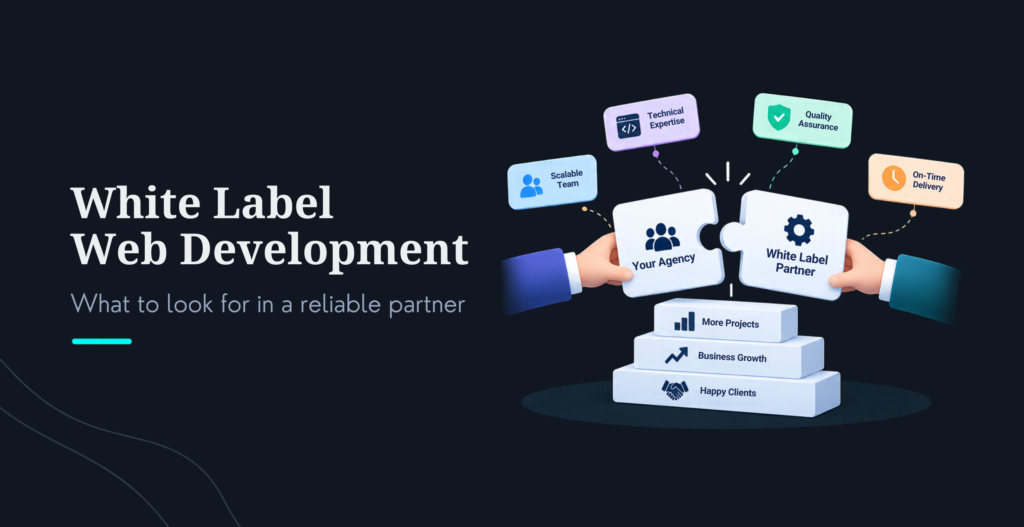
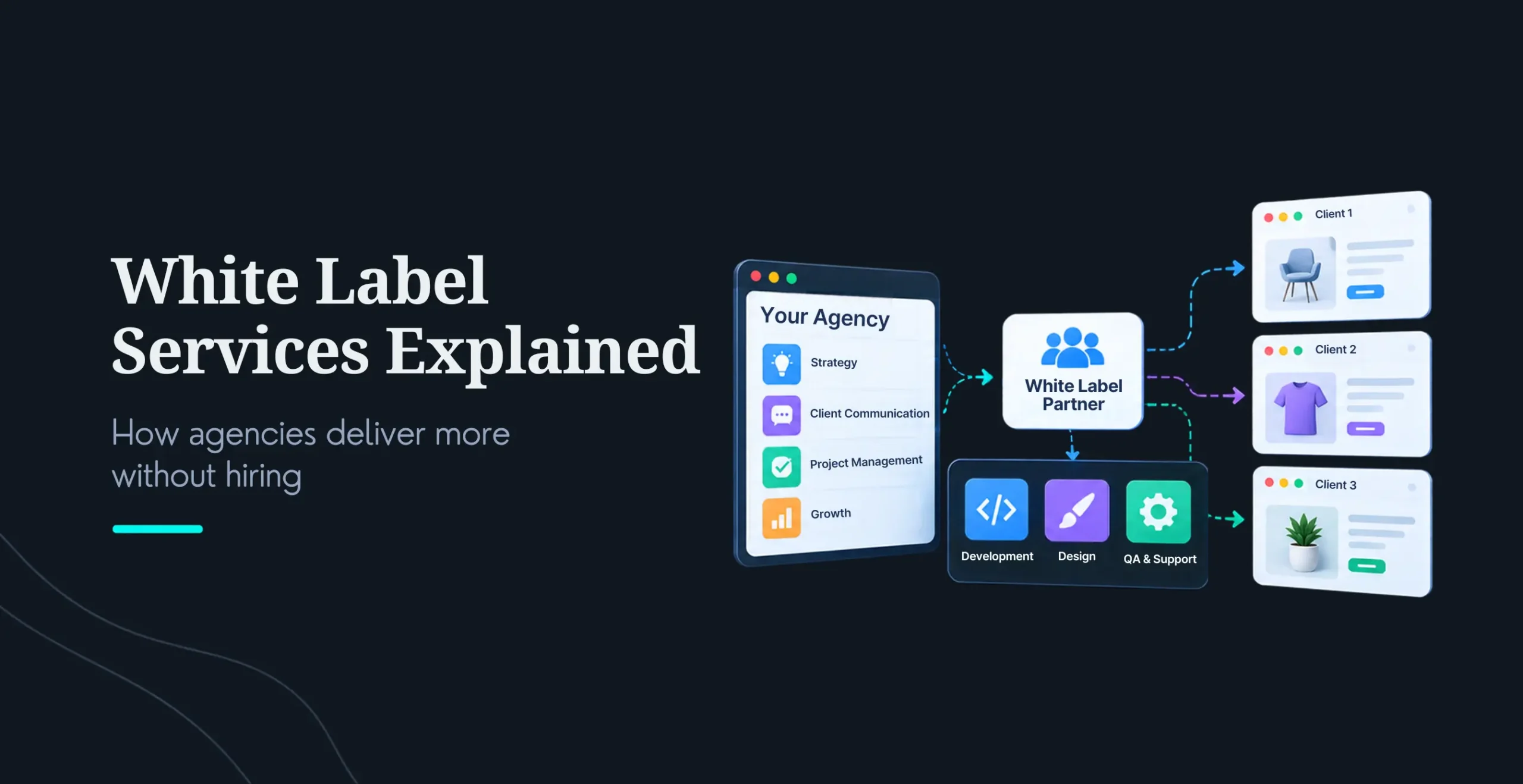
White label web development lets an agency deliver websites under its own brand while a behind-the-scenes partner builds them. The partner handles strategy, design, development, testing, and maintenance; you own the client relationship, manage communication, and present the work as your own. The client never sees the partner, that invisibility is the whole point.
The workflow is straightforward once it’s running: you sell the project under your brand, brief the partner with requirements and brand guidelines, they build it, you quality-check and present it to the client, and they handle ongoing support within the agreed plan. In practice it spans the full stack, WordPress and WooCommerce, Shopify and Shopify Plus, Webflow, custom Laravel or React builds, landing pages, and maintenance care plans, plus, increasingly, AI-assisted builds like Figma-to-WordPress. The appeal for agencies is simple and real: you add senior development capacity across multiple platforms without carrying the salaries, benefits, tools, and bench-time cost of an in-house team, typically at a meaningful discount to building the same capability yourself. (If you’re weighing that build-vs-partner decision specifically, our guide to outsourcing WordPress development covers the mechanics.)
The 15-Point Due-Diligence Checklist
This is the heart of it. Vet any prospective partner across these five areas before you commit. Treat a failure on confidentiality or technical capability as disqualifying, the rest are negotiable, those two are not.
Confidentiality (points 1-3)
1. Will they sign an NDA before you share any client details?
2. Will they sign an explicit non-solicitation agreement barring them from approaching your clients directly?
3. Is confidentiality their default posture? Do they talk about it unprompted, or do you have to drag it out of them?
A partner who treats NDA-first as obvious is telling you they understand the white label relationship. One who resists is telling you the opposite.
Technical capability (points 4-7)
4. Can they show live portfolio URLs (not just screenshots, which are trivial to fake) for projects like yours?
5. Do they have proven depth on the specific platforms you sell, WordPress, Shopify, WooCommerce, Webflow, whatever your stack is?
6. Do they follow a documented process with defined milestones, QA testing, and revision protocols, rather than winging each project?
7. Do they understand performance and the fundamentals, Core Web Vitals, mobile responsiveness, technical SEO basics, that determine whether the site you hand your client actually works?
Communication (points 8-10)
8. Is there a real project-management layer, a dedicated PM sitting between you and the developers, so you’re not left managing engineers yourself? This single factor separates a partner from a staffing agency.
9. Is there an SLA with response-time commitments tied to issue severity, so a production-down emergency doesn’t sit in a queue behind a copy tweak?
10. Can they clearly walk you through how they handle the full cycle, requirements, planning, development, testing, deployment?
Commercial terms (points 11-13)
11. Do they quote fixed-price rather than hourly? Hourly billing on a white label build is an invitation to scope creep you can’t control and can’t predict for your own client.
12. Is there a written revision and change-request policy, so scope doesn’t drift and disputes don’t happen?
13. Do you get clean IP transfer on every deliverable, so there’s never a question about who owns the code you’re selling?
Agency track record (points 14-15)
14. Can they give you references from other agencies specifically (not just end clients), people who understand the white label dynamic and can speak to reliability?
15. Do they offer a fair termination clause and, crucially, a willingness to do a small paid pilot before you commit to large projects?
A partner confident in their quality will happily prove it on a low-stakes first job. One who pushes for a big commitment up front, without a pilot, is a risk.
How to use it: send the 15 points to each candidate, verify the claims yourself (actually visit the live URLs, actually call the references), score them with confidentiality and technical capability weighted most heavily, and start with a paid pilot before scaling. Only expand once the pilot has proven quality, communication, and on-time delivery in reality, not on a sales call.
Pricing and Margin Math
To price profitably you need both what you’ll pay wholesale and what the market supports at retail. Here are commonly cited 2026 benchmarks (treat them as scope-dependent planning ranges, and get a scoped quote). One caution: these wholesale bands mostly reflect offshore fulfillment. Onshore partners typically cost considerably more, which changes your margin math.
On the wholesale side, a small brochure site runs roughly 800–2,500; a mid-market custom marketing site 2,500–7,000; ecommerce (Shopify or WooCommerce) 3,500–12,000; a Webflow custom build 3,000–8,000; custom front-end or app work $7,000+; a landing page 400–1,500; and a maintenance care plan 150–600/month. Many partners also offer monthly retainers (commonly four-figure) or dedicated developers (3,000–8,000/month depending on seniority and location).
The margin math is where agencies leave money on the table, so get it right. The common reselling target for development is a 2x-3x markup, which works out to a 50-65% gross margin on paper. Realized margins run lower: one 2026 benchmark puts web design and development at 35-55% (median about 45%) once revisions and scope creep land, which is exactly why fixed-price quotes and a written revision policy are on the checklist. One pricing guide models the same $6,000 client price at a 65% margin on a wholesale rate card, 60% on a fixed-price project, 55% on a retainer, 50% on a dedicated team, and just 40% (and at risk) on hourly billing with overruns. So a $2,500 wholesale site typically sells to the client at 5,500–7,500; a $3,500 ecommerce build at 8,000–12,000+. Worked through: buy a mid-market site at $5,000 wholesale, sell at $12,000, and you keep $7,000 at ~58% gross. Two honest caveats that separate paper margin from real margin: that gross figure is before your own project-management and account time, so a 2x markup nets closer to 40-45% once you count the hours you spend managing the partner and the client; and treat 2x as your floor, below it you’re effectively doing the client management for free. Price for the management layer, or the model quietly stops paying. For a fuller picture of how development costs break down (useful when you’re quoting clients), our website design and development cost guide lays it out.
Red Flags and the Mistakes That Burn Agencies
The checklist tells you what good looks like; here’s what trouble looks like, and the mistakes that cause it. The disqualifying red flags: refuses to sign an NDA or non-solicitation, offers only screenshots with no live URLs, gives you raw access to engineers with no PM layer, has no SLA, bills hourly only with no fixed-price option, has no written revision policy, won’t commit to clean IP transfer, can’t produce agency references, locks you into an unfair termination clause, or won’t do a paid pilot. Any one of the first two should end the conversation; a cluster of the rest should.
The mistakes agencies make map directly onto those flags, and they’re all avoidable. The biggest is choosing on price alone, the cheapest partner routinely delivers the lowest quality, and since your brand is on the work, their failure becomes your reputation problem. Close behind: not actually verifying the portfolio (screenshots lie; visit the live sites), skipping the NDA and non-solicitation (client poaching is the nightmare scenario, and it’s entirely preventable with a signature), not nailing down SLAs and a written revision policy (which is how scope drifts and deadlines slip), skipping the paid pilot (committing a big project to an unproven partner), and letting the partner communicate with your client directly (which both erodes your ownership and opens the poaching door). The through-line: every one of these is cheap to prevent up front and expensive to fix after you’ve signed. Do the vetting before the contract, not after the first disaster.
Platform-Specific Things to Check
Different platforms demand different competencies, so tailor your technical vetting to what you actually sell.
For WordPress and WooCommerce, confirm genuine depth beyond theme assembly: custom theme and plugin development, WooCommerce competency for stores, and security best practices (WordPress is the most-attacked CMS, so this matters). It suits most small-to-mid-market and content-heavy clients. For Shopify, if you serve serious ecommerce, verify Shopify Plus experience specifically, plus Checkout Extensions, custom themes and apps, and the operational pieces, payment gateways, shipping, tax, inventory logic, that make a store actually function. For Webflow, check real command of the platform’s CMS, interactions, and responsive design, plus SEO fundamentals, since Webflow clients are usually design-forward and will judge the result visually. For custom Laravel or React work, you need a different tier of partner entirely: genuine engineering depth in the framework, API integration, database design, and security, this is app development, not site building, and the vetting bar is higher. Match the partner’s proven strength to your platform mix; a great WordPress shop is not automatically a great Shopify Plus or custom-app shop, and assuming otherwise is a common, costly mistake.
The trade is the same one every agency weighs: flexible cost and speed versus fixed cost and control. An in-house developer is a 75K–160K+/year all-in commitment you pay whether or not there’s billable work, bench time between projects is the silent margin killer. White label converts that into a variable cost you pay only against revenue, lets you launch a new platform capability in days rather than the months it takes to hire, gives you breadth across platforms you could never staff for, and shifts turnover and coverage risk to the partner. For most agencies, white label wins for overflow, for specialized or occasional platform needs (Shopify Plus, custom apps), for testing a new service line, and whenever demand is variable.
In-house wins in the specific cases where control and consistency outweigh flexibility: when development is the literal core of your agency’s identity and you want to own that expertise, when demand is steady and predictable enough that bench time isn’t a risk, or when you need absolute process control. The pragmatic answer for most is a hybrid, core platform in-house, overflow and specialized work white label, and a smart sequence is to white label a new capability first, prove the demand is steady, then hire once the bench-time risk is gone. If you want to run the actual numbers on that decision, our breakdown of agency vs in-house cost does the math.
Frequently Asked Questions
What is white label web development?
It lets an agency deliver websites under its own brand while a behind-the-scenes partner builds them. The partner handles design, development, testing, and maintenance; you own the client relationship and present the work as your own, the client never sees the partner. It spans WordPress, Shopify, Webflow, custom builds, and maintenance, and lets agencies add senior development capacity across platforms without the salaries, benefits, tools, and bench-time cost of an in-house team, usually at a meaningful discount to building the same capability internally.
How do I choose a reliable white label web development partner?
Vet across five areas with a 15-point checklist: confidentiality (NDA and non-solicitation, signed before any brief), technical capability (live portfolio URLs, proven platform depth, documented process, performance knowledge), communication (a dedicated PM, an SLA with response times, a clear process), commercial terms (fixed-price quoting, a written revision policy, clean IP transfer), and agency track record (references from other agencies, a fair termination clause, a willingness to do a paid pilot). Treat confidentiality and technical capability as pass/fail, verify every claim yourself, and start with a paid pilot before scaling.
What does white label web development cost, and what can I charge?
Wholesale, roughly: brochure sites 800–2,500, mid-market custom sites 2,500–7,000, ecommerce 3,500–12,000, Webflow builds 3,000–8,000, custom app work $7,000+, landing pages 400–1,500, and care plans 150–600/month, mostly at offshore rates. The common reselling target is 2x-3x. So a $2,500 wholesale site typically becomes 5,500–7,500 to the client, and a $5,000 build becomes around $12,000. Treat all figures as scope-dependent planning ranges and get a real quote, integration complexity and revisions drive the number.
What profit margin should I target?
The common reselling target for development is a 2x-3x markup, which works out to a 50-65% gross margin on paper, though one 2026 benchmark puts realized web development margins at 35-55% (median about 45%) once revisions and scope creep land. Treat 2x as your floor. One honest caveat: that gross figure is before your own project-management and account-management time, so a 2x markup nets closer to 40-45% once you count the hours you spend managing the partner and the client. Price for that management layer explicitly, or the margin is illusory. Specialized or complex work (custom apps, Shopify Plus) supports the higher end of the range.
What are the biggest red flags in a white label partner?
The disqualifying ones: refusing to sign an NDA or non-solicitation, and offering only screenshots with no live portfolio URLs. The serious-but-negotiable ones: no dedicated PM (raw access to engineers you have to manage), no SLA, hourly-only billing with no fixed-price option, no written revision policy, no clean IP transfer, no agency references, an unfair termination clause, and refusing a paid pilot. The common agency mistakes map onto these, choosing on price alone, not verifying the portfolio, skipping the NDA, and letting the partner talk to your client directly. All are cheap to prevent before signing and expensive to fix after.
Does platform expertise really matter, or can any good shop handle any platform?
It matters a lot, and assuming otherwise is a costly mistake. A strong WordPress shop is not automatically good at Shopify Plus or custom Laravel/React work, these demand genuinely different competencies. For WordPress, verify custom theme/plugin and WooCommerce depth plus security. For Shopify, verify Plus experience, Checkout Extensions, and the operational pieces (payments, shipping, tax, inventory). For Webflow, verify CMS, interactions, and responsive/SEO command. For custom apps, you need real engineering depth (API integration, database design, security), a higher bar entirely. Match the partner’s proven strength to the platforms you actually sell.
Should I use white label or hire in-house developers?
White label wins for overflow, specialized or occasional platform needs, testing a new service line, and variable demand, you pay only against revenue, launch new capabilities in days, get breadth across platforms, and offload turnover risk, usually below the cost of building in-house. Hire in-house when development is the core of your agency’s identity, demand is steady and predictable (no bench-time risk), or you need total process control. Most agencies land on a hybrid: core platform in-house, overflow and specialized work white label. A smart sequence is to white label first, then hire once demand proves steady.
Why is a paid pilot so important before committing?
Because a sales call and a portfolio tell you what a partner claims; a paid pilot tells you what they actually deliver, on quality, communication, and on-time delivery, at low stakes. A partner genuinely confident in their work will happily prove it on a small first project. One who pushes for a large commitment up front while resisting a pilot is signaling either overconfidence or something to hide. The pilot is cheap insurance against committing a major, brand-critical project to an unproven partner, which is one of the most common and damaging white label mistakes.
Conclusion
Choosing a white label web development partner is really a trust decision wearing a procurement decision’s clothes. The capacity is easy to find; the reliability is not. That’s why the 15-point checklist matters: it turns a vague “do they seem good?” into a concrete, verifiable yes or no across the five things that actually determine whether this partnership protects your brand or endangers it, confidentiality, technical capability, communication, commercial terms, and agency track record.
Vet hard before you sign, not after the first missed deadline. Insist on the NDA and non-solicitation, verify live work and references yourself, demand a dedicated PM and fixed-price terms, and prove it all with a paid pilot before you scale. Price at the common 2x-3x target and account for your management time so the margin is real. Do that, and white label becomes exactly what it should be, senior development capacity on demand, under your brand, at a healthy margin. Skip it, and you’ve handed your reputation to a stranger. Choose the partner as carefully as you’d make the hire it replaces, because functionally, that’s what it is. For the parallel version of this decision when it’s a client choosing you, our guide on how to choose a web design agencyis a useful companion.
Looking for a white label web development partner that meets this bar?
Book a consultation to talk through your capacity needs and start with a scoped paid pilot.
Parth Pandya
Founder & CEO
Founder & CEO of KrishaWeb, leads an Enterprise Web Agency. With contributions to WordPress and organization of WordCamps, he pioneers innovation and community engagement in the digital realm.




 KrishaLabs
 KrishaStudio
 KrishaStore