If you are paying for a website or a web application in 2026, the way it gets built has changed underneath you. And most of that change happens in places you never see.
You do not need to know what a coding assistant is. But you should know this: the same project that took five months to build two years ago can often ship faster now, the cost structure has shifted, and the gap between an agency that uses these tools well and one that does not is now something you pay for, in time and in money.
I lead the custom development team at KrishaWeb. This is the plain-English version of what AI has actually changed about building software, written for the person approving the budget, not the person writing the code, and what it means for your timeline and cost. And the questions are worth asking before you hire anyone to build for you.
Table Of Contents
Table Of Contents
What actually changed (in terms that matter to you)
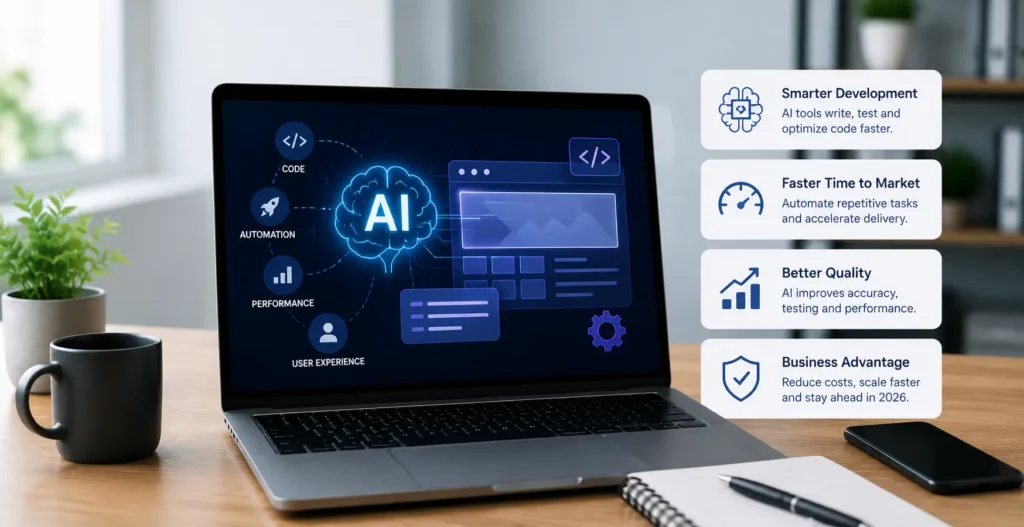
Developers now have AI tools that help them write, test, and check code far faster than before. GitHub’s research on one of the most common tools found developers shipping certain work 40 to 55% faster, and that roughly matches what we see across our own projects.
Here is what that means for you, with the jargon stripped out.
The boring, repetitive parts of building software, the parts that used to eat days, now take hours. The first draft of a feature, the testing, the security checks, the documentation. AI does not do these perfectly, but it does the heavy first pass, and a developer refines it instead of building it from scratch.
That shift touches three things you actually care about: how fast your project ships, what it costs you, and how many bugs survive to launch. Let me take each one.
What it means for your timeline
Projects move faster now. Not magically, not on everything, but meaningfully on a large share of the work.
The gain is biggest on the routine stuff: standard features, common page types, the plumbing that every web project needs. It is smallest on the genuinely hard parts, the architecture decisions, the tricky business logic, the things unique to your situation. Those still take human time, because they still take human judgment.
So when an agency quotes you a timeline in 2026, it is fair to expect it to reflect these tools. A team using AI well should be quoting faster on the routine portions of your build than a team working the old way. If two quotes land far apart on timeline for similar work, that gap is often the difference between a team that has adopted these tools and one that has not.
One honest caveat. Faster on the build does not mean faster on everything. Your project timeline still depends heavily on how quickly your side makes decisions, reviews work, and provides what the team needs. AI sped up the developers. It did not speed up approvals.
What it means for your cost
This is the part owners most want a straight answer on, so here it is.
The cost of the labor-heavy parts of a build has come down because the work takes less developer time. That is real, and a good agency passes some of it on through faster delivery and more competitive quotes.
But two things keep the total from simply collapsing. First, the hard parts of your project, the parts that needed senior judgment, still need it, and that time has not gotten cheaper. Second, if you want AI features in your own product, like a chatbot, smart search, or personalization, that is a new capability you are adding, with its own cost, not a discount on the build.
The clearest way to think about it: AI made building software more efficient, not free. The right expectation is better value, faster delivery, and more capability for your budget, not a fire sale. Any agency promising a serious build for a fraction of the going rate “because AI” is telling you something about the quality you will receive.
What it means for quality and risk
Here is the part that does not show up in a sales pitch and the part you should care about most.
AI writes code fast. It also writes insecure code sometimes, because it learned from public code, and plenty of public code has security holes in it. It occasionally invents things that look right and are not. Left unchecked, AI can introduce problems faster than a human would.
That is the risk. The protection against it is a process, and this is the single most important thing for you to ask about when hiring.
A responsible team in 2026 uses AI to move fast and then runs every line through security scanning and human review before it ships. The AI accelerates. A developer who understands the code checks it, owns it, and signs off on it. At KrishaWeb, nothing AI helped write reaches a client’s live system without a developer who can stand behind it personally.
The agencies to worry about are the ones using AI to cut corners rather than to move faster safely. Same speed, no safety net. You cannot see the difference in a demo. You can see it in the questions they are willing to answer.
What still needs a human (and always will)
It is worth being clear about what AI cannot do, because it is exactly the part you are really paying for.
AI is brilliant at the next line of code and clueless about whether you are building the right thing. It does not understand your business, your customers, or your goals. It cannot decide how your system should be structured to grow with you, judge what will actually feel good to your users, or catch the subtle problem that only matters because of something specific to your situation.
That judgment, the architecture, the strategy, the taste, the understanding of your business, is human work, and it is the work that determines whether your project succeeds or just functions. AI made the typing faster. It did not make the thinking optional.
This is why the team you hire still matters as much as it ever did. AI is a power tool. A power tool in skilled hands builds something great. The same tool in careless hands just builds the wrong thing faster.
The questions to ask before you hire in 2026
You do not need to understand the tools to hire well. You need to ask the right questions and listen to how an agency answers.
Ask how they use AI in their process. A confident, specific answer (we use it here, we check it there) is a good sign. A vague answer, or a denial that they use it at all, tells you they are either behind or not being straight with you.
Ask what their review and security process looks like. The answer you want is that AI-assisted code goes through automated security scanning and human review before it ships. If they cannot describe a process, that is the risk we talked about.
Ask who owns the code. AI involvement does not change this. You should own what you pay for, and it should be in writing.
Ask how AI affects your specific timeline and cost. A good agency can explain, in plain terms, where AI saves you time and where it does not. One that just says “AI makes everything cheaper and faster” is overselling.
The tools are not going away, and the gap between teams that use them well and teams that do not is widening every quarter. So for your business, it comes down to two options.
If you have an in-house team, get them on the right tools with the right training and the right safety process around it. It takes intent, but for a business that builds a lot of software, it pays off.
If you do not, partner with a team that already works this way, so you get the speed and the safety without building the capability yourself. At KrishaWeb,AI-enabled development is simply how we build now, with the security scanning, the human review, and the sign-off already part of the process.
Either way, the time for ignoring this is over. The only real question is whether you build the capability or hire it.
If you want a development team that already works this way, tell us what you are building. Schedule a call to talk it through, or contact us with your project.
Frequently Asked Questions
Will AI make my web development project cheaper?
It makes parts of it more efficient, which can lower cost and shorten timelines, but it does not make a serious build cheap. The routine work takes less developer time now, and a good agency passes some of that on. But the hard parts of your project still need senior human judgment, and that has not gotten cheaper. If you are adding AI features to your own product, that is a new capability with its own cost. Expect better value and faster delivery, not a fire sale. Any agency promising a real build for a fraction of the going rate “because AI” is signaling the quality you will get.
Is my project faster to build now because of AI?
Usually, yes, on a meaningful part of it. AI speeds up the routine, repetitive work the most and the genuinely complex work the least because the hard parts still need human judgment. A team using these tools well should quote faster on the standard portions of your build. One thing to keep in mind: your timeline also depends on how quickly your side makes decisions and reviews work. AI sped up the developers, not the approvals.
Is AI-generated code safe to use in my product?
It is safe when it is handled properly and risky when it is not. AI can produce insecure code because it learned from public code that includes security flaws, and it sometimes generates things that look correct but are not. The protection is a process: automated security scanning plus human review by a developer who understands the code before anything ships. When you hire, ask an agency to describe this process. A clear answer is a good sign. No clear answer is the risk.
Will AI replace the web development agency I hire?
No. AI changes how the work gets done, but it does not replace the judgment that makes a project succeed: understanding your business, deciding what to build, structuring it to grow, and catching the problems a tool cannot see. AI made the coding faster, not the thinking optional. The team you hire matters as much as ever, because a powerful tool in skilled hands builds something great, and the same tool in careless hands just builds the wrong thing faster.
How do I know if my agency is actually using AI well?
Ask them directly how they use AI, what their security and review process is, and who owns the code. A team using these tools well gives specific, confident answers: where AI helps, how they check its output, and how they keep it safe. A vague answer, or a claim that AI makes everything cheap and instant, tells you they are either behind the curve or overselling. You do not need to understand the tools to judge the answers. Clarity and honesty are the signal.
Nirav Panchal
Lead – Custom Development
Lead of the Custom Development team at KrishaWeb, holds AWS certification and excels as a Team Leader. Renowned for his expertise in Laravel and React development. With expertise in cloud solutions, he leads with innovation and technical excellence.




 KrishaLabs
 KrishaStudio
 KrishaStore