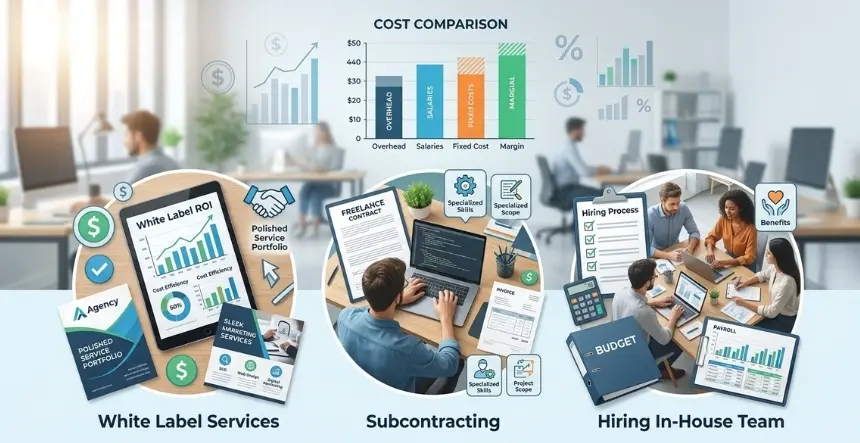
Every growing agency hits the same wall. More work than the team can handle. Three options on the table. Most agency owners pick one based on gut feeling rather than actual numbers.
This post does the math. Real 2026 figures for the USA, UK, and Australia. The full cost of hiring, including the parts most calculations quietly skip. What subcontracting actually costs once you account for management time and revision cycles. And what a white label partnership costs compared to both.
The goal is not to sell you on one option. It is to give you the comparison you need to make the right call for your specific situation.
The median US web developer salary reached $90,930 by May 2024, according to Bureau of Labor Statistics data. The true employer cost, including benefits, taxes, equipment, and overhead, runs $112,000 to $126,000 per year. UK developers cost the equivalent of $60,000 to $90,000. Australian senior developers run AUD $105,000 to $130,000 base, with total employer cost 25 to 35% above that. None of these numbers include the three to six months it typically takes to recruit and get a new developer productive.
Hiring is the option that feels the most permanent and the most professional. You own the resource. They work on your clients. They understand your culture. They build expertise in your stack.
The problem is that the fully loaded cost is almost always higher than agency owners calculate at the time of the hire, and the risk is higher than it appears.
The real cost of a US in-house developer in 2026
Cost Component
Annual Amount
Notes
Base salary (mid-level)
$85,000 to $95,000
White Label Agency 2026 benchmark
Payroll taxes (employer)
$7,000 to $8,000
Social Security, Medicare, FUTA
Health insurance
$7,200 to $14,400
Employer contribution averages $7,200 for single coverage
Retirement contribution
$2,500 to $4,000
Typical 401k match
Equipment and software
$3,000 to $6,000
Laptop, licenses, tools
Recruiting and onboarding
$8,000 to $15,000 one-time
Job boards, time, training
Management overhead
$5,000 to $10,000/year
Approximate cost of manager time
TOTAL FIRST YEAR
$118,000 to $152,000
Before sick leave, PTO replacement, or turnover cost
The real cost of a UK in-house developer in 2026
Cost Component
Annual Amount
Notes
Base salary (mid-level)
GBP 45,000 to GBP 60,000
London rates at upper end
Employer National Insurance
GBP 5,500 to GBP 7,800
13.8% of salary above threshold
Pension contribution
GBP 1,800 to GBP 2,400
Minimum 3% employer auto-enrolment
Equipment and software
GBP 2,000 to GBP 4,000
Recruiting cost
GBP 5,000 to GBP 10,000 one-time
Agency fees or advertising time
TOTAL FIRST YEAR
GBP 59,000 to GBP 84,000
Approximately USD 74,000 to USD 106,000 at current rates
The real cost of an Australian in-house developer in 2026
Cost Component
Annual Amount
Notes
Base salary (mid-level)
AUD 90,000 to AUD 120,000
Sydney/Melbourne at upper end
Superannuation (employer)
AUD 10,800 to AUD 14,400
12% mandatory from July 2025
Workers’ compensation
AUD 1,500 to AUD 3,000
State-dependent
Equipment and software
AUD 3,000 to AUD 5,000
Recruiting cost
AUD 8,000 to AUD 15,000 one-time
TOTAL FIRST YEAR
AUD 113,000 to AUD 157,000
Approximately USD 73,000 to USD 102,000
The hidden costs hiring guides do not mention
The numbers above are the calculable costs. The harder-to-quantify ones are often larger.
Ramp-up time: a new developer typically takes three to six months to reach full productivity. You are paying the full salary during that period while output is 40 to 60% of what you are paying for.
Turnover cost: the average developer tenure at a small agency is 18 to 24 months. When they leave, the search, the recruiting fee, the knowledge transfer, and the ramp-up cycle start again. The average replacement cost is 50 to 100% of annual salary.
Project variability: a full-time developer costs the same whether you have three projects running or one. The fixed cost of a developer sitting at partial capacity in a slow quarter is a real drag on margin.
Single point of failure: one developer means one skill set. A client who needs Shopify Plus when your developer only knows WordPress becomes a problem you either turn down or underdeliver on.
The real hiring question is not, ‘Can we afford to hire?’ ‘It is ‘can we afford to maintain a full-time developer cost through the inevitable slow quarters, project variability, and turnover cycles that come with every agency?’ For many agencies, the honest answer is no. For agencies with consistent $1M-plus revenue from web development specifically, the answer may be yes.
Option 2: Subcontracting to Freelancers
Subcontracting is the middle option. No employment commitment. You bring in a freelancer for a specific project, pay them directly, and mark up their time for the client. It sounds like the flexible option and often is until the problems start.
What freelancers actually cost in 2026
Developer Level
USA Hourly Rate
UK Hourly Rate
Australia Hourly Rate
Junior
$60 to $90
GBP 30 to GBP 50
AUD 60 to AUD 90
Mid-level
$90 to $140
GBP 50 to GBP 80
AUD 90 to AUD 130
Senior
$140 to $220+
GBP 80 to GBP 120
AUD 130 to AUD 180+
The real cost of subcontracting once you include management time
The hourly rate is only part of the subcontracting cost. Add the following, and the picture changes.
Brief preparation and handoff: writing a proper brief for a freelancer takes two to four hours per project, every time. At $100 to $150 per hour for your own time, that is $200 to $600 per project before a line of code is written.
Supervision and feedback cycles: freelancers need review, feedback, and course correction. Expect two to four hours of your time or a senior team member’s time per week of active freelancer work.
Quality review before client delivery: reviewing freelancer work before it goes to the client adds another two to four hours. Your name is on it. You carry the quality risk.
Revision cycles: In a KrishaWeb analysis of agencies using ad-hoc freelancers, revision cycles average 3.8 rounds per project versus 1.6 rounds with a structured white label partner. The extra 2.2 rounds each cost your time to manage.
A typical 40-hour freelance project at $100/hour ($4,000 in development cost) realistically adds 12 to 20 hours of agency management time at $100 to $150 per hour, bringing the true cost to $5,200 to $7,000 before the client bill. If you quoted the project with a 50% margin on the $4,000 development cost, your actual margin after management time is closer to 20 to 30%.
The reliability problem with freelancers
The structural risk with freelancer subcontracting that no cost calculation fully captures: freelancers have multiple clients. Your project is one of several. When a better-paying or more interesting project arrives, yours gets deprioritized. This is not a character failing. It is the nature of a freelancer’s business model. Agencies that have built their overflow capacity on a network of freelancers regularly discover this risk materializing at the worst possible moment: the week before a client deadline.
Option 3: White Label Development Partnership
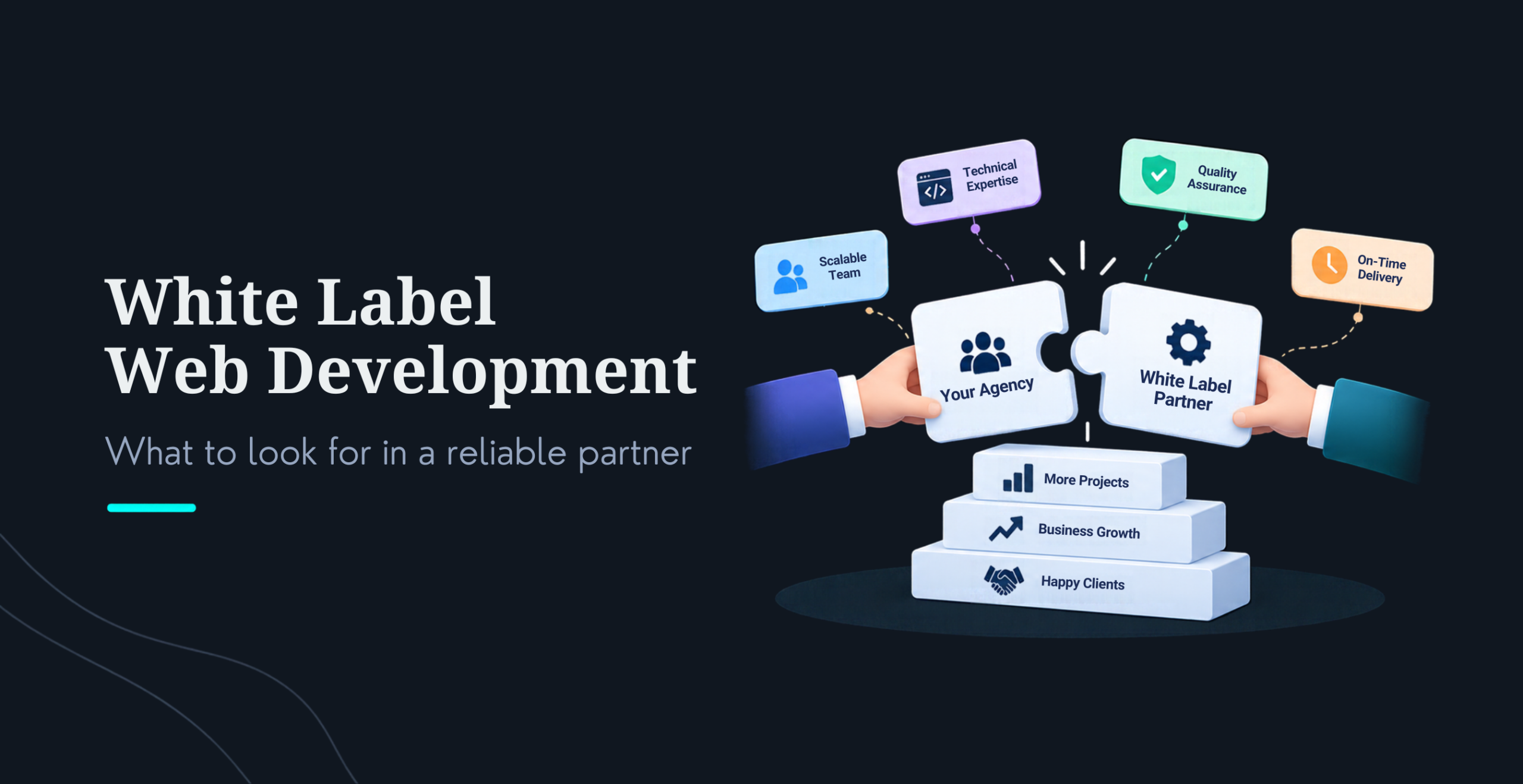
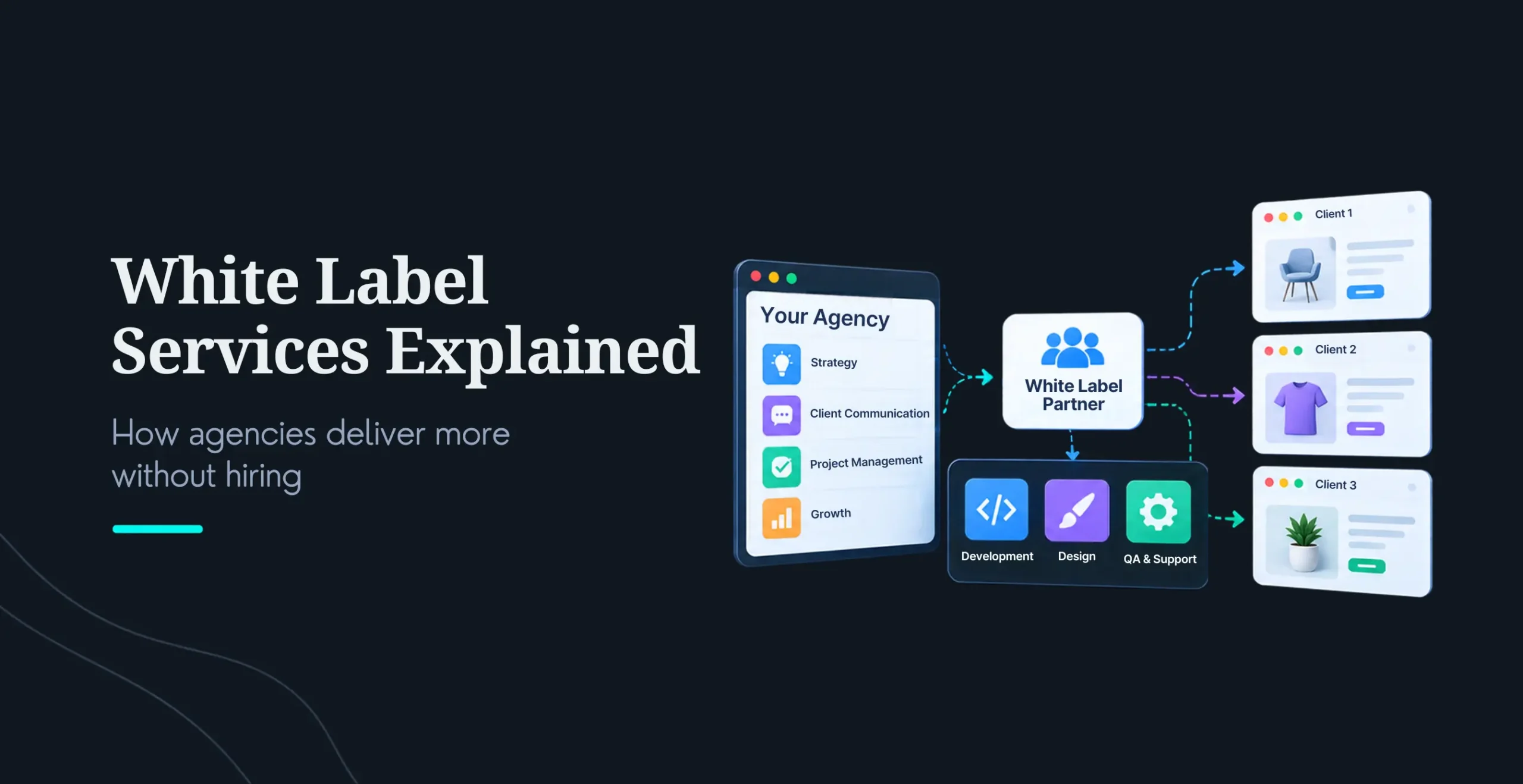
A white label partnership is a structured relationship with a specialist development team that works under your brand, under a signed NDA, with fixed pricing, dedicated account management, and contractual protections that freelance subcontracting does not provide.
The cost structure is fundamentally different from both hiring and freelancing, which is why comparing hourly rates misses the point.
What a white label partnership costs in 2026
Model
Monthly Cost
Effective Rate
Best For
Starter plan (KrishaWeb)
$729/month
$18 to $36/hr effective
2 to 4 ongoing clients, overflow capacity
Pro plan (KrishaWeb)
$1,518/month
$19 to $25/hr effective
5 to 10 concurrent clients
Agency plan (KrishaWeb)
$2,157/month
$18 to $22/hr effective
10+ concurrent projects
Per-project (no commitment)
$800 to $15,000+ per project
Varies by scope
One-off builds, overflow
At the Pro plan rate of $1,518 per month, you have three to four hours of senior development daily. That is over 60 hours per month of productive development time. At the effective rate of $19 to $25 per hour, that is the cost of a US mid-level freelancer’s hour for a whole day of senior output.
What is included in the white label rate that freelance rates do not cover
NDA covering client identity, non-solicitation, IP ownership, and non-compete
Dedicated account manager who knows your agency, your standards, and your clients
Staging delivery before any work touches production
Core Web Vitals testing and documentation before staging handover
Fixed-price quotes on defined scopes, protecting your margin from the start
Zero partner branding anywhere in the deliverable
Full IP assignment to your agency on project completion
Post-launch support window on every project
The management time difference
The most undervalued advantage of white label over freelance subcontracting is operational. A white label partner with a dedicated account manager needs one-third to one-half the management time of a freelancer network. The account manager handles brief clarification, progress updates, quality checks, and issue resolution. You review staging and give a thumbs up or feedback. That is the scope of your involvement.
Compare that to managing three or four freelancers simultaneously on a busy month, each needing individual briefing, supervision, and quality review. The time saving alone, at $100 to $150 per hour for your time, often covers the entire monthly plan cost.
The Three-Year Comparison: Real Numbers
Same scenario across three years. An agency winning six additional web projects per year that their in-house team cannot handle, averaging $8,000 per project, billed to the client.
In-House Hire
Freelancer Subcontracting
White Label (Pro Plan)
Year 1 cost
$118,000 to $152,000
$40,000 to $55,000 (development) + $12,000 to $18,000 (your management time)
$18,216 (12 months)
Year 1 revenue from 6 projects
$48,000
$48,000
$48,000
Year 1 net (revenue minus cost)
Negative $70,000 to $104,000
Negative $4,000 to positive $8,000
Positive $29,784
Year 2 cost (developer + growth)
$95,000 to $115,000
Similar to Year 1
$18,216
Year 2 revenue (10 projects now possible)
$80,000
$80,000
$80,000
Year 2 net
Negative $15,000 to negative $35,000
$7,000 to $22,000
$61,784
Year 3 cost
$100,000 to $120,000
Similar
$18,216
Year 3 net
$40,000 to $60,000 (finally positive)
$7,000 to $22,000
$61,784
The in-house hire reaches positive net return in year three, assuming the developer is fully utilized and turnover does not occur. The freelance model is profitable earlier but delivers lower margins because of management time costs. The white label model is profitable from month one.
These numbers change if the in-house developer enables the agency to take on more work than the white label model could handle, or if the in-house developer’s skills expand the agency’s service offering into higher-margin territory. The hire makes sense when the strategic value of ownership outweighs the financial disadvantage. For most agencies at the six-to-ten-projects-per-year stage, it does not yet.
What Each Option Looks Like for Different Agency Types
Agency Type
Best Option
Why
Digital marketing agency adding web as a service
White label
No headcount cost, no skill gap, immediate capacity
Design studio without development capability
White label
Builds without disrupting the design team’s focus
Web agency at capacity with consistent $500K+ development revenue
Hire
Ownership and cultural integration justify the cost at this volume
SEO agency doing one-off site projects
Per-project white label
No commitment needed for intermittent volume
Agency with specialist project needs (Shopify Plus, headless)
White label
Specialist skills are expensive to hire and rarely needed full-time
Freelancer scaling to agency
White label
Delivers agency-scale output without agency-scale headcount
Agency with tight margins and variable pipeline
White label
Variable cost aligns to variable revenue
The Hybrid Model Most Successful Agencies Use
The cleanest framing from White Label Agency’s 2026 research of 600+ digital agencies: the most successful ones use a hybrid model. One account manager or project coordinator in-house who owns client relationships and briefs. KrishaWeb or a comparable white label partner handles technical delivery. The in-house hire is a relationship and operations role. The technical execution is a variable cost that scales with pipeline.
This hybrid protects the agency’s ability to grow without the fixed cost drag of a technical hire the business is not yet ready to fully utilize. It also keeps the client relationship inside the agency, which is where the strategic value is.
What is the difference between white label development and subcontracting?
Subcontracting is when you hire an external developer or freelancer to do work for your client, with no formal structure around confidentiality, branding, or IP ownership. The freelancer may or may not know they are working for an agency client. White label development is a structured partnership with a signed NDA covering client identity, a contractual prohibition on partner branding in deliverables, and IP assigned to your agency as work-for-hire on completion. The client never knows a third party was involved. The operational and contractual structure is what makes it white label rather than standard outsourcing.
Is white label development cheaper than hiring?
In most cases, yes, especially in the first two to three years. An in-house US developer costs $118,000 to $152,000 in the first year, including all employer costs. A KrishaWeb Pro plan costs $18,216 per year for comparable productive output. The in-house model reaches financial parity only when the developer is consistently fully utilized, the agency can absorb the fixed cost through slow periods, and turnover does not reset the calculation. For agencies at the six-to-ten-project-per-year stage, white label is almost always cheaper.
What are the risks of white label development?
The primary risks are partner quality (the work reflects on your agency), communication gaps (poorly briefed projects produce wrong output), and client confidentiality (a partner without a proper NDA creates exposure). All three are mitigated by choosing a partner with a formal NDA process, a dedicated account manager, and a track record of agency delivery rather than direct-client work. The risks of freelance subcontracting include the same ones plus the reliability risk that comes with no contractual capacity commitment.
Can I use white label development just for specific platforms or project types?
Yes. Most white label development arrangements are flexible. You can use KrishaWeb for WordPress overflow only, or for Shopify projects your team cannot build, or for any specialist requirement that comes up intermittently. The per-project model has no monthly commitment. The monthly plans are worth the structure when volume is consistent. Mixing in-house capability with white label specialist delivery is the pattern most growing agencies use.
How do I know if my agency is ready for a white label partnership?
Four signals: you are regularly turning down projects because of capacity. You are taking projects on platforms your team does not build well. You are losing margin to management overhead on freelancer projects. Or you have a specific project in hand right now that your team cannot start for three weeks. Any one of these means a white label partnership is worth at least a 30-minute call to evaluate.
Start with a Free Partnership Call
If you want to know specifically what a white label partnership would cost for your current project mix and pipeline, the30-minute call is where we run those numbers with you. Bring your typical project types, your current team capacity, and your monthly revenue from web development. We will tell you which plan makes sense and what the effective cost per project looks like against your current method.
KrishaWeb is a web development agency and web design agency that has been the development team behind agency projects since 2008. 2,400+ projects. 42+ countries. USA, UK, Australia, and Canada.
Book your free partnership call and tell us how you currently handle overflow and what your biggest capacity constraint is. We respond the same business day.
Parth Pandya
Founder & CEO
Founder & CEO of KrishaWeb, leads an Enterprise Web Agency. With contributions to WordPress and organization of WordCamps, he pioneers innovation and community engagement in the digital realm.




 KrishaLabs
 KrishaStudio
 KrishaStore