A client comes to you wanting to sell online. Product catalog, subscriptions, custom shipping rules, a couple of payment gateways, maybe wholesale pricing for their B2B buyers. You can absolutely handle the branding, the UX, the marketing strategy, the client relationship. What you can’t confidently promise is the checkout logic, the payment webhook testing, or what happens when their product catalog hits 3,000 SKUs and the site starts crawling.
Turn the project down and you lose the revenue, plus whatever else that client would have sent your way later. Take it on without the right technical depth and you risk a launch that breaks on day one, or a checkout that quietly loses orders for weeks before anyone notices.
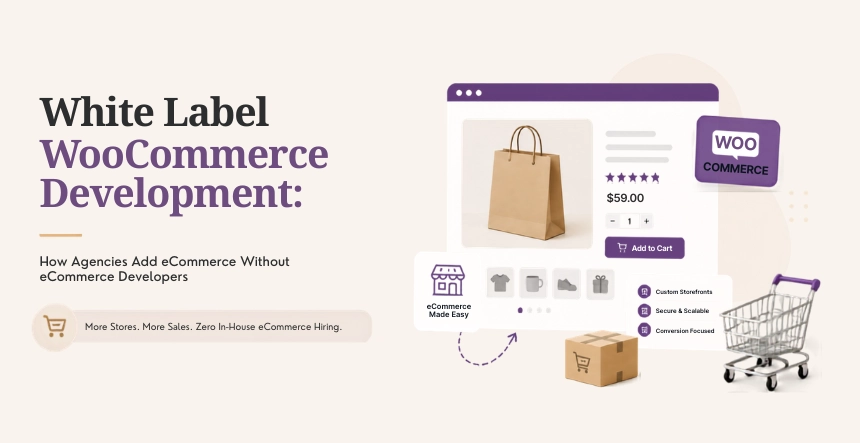
White label WooCommerce development is when an external WooCommerce team builds or supports an online store for your client under your agency’s brand. You keep the client relationship, the strategy, the pricing, and the communication. The partner handles the technical work: store setup, custom development, integrations, performance, QA, and ongoing maintenance.
WooCommerce’s actual market position depends heavily on how you measure it. Some datasets put it around 6.64% of all measurable web origins. Others show it above 30% of tracked eCommerce stores specifically. Those numbers aren’t contradicting each other so much as measuring completely different things, one counting every website on the internet and the other counting only stores. Either way, it’s still one of the platforms agencies get asked about constantly, largely because it lives inside WordPress and extends through themes, plugins, custom code, and external APIs rather than locking you into a closed system.
This article covers what agencies can actually outsource, how the delivery process works, what quality and security controls matter before you hand off client work, how a partner compares to hiring or freelancing, and how to choose one for your next WooCommerce brief.
Table Of Contents
Table Of Contents
What Is White Label WooCommerce Development?
White label WooCommerce development is a service arrangement where an external WooCommerce team builds, customizes, or maintains an online store for your client. You present the work under your own brand and manage the relationship. The partner provides technical delivery, testing, documentation, and support behind the scenes.
Split it into two layers and it’s easier to see where the boundaries actually sit.
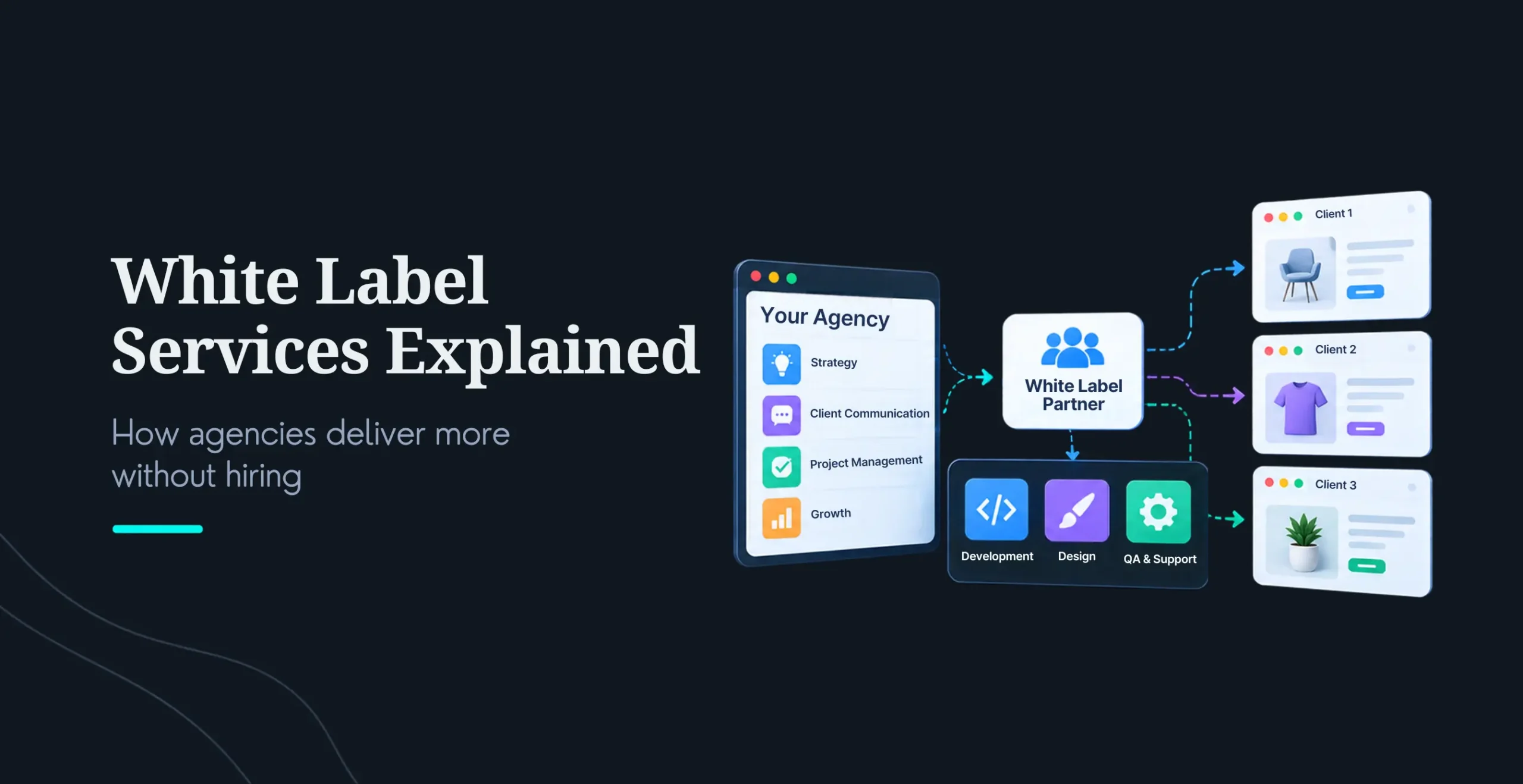
On your side of the line: client communication, business and marketing strategy, brand direction, UX and creative decisions, the commercial proposal, client pricing, feedback management, final presentation, and account growth.
On the partner’s side: WooCommerce architecture, product and catalog setup, theme development, checkout functionality, payment integrations, shipping and tax configuration, custom plugins, API connections, performance optimization, staging and QA, deployment support, documentation, and maintenance.
Exactly where that split falls depends on the contract and the specific project. Some agencies want the partner untouched by anything client-facing. Others are comfortable letting the partner join a staging review call directly, as long as it’s clearly agreed upfront.
White label is not the same as a referral
Referral model
White label model
Client gets introduced to another provider
Client stays with your agency
Provider may use its own brand
Work is presented under your brand
You might earn a commission
You control the commercial relationship
Less control over delivery quality
You manage the entire client experience
A referral hands the client off. White label doesn’t. That distinction is the whole point of the model, and it’s worth being clear about it internally before you start pitching WooCommerce work you’re planning to deliver this way.
How Does White Label WooCommerce Development Work?
A typical project starts with your brief, technical discovery, and scope approval. The partner then develops the store in an agreed environment, gives you staging access, runs QA, works through consolidated feedback, supports launch, and hands over documentation. You stay the client-facing owner the entire way through.
Gathering the business and product requirements comes first. Product types, how many products and variations, product attributes, customer types, pricing rules, payment methods, shipping regions, tax requirements, inventory workflows, subscription needs, marketing integrations, reporting requirements, and the launch date all get captured here.
Technical discovery follows on the partner’s side. They review hosting, WordPress and WooCommerce versions, theme compatibility, the existing plugin stack, payment gateways, shipping integrations, external APIs, product data, existing customizations, performance limitations, and any security concerns worth flagging early.
Scope and responsibilities get confirmed explicitly. What you’re supplying, what the partner is building, what the client is supplying, who’s adding the product data, who manages licenses, who runs QA, who approves the staging site, who handles launch day, and what post-launch support actually includes.
Development happens on staging, never directly on a live store. This sounds obvious but gets skipped more often than you’d think, particularly on smaller projects where everyone’s in a rush.
Testing covers the full purchase journey, not just whether the pages look right. Product pages, variations, cart, checkout, payments, coupons, taxes, shipping, transactional emails, customer accounts, order status changes, refund workflows, mobile layouts, analytics, and SEO elements all need real testing before anything ships.
Launch and handover close it out, with access details, documentation, deployment notes, plugin and license information, admin training, backup instructions, and maintenance recommendations delivered as standard, not as an afterthought once the invoice is sent.
What Services Can Agencies Outsource?
Nearly every technical stage of a WooCommerce project can be outsourced: store setup, custom themes, product imports, checkout customization, payment and shipping integrations, subscriptions, performance optimization, migrations, maintenance, and support. Your agency keeps control of the customer relationship, creative direction, and final approval throughout.
Store setup
WordPress and WooCommerce installation, theme configuration, store settings, product categories and attributes, variable products, customer accounts, order statuses, transactional emails, tax settings, shipping zones, coupon rules, and checkout settings all sit in this bucket.
Custom WooCommerce development
Product configurators, custom product fields, conditional and wholesale pricing, membership pricing, quote-request workflows, custom checkout fields, conditional shipping, product bundles, pre-orders, waitlists, custom order statuses, customer dashboards, and role-based access are common custom requests.
Custom functionality needs to be built somewhere maintainable. Placing major changes directly inside a parent theme is a classic mistake, because the next theme update overwrites everything silently.
Product catalog migration
Product imports, variations, categories, attributes, images, prices, stock levels, customer records, historical orders, reviews, coupons, and redirects all need to move cleanly during a migration. Data should be cleaned and mapped before anything gets imported. A spreadsheet with inconsistent attributes or missing SKUs turns into a support ticket queue two weeks after launch.
Payment integrations
Card payments, digital wallets, bank transfers, buy-now-pay-later options, regional gateways, subscription payments, refunds, 3D Secure flows, and webhook validation all belong here. WooCommerce’s own Stripe documentation notes that the Stripe extension supports 3D Secure and provides testing tools for checkout flows, which is exactly the kind of thing that needs to be exercised properly before a store goes live, not discovered live.
Shipping and tax integrations
Shipping zones, flat-rate shipping, free-shipping thresholds, local pickup, real-time carrier rates, delivery estimates, tracking links, tax rules, regional tax display, and B2B exemptions all need configuration specific to how the client actually ships and where they’re required to collect tax.
Subscription and membership stores
Recurring payments, trial periods, membership levels, restricted products, renewal emails, failed-payment handling, account upgrades, and cancellation workflows are more advanced territory. These projects need careful testing because payment logic, account state, and order data all interact across multiple moving parts at once.
Performance optimization
Database optimization, caching, CDN configuration, image optimization, script management, query analysis, hosting improvements, product-filter optimization, checkout troubleshooting, and High-Performance Order Storage configuration all fall under this. WooCommerce’s own documentation describes High-Performance Order Storage as a custom order-table system built to give WooCommerce a more suitable database structure for order data, and points to caching, CDN setup, the wp_options table, PHP limits, and server security rules as the usual suspects when a store slows down.
Maintenance and support
WooCommerce updates, plugin and theme updates, security checks, backup verification, bug fixes, compatibility testing, product updates, small feature changes, performance monitoring, and emergency troubleshooting keep a store healthy well past launch day.
WooCommerce SEO support
Product templates, category structure, breadcrumbs, product schema, Merchant listings, canonical URLs, faceted-navigation controls, image optimization, redirects, sitemap validation, internal links, and Core Web Vitals are all areas a technically capable partner can support. Google specifically recommends sharing product information through structured data and Merchant Center so it can understand and surface that product data across its shopping surfaces.
Product feeds and marketing integrations
Google Merchant Center feeds, Meta catalog integrations, email marketing connections, CRM synchronization, marketing automation, abandoned-cart workflows, analytics and conversion tracking, and product-feed troubleshooting round out what a good partner can take off your plate.
Why Agencies Use White Label WooCommerce Development
White label WooCommerce development lets agencies accept eCommerce projects without immediately recruiting developers who specialize in products, payments, shipping, taxes, subscriptions, and order workflows. It adds delivery capacity while your agency keeps its brand, client relationship, pricing, and strategic role fully intact.
It lets you say yes more often
Clients ask for online stores, product catalogs, subscription services, wholesale portals, booking and payment systems, improvements to an existing store, international selling, and custom checkout experiences. A white label partner is what lets you respond to that demand instead of quietly turning it away.
It avoids hiring ahead of demand you’re not sure about yet
WooCommerce work is often seasonal and project-driven. Hiring a full-time eCommerce developer before your pipeline is stable creates a fixed cost you might regret in three months. A partner instead gives you project-based support, monthly capacity, specialist help for a specific launch, and maintenance once the initial build is done, all without the commitment of a salary.
It adds technical depth your generalist team probably doesn’t have
A solid general WordPress developer may not have deep experience with payment webhooks, order-management systems, shipping calculations, tax logic, product variations, subscription renewals, inventory synchronization, or performance under real catalog growth. A WooCommerce-focused partner cuts out most of that learning curve.
It protects the client relationship you already built
Strategy, UX, branding, marketing, communication, account management, and revenue stay with you. The development partner operates as an extension of your delivery team, not as a replacement for any part of the relationship.
It opens up recurring revenue
WooCommerce stores need ongoing care. Monthly maintenance, conversion improvements, product and catalog support, performance monitoring, new integrations, seasonal updates, and landing-page campaigns are all things your agency can sell as recurring retainer work once the initial build is live.
A reliable white label WooCommerce partner offers more than development hours. Before you hand over anything client-critical, confirm source-code ownership, repository access, staging and QA procedures, payment testing, backup processes, update management, plugin licensing, security controls, and documentation.
Code and intellectual property
Who owns the code? Where’s the repository hosted? Does your agency actually have administrator access? Is custom code documented? Is third-party code properly licensed? Is the partner using anything proprietary you can’t take with you? How does access transfer if the relationship ends? Does the client receive the rights they’re actually entitled to?
KrishaWeb provides full source-code ownership and writes code directly into the agency’s GitHub, GitLab, or Bitbucket account starting from the first commit, rather than handing over a repo at the end that you’re trusting was built cleanly the whole time.
Payment security
Payment functionality needs careful handling every time, no exceptions. Confirm test mode gets used before launch, webhooks are validated, failed payments are actually tested, refunds are tested, 3D Secure flows are exercised where relevant, sensitive payment data isn’t stored unnecessarily, credentials are shared securely, and production keys never end up sitting in a public repository. WooCommerce’s own Stripe documentation confirms the extension supports 3D Secure and provides test-card workflows specifically so this testing can happen properly before go-live.
Store security checklist
Security area
What to confirm
Access
MFA, least privilege, and individual user accounts
Updates
Core, WooCommerce, plugin, and theme update process
Backups
Frequency, storage, retention, and restoration tests
Staging
Production changes are tested before deployment
Plugins
Trusted sources, active licenses, and unused-plugin removal
Hosting
HTTPS, supported PHP, database configuration, and monitoring
Payments
Test mode, webhooks, refunds, and failed-payment scenarios
Recovery
Rollback plan and incident escalation process
Performance under real conditions
WooCommerce’s own documentation points to High-Performance Order Storage, caching, CDNs, database configuration, and server settings as the usual areas to check when a store is running slow. Ask specifically how a partner handles large product catalogs, product filtering, variations, order data at volume, checkout requests under load, scheduled tasks, caching exclusions, database growth over time, and traffic spikes around sales events.
Quality assurance, in full
Products, variations, cart, checkout, payments, coupons, shipping, taxes, customer accounts, transactional emails, mobile layouts, analytics, product feeds, order notifications, refunds, and admin workflows all need real testing, not a quick visual scan before launch.
Pricing and Margin Considerations
White label WooCommerce development gets priced per project, hourly, through a monthly retainer, or with dedicated development capacity. Fixed pricing suits clearly defined stores. Retainers suit recurring maintenance and enhancements. Dedicated capacity suits agencies with predictable, steady eCommerce demand.
Pricing model
Best for
Main benefit
Main risk
Fixed project
Defined store builds or migrations
Predictable project cost
Scope creep
Hourly
Discovery or evolving requirements
Flexibility
Less cost certainty
Monthly retainer
Maintenance and recurring enhancements
Continuity
Unused capacity
Dedicated developer
Consistent eCommerce pipeline
High continuity
Greater commitment
Don’t calculate margin using the partner’s fee alone. Total delivery cost needs to include development, project management, QA, client communication, product-data cleanup, payment testing, rework, plugin licenses, hosting and deployment, post-launch support, and the admin overhead of any scope changes.
Say the complete delivery cost lands at $5,000 and you’re targeting a 60% gross margin. Client price would need to be $12,500 to hit that target. That’s an illustrative number, not a market rate. Actual pricing depends on scope, catalog size, integrations, design requirements, complexity, timeline, and the level of support the client needs after launch.
Have a WooCommerce brief you're not sure how to price yet?
Talk to our team before you send the client a number. We’ll help you model the real delivery cost before you commit to a margin.
White Label Partner vs. Freelancer vs. In-House Team
Factor
White label partner
Freelancer
In-house team
Speed to capacity
Usually fast
Depends on availability
Requires hiring
Technical breadth
Often a team with multiple skills
Usually individual expertise
Depends on the hire
eCommerce depth
Can include WooCommerce specialists
Varies significantly
Depends on recruitment
Project management
May be included
Usually agency-managed
Internal responsibility
Scalability
Can add resources
Availability may be limited
Recruitment required
Fixed employment cost
Lower
Lower
Higher
Continuity
Depends on agreement
May vary
Usually strong
Client confidentiality
Agreement-dependent
Agreement-dependent
Internal control
Best fit
Agencies expanding capability
Narrow, defined tasks
Predictable long-term demand
Main risk
Quality or vendor dependency
Reliability and handover
Idle capacity and overhead
A white label partner fits when eCommerce opportunities come in irregularly, when you need capacity fast, when you don’t have WooCommerce specialists in-house, when protecting the client relationship matters, when you need several technical capabilities at once, or when you want to test real demand before hiring anyone.
A freelancer fits for narrow, well-defined tasks, when you already trust a specific specialist, when the work doesn’t need ongoing support, and when your agency can manage the technical process closely enough to catch problems early.
An in-house team fits when WooCommerce is genuinely a core revenue stream, when demand is consistent month over month, when you want daily internal collaboration, when building proprietary technical expertise matters strategically, and when you can carry the salary and management overhead that comes with it.
For a fuller look at the WordPress side of this same decision, including code ownership and how the process runs day to day,our white label WordPress development guidecovers the same evaluation framework applied to broader WordPress work.
How to Choose a White Label WooCommerce Partner
Choose based on technical capability, eCommerce experience, QA, security, ownership, communication, and documentation. Ask specifically how the team handles payments, shipping, product data, subscriptions, performance, and launch support. A small pilot project reveals more than any sales deck ever will.
Technical questions worth asking
How many WooCommerce stores has the team actually delivered? Can they work with custom themes, or only pre-built ones? Do they build custom plugins when needed? Can they support subscriptions? Can they handle a large catalog without the site slowing down? Do they genuinely understand product variations, or just the basics? Can they integrate the specific payment gateway your client needs? Can they configure shipping and tax rules correctly for the client’s regions? Can they take over and support existing WooCommerce code they didn’t write? Do they understand WooCommerce performance at a technical level?
Process questions worth asking
How are briefs reviewed before work starts? Who owns technical discovery? Is a project manager actually assigned, or is it ad hoc? How does staging work in practice? How is feedback handled and consolidated? How are scope changes priced? What QA checks are actually performed, in writing? What happens on launch day specifically? What does post-launch support include, and for how long?
Ownership and security questions worth asking
NDA in place? IP assignment signed? Source-code access confirmed? Repository ownership clear? Plugin licenses accounted for? Credentials managed securely? Backup responsibility defined? Incident response process documented? Client-contact restrictions agreed? Handover process spelled out?
Start with a pilot before anything client-critical
A small WooCommerce store, a product migration, a checkout improvement, a payment integration, a maintenance backlog item, a performance audit, or a product-feed setup are all reasonable low-risk first projects. Evaluate scope accuracy, communication, code quality, how thoroughly payments were actually tested, documentation, client feedback, how much internal management time it consumed, and whether delivery was reliable start to finish.
White label WooCommerce development doesn’t remove your agency’s responsibility for scope, client expectations, QA, or commercial outcomes. It adds specialist delivery capacity. You still need to manage the client relationship, review the work, protect ownership, and make sure the store can actually be maintained after launch.
Mistakes that show up repeatedly
Choosing a provider on hourly cost alone. Treating a WooCommerce store like a simple brochure website with a shop page bolted on. Ignoring product-data quality before migration. Skipping real checkout scenario testing. Forgetting to test refunds and failed payments specifically. Not testing shipping zones properly. Ignoring tax requirements until launch week. Running too many overlapping plugins. Making production changes without staging first. Leaving custom code undocumented. Not tracking internal review time against the project. Letting client feedback flow uncontrolled straight to the developer. Never defining what post-launch support actually covers. Ignoring performance as the product catalog grows past the initial launch size.
Five myths worth challenging directly
“WooCommerce is only suitable for small stores.” It can support many store types, but complexity depends on catalog size, traffic, integrations, order volume, hosting, and custom functionality, not the platform itself.
“Installing WooCommerce is the same as building an online store.” Installation is the starting point. A working store also needs product architecture, payment flows, shipping, taxes, customer accounts, emails, real testing, analytics, security, and ongoing maintenance.
“A plugin can solve every requirement.” Plugins accelerate development, but stacking too many creates conflicts, performance drag, licensing costs, and update risk that compounds over time.
“The payment provider handles the entire security problem.” Payment integrations still need secure configuration, real testing, webhook handling, credential management, and consistent updates on your side.
“White label development is completely hands-off.” Your agency stays responsible for client communication, scope, quality, and final approval, regardless of who’s writing the code.
Expert Tips for Better WooCommerce Delivery
Standardize your WooCommerce brief. A reusable template covering business model, product count and types, variation structure, payment methods, shipping regions, tax requirements, inventory process, customer types, required integrations, existing plugin stack, hosting, analytics, SEO requirements, and launch date saves rework on every project.
Separate must-have from later. Divide requirements into launch-critical features, important post-launch features, future experiments, and nice-to-have enhancements. This keeps a first release from quietly becoming an impossible scope.
Keep product data clean before anything else starts. Standardize SKUs, confirm categories, define attributes, remove duplicate products, prepare image filenames, confirm prices, verify stock fields, map old URLs, and check product descriptions before a single line of development happens.
Test the actual purchase journey, not just the visual layer. Complete real test orders across different products, product variations, coupons, different shipping addresses, different payment methods, mobile devices, guest checkout, customer accounts, and refund scenarios.
Maintain a plugin governance list. Track each plugin’s purpose, license owner, renewal date, version, dependencies, alternatives, update risk, and whether it’s actually essential. This one habit prevents a huge share of post-launch surprises.
Watch performance after launch, not just before it. Checkout speed, search and filtering, product-page performance, order-processing time, database growth, scheduled actions, failed payments, error logs, and Core Web Vitals all deserve ongoing attention once the store is live and real traffic starts hitting it.
White label WooCommerce development is an arrangement where an external WooCommerce team builds or maintains your client’s online store under your agency’s brand. You keep direct contact with the client while the partner handles the agreed technical work behind the scenes.
What WooCommerce services can agencies outsource?
Store setup, custom themes, product imports, checkout customization, payment integrations, shipping rules, subscriptions, custom plugins, performance optimization, migrations, maintenance, and product-feed integrations are all commonly outsourced.
Is white label WooCommerce development profitable?
It can be, when your agency includes development, project management, QA, product-data preparation, client communication, rework, software, and support in the delivery-cost calculation, not just the partner’s invoice.
How much does white label WooCommerce development cost?
Cost depends on catalog size, product count, design complexity, integrations, payment options, shipping rules, timeline, and post-launch support needs. Fixed pricing fits a clearly defined project. A retainer fits ongoing work after launch.
Can a white label partner build custom WooCommerce features?
Yes. A capable partner can build product configurators, custom checkout fields, wholesale pricing, subscription workflows, product bundles, custom order statuses, customer dashboards, and integrations, provided the requirements are scoped and tested properly before development begins.
Who owns the WooCommerce code?
Ownership depends on the contract. Insist on clear IP-assignment terms, repository access, plugin-license clarity, documentation, and the ability to transfer the project to a different developer if you ever need to.
Can a white label partner support payment gateways?
A capable WooCommerce partner can configure and support the payment gateway your client already uses. Confirm their experience with that specific vendor, along with test mode, webhook handling, refund processing, and any additional authentication requirements, before going live.
Can agencies outsource WooCommerce maintenance?
Yes. Maintenance typically covers core, WooCommerce, plugin, and theme updates, security checks, backups, compatibility testing, bug fixes, small feature changes, and performance monitoring. Spell out exactly what’s included in the maintenance agreement.
Is WooCommerce suitable for complex eCommerce projects?
WooCommerce can run complex stores, but the right fit depends on catalog size, order volume, hosting, customization needs, and post-launch support. A proper discovery phase should confirm whether the platform is the right choice for a given project.
How should an agency choose a WooCommerce partner?
Assess technical experience, delivery track record, QA maturity, security practices, documentation quality, code ownership terms, and communication. A small pilot project is the best way to confirm fit before committing to larger client work.
Conclusion
WooCommerce work is rarely the reason an agency turns down a project. It’s the missing checkout expertise, the payment testing nobody has time for, or the shipping and tax logic that needs to be right the first time, that actually causes the hesitation. White label WooCommerce development closes that specific gap without asking you to build an internal eCommerce team before you’re sure the demand justifies one.
The partner worth choosing offers more than spare development hours. Clear scoping, real WooCommerce expertise, disciplined QA, properly tested payments, documented code, transparent ownership, and a handover process your agency can actually trust with a client’s live revenue.
If your agency is fielding WooCommerce requests it can’t currently staff with confidence, bring the next one to a scoping conversation before you either turn it down or wing it.
Ready to Scale Your Agency?
Tell us what you are trying to deliver. Schedule a call to talk it through, or contact us with your project.
Founder & CEO of KrishaWeb, leads an Enterprise Web Agency. With contributions to WordPress and organization of WordCamps, he pioneers innovation and community engagement in the digital realm.




 KrishaLabs
 KrishaStudio
 KrishaStore