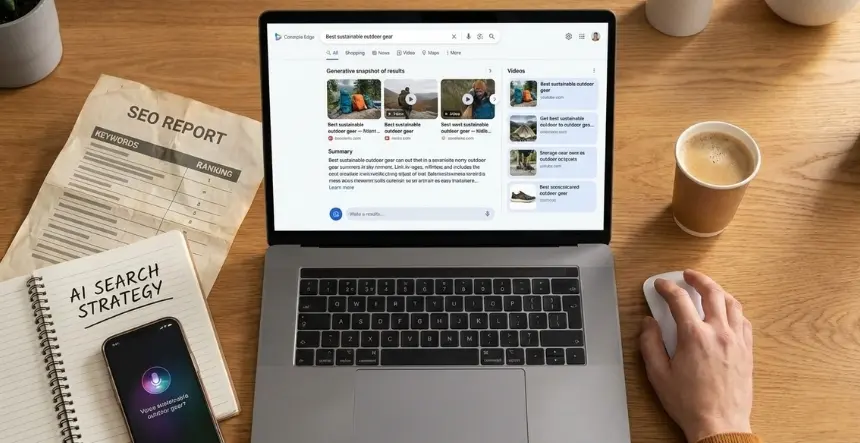
In the past, being listed at #1 on Google meant a website received a large amount of traffic; however, with the advent of AI-based search engines, users now get direct answers, resulting in a 25% to 40% decrease in organic clicks across all industries. Search Results in the form of Google AI Overview appear to account for approximately 15% – 20% of all search queries, and they deliver a synthesised answer rather than a list of links to various websites.
Although traditional SEO continues to provide rankings, it also requires being selected as an online resource to achieve high rankings in AI-based searches. Using data for both 2025 and 2026, this 1500+ word resource explains the new digital marketing landscape and provides proven AIO (AI Optimisation) strategies to help regain lost visibility.
What Is AI Search (And Why It’s Rewriting the Rules)?
AI search generates conversational answers from trusted sources, bypassing traditional SERPs.
AI search uses large language models (LLMs) to interpret complex queries, fetch real-time data, and craft responses that resolve user needs instantly. Unlike keyword-driven results, it models intent, context, and entities for precise, multi-faceted replies.
From Blue Links to AI Answers
Search began with blue links from the 1990s matching exact terms. Google’s 2013 Hummingbird update introduced semantic understanding, which evolved into BERT (2019) for natural language processing. By 2025, AI Overviews (launched 2024) synthesise answers atop 15%+ of desktop searches, while Bing Copilot, ChatGPT Search, and Perplexity pull from web indexes dynamically.
Real-world example: Searching the term “best way to optimise for AI search” yields a bulleted summary, rather than 10 links, from which the audience can extract relevant information, ultimately creating a 30% CTR decrease for positions #1 on AI-heavy SERPs.
How AI Search Engines Decide What to Show
AI will determine the intended meaning of content via entity recognition (linking “WordPress” to CMS data), intent modelling (inferring a user’s intention as either information-seeking or transactional), and by evaluating a page’s trustworthiness. In making these evaluations, AI takes into account several factors, including:
Freshness: Pages updated within the past six months receive preference in the rankings.
Clarity: Pages that are well-structured, with concise paragraphs and information that is easy to extract (through lists or tables), will be ranked higher than those that are not structured clearly.
Authority: Signals of E-E-A-T (which stands for expertise, authority, and trust) (such as author bylines and citations) play an important role in determining the relative authority of any page on a topic.
Perplexity uses a model that rewards pages that provide clear evidence of expertise over pages that provide generic lists of sources, to provide users with results that feel very much as though human curation was involved in generating the response.
Why Traditional SEO Alone Is No Longer Enough
High rankings ≠ AI citations; zero-click dominance hides even top content.
SEO optimised for crawlers and users, but AI extracts snippets without clicks, rendering 65%+ of searches zero-click on mobile.
The Decline of Click-Through Rates
Google reports AI Overviews in 1.3 billion monthly US queries, with 30% fewer clicks to underlying sites. SEMrush data shows position #1 CTR dropped 18% YoY in 2025 for informational queries. Businesses with strong SEO lose 20-50% traffic if unoptimized for extraction.
SEO Without Context Loses Visibility
Keyword-stuffed 500-word posts are deprioritised by AI due to AI algorithms scanning for complete coverage of an Author’s Intent (AI). Thin/overview-style content (e.g. “10 ways to Optimize Your Content for SEO”) will be defeated by a 2000-word Guide/Resource that has thorough explanations, real-world examples, supporting and opposing points. To identify gaps that the SEO industry has created, look at the Top Articles in your market. You’ll find that these Top Articles don’t include the basic AIO’s best practices, such as the correct Schema for each Entity involved.
How AI Search Actually Discovers and Selects Websites
AI rewards scannable, entity-rich, authoritative content via advanced crawling. LLMs like those in Google Search use multimodal indexes that blend text, schema, and visuals.
Content Structure Matters More Than Ever
AI parses H1-H4 hierarchies, TL;DR blocks, numbered lists, and FAQs effortlessly. Studies show that structured pages appear in AI answers 3.5x more often. Use short paragraphs (3-4 lines), bold key phrases, and tables—formats that convert to clean summaries.
Example structure:
**TL;DR:** [1-sentence summary]
– Bullet 1: Key fact
– Bullet 2: Actionable step
E-E-A-T Is Now a Ranking AND Selection Factor
In Google’s 2024 E-E-A-T Guidelines for AI, experience is demonstrated through the use of case studies, expertise through bylines (e.g., “I am SEO Specialist with over ten years’ experience”), authority through citations/backlinks, and trust through sources. Pages written by a named author will see a two-times increase in citations.
Entities Rather Than Just Keywords
AI creates knowledge graphs for entities (e.g., “KrishaWeb,” a Gujarat agency). You can optimise your website using schema markup (a FAQ, HowTo, Organisation), topical clusters, and internal links. Optimising your website with these tools increases the likelihood that co-occurrence between entities will appear in AI’s responses by 40%.
SEO vs AI Search Optimisation (AIO): What’s the Difference?
TL;DR: SEO ranks links; AIO gets you quoted in answers.
Aspect
Traditional SEO
AI Optimisation (AIO)
Primary Goals
SERP positions 1-3
Snippet inclusion in AI summaries
Key Signals
Backlinks, keywords, page speed
Structured data, E-E-A-T, question-answering
Content Focus
Density, LSI terms
Conversational depth, TL;DRs, entities
Success Metrics
Impressions, CTR, rankings
AI mentions, zero-click traffic, branded queries
Tools
Ahrefs, Semrush
Perplexity audits, Frase, SurferSEO AIO modules
Timeline
3-6 months for ranks
1-3 months for citations
SEO foundations remain; AIO layer on for the AI era.
Key Website Optimisation Strategies for AI Search Visibility
Prioritise questions, structure, and proof.
Optimise for Questions, Not Just Keywords
Target Long-Tail Conversational Queries like “How Long For AI Overviews to Rank?” or “Best AIO tools in 2026”. Use Natural Phrasing (as Seen on Your H2s and H3s). Tools Like Answer The Public Show You 100 or More Variations Per Subject.
Build Answer-First Content Blocks
Craft self-contained sections:
Definition Boxes: “AI Search: LLMs delivering synthesized answers from web sources.”
Step-by-Step: Numbered processes with screenshots.
Pros/Cons Tables: For comparisons.
These are extracted directly into responses.
Boost Trust Signals Throughout Your Site
Author bio: “Written by [Name], the Content Manager for KrishaWeb with over 500 optimised articles.”
Case study: “AIO increased AI citations for a client by 300 %.”
Citations: Inline links to authoritative studies.gov.
Schema: Add article, FAQ page schema for rich snippets.
What Businesses Risk If They Ignore AI Search
Businesses that do not adopt AI Search risk becoming invisible in a world where relevance is defined by AI. An SEO-only website will disappear from the top of search results, costing it 40% of its potential traffic and making the brand “unrecognisable” compared to its competitors (70% of Gen Z users). Competitors leveraging KrishaWeb or other providers will capture the voice or AI-driven traffic of early adopters.
How to Start Optimising Your Website for AI Search Today
Audit, update, track—start small.
Audit Your Content for AI Readiness
Query your top pages in Perplexity/ChatGPT: Does it cite you accurately? Score E-E-A-T on a 1-10 scale.
Update Existing High-Performing Pages First
Prioritise top 10 organic pages: Add 200-300 words of depth, FAQs (5+ questions), TL;DRs. Refresh data to 2026 stats.
Track New Success Metrics
Use Google Search Console for impressions, Ahrefs for AI mentions, and custom alerts for “site:yourdomain” in AI tools.
The Future of Website Discovery in an AI-First World
Sites evolve from destinations to cited authorities.
Search turns assistive: Users converse with AI for decisions, referencing expert sites. Winners build utility-first ecosystems—think topical hubs over single pages. Adaptability trumps tactics as models improve.
Conclusion: SEO Isn’t Dead—But It’s No Longer Enough
As AI continues to develop and grow, how people discover information has shifted from a ranking-based system (page 1 vs. page 15) to directly answering questions through AI responses. For this reason, businesses that rely solely on traditional SEO will begin to lose significant website traffic and will continue to see their “keyword ranking” increase over time, while the number of actual visitors to their websites decreases. The best way to capture traffic is to create an Environment where you can provide structured content for AI they can trust, and to continue using your content when they answer similar Search Queries.
KrishaWeb’s AI Search & AIO Solutions
KrishaWeb helps businesses move beyond classic SEO by combining technical optimisation, entity-building, and content restructuring tailored for AI search. The team focuses on E-E-A-T-driven content, answer-first layouts (TL;DRs, FAQs, comparison tables), and schema implementation to make your pages easier for AI systems to parse and cite.
Services include AI Search Readiness Audits, SEO + AIO content strategy, technical enhancements for platforms like WordPress and Webflow, and ongoing monitoring of AI mentions and zero-click performance.
A Digital Marketing Project Manager and Lead, excels as a strategist and Digital Marketing expert. With a focus on driving digital initiatives, Delivers targeted results and effective marketing solutions.




 KrishaLabs
 KrishaStudio
 KrishaStore