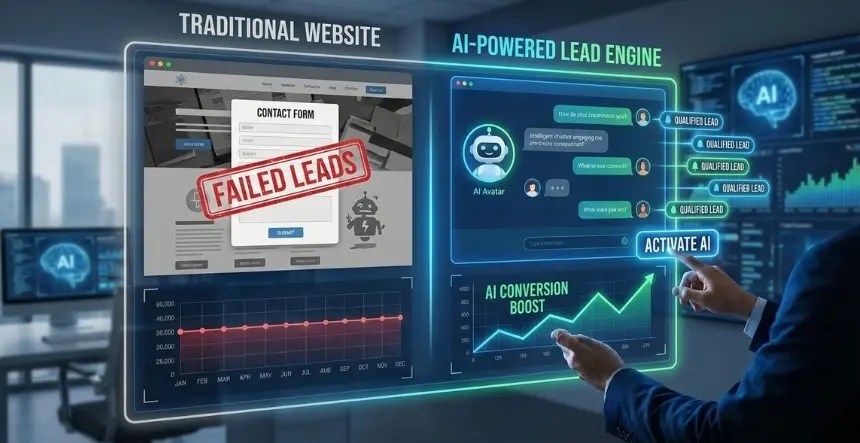
When compared to years prior, businesses are reporting an increase in organic traffic by 20-30% due to AI search features; however, there has been a decline in the volume of lead inquiries by 25% YoY. Now that AI Tools such as Google AI Overviews filter the suggestions they make before the user even clicks, they allow for increased trust and transparency, rather than simply providing exposure. This guide will show you what’s being hidden and give you the necessary steps on turning AI traffic into revenue.
The AI Era Changed How Users Find and Choose Businesses
AI pre-screens websites for users, prioritising trust over rankings.
AI search engines act as gatekeepers, summarising expertise from top sources instead of sending users to every ranked page.
From Search Results to AI Answers
Google AI Overviews appear in 15-20% of queries, while ChatGPT Search, Bing Copilot, and Perplexity deliver instant answers with cited sources. People want clear, concise recommendations from AI. An estimated 48% of users now use AI without even clicking on a link. Given the changes in how people use technology, it is important for websites to be endorsed by AI before decision-makers can find them.
What AI Looks for Before Recommending a Website
Before an AI can recommend a page, there are three major factors to consider: content clarity, the presentation of authority signals, and the demonstration that the page’s intent matches the user’s question (or needs).
The #1 Reason Websites Fail: They’re Built for Traffic, Not Trust
Visibility without credibility kills conversions.
Many websites attempt to achieve success through generic (wording), “top company,” or “top supplier” statements, without verifying their claims with supporting documentation. Visitors to websites that are acquired from AI summary pages anticipate fast proof of value, and those websites that are unable to show their value will have a high bounce rate. The average bounce rate for business websites is 50.59%, which results in losing valuable prospects.
Common Lead-Generation Mistakes Businesses Make in the AI Era
Flaws invisible to owners are glaring to AI and users.
Messaging That’s Vague or AI-Unfriendly
Messaging lacks clarity and is not AI-friendly (examples include the use of buzzwords such as “innovative solutions,” rather than a problem-solution approach, such as “We can Reduce Churn by 40% through our Proven Framework”). The AI engine will overlook any content that isn’t directly solving problems, as compared to other sites/content with unclear messaging.
Poor Content Structure
Long paragraphs combined with no clear call-to-action (CTA) will make it impossible for the AI System to understand this content; therefore, AI prefers the use of (H2/H3 style headings, summary with the abbreviation TL;DR, Numbered Lists, and FAQ’s as these will have 3x the likelihood of being referenced and converting).
Lack of Conversion-Focused UX
Confusing CTAs (“Learn More” vs. “Book Free Audit”), friction-heavy forms (10+ fields), and no intent-based journeys push users away. Mobile friction causes 60% abandonment in multi-step processes.
Why Traditional SEO Alone No Longer Drives Leads
Rankings don’t equal revenue in zero-click search.
CTR for #1 positions fell 32% (28% to 19%) after the AI Overviews rollout. Overall, organic CTR plummeted 61% for AIO queries. SEO-optimised thin content gets traffic but no trust. (Source: Search Engine Journal, dataslayer)
How AI Evaluates Websites for Trust and Authority
AI promotes genuine expertise over optimisation tricks.
E-E-A-T Signals That Matter Today
AI prioritises first-hand experience (case studies with metrics), author credibility (named experts with bios), and real outcomes (“Client X grew revenue 150%”). 52% of AI Overview sources from top 10 results, favoring strong E-E-A-T.
Entity Authority & Topical Authority
Brand identity defines your company. Internal linking between service pages defines the relationships among services, allowing Google to build a knowledge graph of the services. Additionally, creating schema markups (Organisation & Services) links a company’s expertise to user queries.
The Lead Generation Gap: Where Most Websites Break Down
Users know the next step exists—but can’t find it.
Visitors land on service pages expecting guidance, but find vague CTAs, premature sales pitches, or no clear value path. This creates a 70% drop-off between visit and inquiry.
What High-Converting Websites Do Differently in the AI Era
Answer, guide, convert—simultaneously.
Answer-First Content Design
By presenting value propositions first, like “3 Ways we Help You xxx”, we can show a summary overview, a cognitive map of the issues we are trying to assist the user with, which provides for a warming lead concept and also provides AI and Human users with the information they need to take action.
Trust-Building UX Elements
Establishing social proof through client logos and testimonials that corroborate results, and earning certification as a Google Partner, creates a streamlined, credible approach to earning your prospects’ trust.
AI + Human-Friendly Conversion Paths
Providing relevant CTAs (Call to Action), such as Download Audit Checklists, educational lead magnets such as Free SEO Teardowns, or Consultation Flow Guides, establishes buyer readiness and improves performance on websites that rely on Artificial Intelligence for lead generation by as much as 60%.
Conclusion: Stop Chasing Traffic—Start Building Trust
AI search has shown how big a gap there is between visibility and value. This gap shows the staggering amount of “zero” click rates that are approaching 70%. In a world where websites generate leads instead of chasing after traffic, every page on a business website should be treated as if the visitor were getting an expert consultation, with clear and concise answers, proven expertise, and an easy path forward.
KrishaWeb’s Lead Generation Solutions for the AI Era
KrishaWeb transforms traffic into revenue through AI-optimised websites built for trust and conversion. Services include:
Free Website Lead Audit: Analyse content gaps, UX friction, and AI readiness
AIO + Conversion Optimisation: Restructure for citations while improving CTAs
Platform Expertise: WordPress/Webflow sites with conversion-focused architecture
Trust Amplification: E-E-A-T content, case studies, schema implementation
Traffic without trust signals (proof, clear CTAs, expertise) creates bounce rates over 80%. AI sends qualified visitors expecting instant value—generic sites fail this test.
Does AI search reduce website conversions?
Yes, zero-click summaries cut visits by 30%, but AI-optimised sites gain authority and qualified traffic.
What role does content play in lead generation today?
Content builds trust pre-conversion. Answer-first hubs with E-E-A-T convert 4x better than sales pages.
How do I make my website AI-friendly?
Add TL;DR summaries, structured FAQs, schema markup, and expert bylines. Test by querying your pages in Perplexity—aim for accurate citations.
Is a website redesign necessary in the AI era?
Full redesigns help, but 80% of gains come from content restructuring and UX fixes. Start with high-traffic pages first.
Neeta Solanki
Project Manager
A Digital Marketing Project Manager and Lead, excels as a strategist and Digital Marketing expert. With a focus on driving digital initiatives, Delivers targeted results and effective marketing solutions.




 KrishaLabs
 KrishaStudio
 KrishaStore