This post is part of our WordPress 7.0 coverage. For the full feature breakdown, including real-time collaboration, DataViews, new blocks, and the developer upgrade checklist, read our complete guide: WordPress 7.0: Everything Developers and Site Owners Need to Know.
Every WordPress plugin that has ever tried to integrate AI has had to build the same things from scratch. Authentication to an AI provider. A way to format prompts. Logic to parse the response. Error handling. A settings screen for the API key. Then another plugin does it all again, slightly differently, and the result is a fragmented ecosystem where AI capabilities are locked inside individual plugins and nothing talks to anything else.
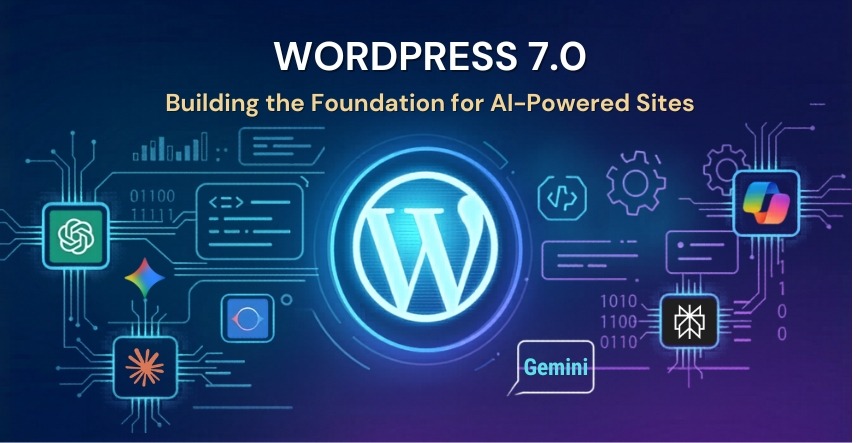
WordPress 7.0, released on April 9, 2026, changes the game at the infrastructure level. For the first time, Core ships with three components that together create a shared foundation for AI across the entire WordPress ecosystem: the WP AI Client, the Abilities API, and the MCP Adapter. None of these is an AI feature in the consumer sense. There is no writing assistant bundled in, no content generator turned on by default. What plumbing enables AI features at scale without every developer rebuilding the same integrations independently?
At KrishaWeb, we have been building on WordPress for 17 years and have closely tracked the 7.0 development cycle through its beta and RC phases. This is our take on what the AI infrastructure actually does, why the architectural decisions behind it are sound, and what developers and site owners can build on top of it now.
Important distinction: WordPress 7.0 does not add an AI writer or content generator to your site. No AI calls are made without explicit configuration. What ships is developer infrastructure—the layer that makes governed, composable AI features possible across the ecosystem.
The Problem WordPress 7.0 AI Infrastructure Actually Solves
Before 7.0, if you wanted to add AI capabilities to a WordPress site, you had two paths. You could install a plugin that bundled its AI integration—its own API key management, its own provider lock-in, its own UI—or you could build a custom integration from scratch. Either way, you were starting from scratch on the infrastructure layer each time.
The result across the WordPress ecosystem was predictable. Dozens of plugins manage AI provider credentials independently, with no shared security model, no way for plugins to share AI connections, and no standard for what an AI-capable WordPress site looks like. Plugin A is integrated with OpenAI. Plugin B is integrated with Google AI. Neither knew the other existed. Site owners managed API keys in multiple places. Developers duplicated authentication logic across codebases.
WordPress 7.0 solves these issues by treating AI infrastructure the same way WordPress has always handled other platform-level concerns: by building a standard interface into Core that the entire ecosystem can build on.
The WP AI Client: One Interface for Every AI Provider
The WP AI Client is the centerpiece of WordPress 7.0 AI infrastructure. It is a provider-agnostic PHP API, merged into Core after Felix Arntz proposed it in February 2026, that gives plugins a single, consistent way to send prompts to AI models and handle responses.
The key design decision is that WordPress Core ships zero AI providers by default. OpenAI, Google AI, and Anthropic are available as separate provider plugins. The client provides the interface; the providers supply the implementation. This keeps Core lean and the ecosystem open.
How it works for developers
The entry point is the wp_ai_client_prompt() function, which returns a WP_AI_Client_Prompt_Builder instance. This builder uses snake_case methods, returns WP_Error objects on failure (standard WordPress conventions), and integrates with the Connectors API for credential management. A basic prompt looks like this:
$prompt = wp_ai_client_prompt();
$prompt->with_text( ‘Write a 50-word meta description for this post: ‘ . $post_content );
$response = $prompt->send();
if ( is_wp_error( $response ) ) {
// handle the error
}
$text = $response->get_text();
The same code works regardless of which AI provider the site administrator has configured. Your plugin does not care whether the site is using OpenAI, Anthropic, or Gemini. It sends the prompt through the shared interface and receives a standardized response.
There is also a JavaScript API available via the wp-ai-client package for client-side use cases. The official Make WordPress dev note is direct about its current limitations: it requires administrator-level capability checks to prevent untrusted users from sending arbitrary prompts to configured providers. For distributed plugins, the recommended approach is to build individual REST API endpoints for each specific AI feature, with granular permission checks, and have JavaScript call those endpoints. The JavaScript API is still being evaluated for scalability.
The Connectors API and Settings screen
API key management is handled through the Connectors API. Provider plugins that register with the PHP AI Client’s provider registry get automatic integration with the Settings screen. Site administrators manage all AI provider connections in one place: Settings, then Connectors in wp-admin. Configure OpenAI once, and every compatible plugin on the site can use that connection without additional setup.
This single change eliminates one of the most common sources of plugin friction for site owners: managing AI credentials in five different plugin settings panels, each with its own interface and storage approach.
WordPress 7.1, scheduled for August 2026, will open the Connectors page to third-party providers beyond the default three. If you are building a connector plugin for a specialized AI model, the time to start is now.
The Abilities API: Teaching AI What Your Site Can Do
The Abilities API was introduced in WordPress 6.9 as a foundational piece of the AI infrastructure. WordPress 7.0 builds on it, and the two components work together. The AI Client handles how plugins communicate with AI models. The Abilities API handles how AI models and the tools that use them discover what a WordPress site is capable of.
The core concept is straightforward: instead of an AI tool needing custom integration code for every WordPress plugin it wants to work with, each plugin registers its capabilities once through the Abilities API. Those capabilities become discoverable through REST endpoints and through the MCP Adapter.
What a registered ability looks like
When a plugin registers an ability, it declares four things: the specific action it exposes, the inputs that action requires, what it returns, and which permissions are required to execute it. A WooCommerce plugin might register abilities like update_product_stock, get_order_by_id, or apply_bulk_discount.
An AI assistant connecting to that site discovers those abilities automatically through the REST API. It does not need a bespoke WooCommerce integration. It works with what the plugin has declared. The assistant can see what the site can do, confirm it has the right permissions, and execute the action through a standard interface.
Why this matters for the ecosystem
The practical implication is significant. A content automation tool built today that uses the Abilities API will work with any plugin that registers abilities, now or in the future, without requiring plugin-specific integration code for each one. The same automation tool can manage WooCommerce products on one site and an LMS catalog on another, as long as both have registered their capabilities through the Abilities API.
For developers building plugins, registering abilities is the mechanism that makes your plugin’s functionality available to AI assistants, automation tools, and any other system that speaks the protocol. It is worth noting that abilities are marked with meta.mcp.public = true are automatically exposed through the MCP Adapter, which connects directly to external AI tools.
The MCP Adapter: Connecting WordPress to External AI Tools
The Model Context Protocol is an open standard developed by Anthropic for how AI assistants communicate with external tools and services. It defines a common language for capability discovery, permission negotiation, and action execution. The WordPress MCP Adapter implements this protocol for WordPress, exposing registered abilities as tools that any MCP-compatible client can discover and call.
The adapter ships separately from WordPress Core and was available before 7.0, but it becomes substantially more useful with the Abilities API and WP AI Client in place. Once the adapter is connected to a site, tools like Claude, ChatGPT, and Gemini can see what your site can do and trigger actions directly through natural language.
What this enables in practice
The MCP Adapter moves WordPress from a system where AI tools can read your content to a system where AI tools can act on your content in governed, auditable ways. Some practical examples of what this makes possible that would have required significant custom scripting before:
Batch-update the meta descriptions on 300 posts using a single natural language instruction to Claude or ChatGPT
Find all WooCommerce products where the short description is missing and generate descriptions using the registered AI connection
Query order data across a date range, identify the top-performing products, and push a summary to a connected Slack channel
Review all posts published in the last 30 days, flag any that are missing a featured image, and generate alt text for media library items that lack it
Run a content audit across the entire site and surface posts that are significantly below the target word count for their category
Each of these workflows uses the shared infrastructure. The AI assistant uses the Abilities API to discover what the site can do. It uses the MCP Adapter to execute the actions. It uses the WP AI Client if the workflow involves generating content from an AI model. No custom glue code required for each combination.
How the Three Components Work Together
The clearest way to understand the relationship between these three components is to walk through a real workflow end to end.
Step
Component Used
What Happens
1
MCP Adapter
An AI assistant connects to the WordPress site and discovers available abilities through the MCP Adapter
2
Abilities API
The assistant reads the registered abilities: create_post, update_meta, get_posts, update_product_stock, etc.
3
WP AI Client
The assistant sends a prompt through the WP AI Client to generate content for a new product description
4
Connectors API
The WP AI Client uses the API key configured in Settings, Connectors — no per-plugin credentials needed
5
Abilities API
The assistant calls the update_product ability with the generated description as the input parameter
6
REST API
The ability executes, the product is updated, the assistant receives a confirmation response
Every step uses shared infrastructure. Nothing in this workflow is locked inside a single plugin. The workflow is composable, auditable, and extensible. Add a new plugin that registers its own abilities, and the same assistant can incorporate it into the workflow without any additional integration work.
What WordPress 7.0 AI Infrastructure Is Not
It is worth being direct about this because the gap between what is actually shipping and how it gets covered in the press creates confusion that leads to bad technical decisions.
It is not an AI writer. No content is generated automatically. No AI is active on your site unless you install a provider plugin, configure an API key in Settings, Connectors, and build or install a feature that calls wp_ai_client_prompt().
It is not a chatbot. The WP AI Client is a PHP API for developers’ use. It does not add a chat interface to your site.
It is not vendor lock-in. The entire design is explicitly provider-agnostic. You choose OpenAI, Anthropic, Gemini, or any future provider plugin. Nothing in Core requires a specific AI provider.
It does not send data to AI providers automatically. No data leaves your server for an AI provider without explicit code requesting it. The official Make WordPress documentation is specific on this point.
It is not finished. The JavaScript API is still being evaluated. The Connectors page expands in 7.1. Advanced connectors filtering is already earmarked for 7.1. What ships in 7.0 is the foundation, not the completed building.
What Developers Can Start Building on WordPress 7.0 AI Infrastructure
With the WP AI Client, Abilities API, and MCP Adapter in place, several categories of WordPress plugins and features become significantly easier to build than they were before.
AI-enhanced editorial workflows
Plugins that assist content teams are the most immediate beneficiary. A plugin that generates SEO meta descriptions for posts using the configured AI provider no longer needs to build its own OpenAI integration. It calls wp_ai_client_prompt(), gets back a response, and lets the site administrator choose the provider through the standard Connectors screen. The same plugin works on sites using OpenAI and sites using Anthropic, without any code changes.
Automated content auditing
The combination of the Abilities API and the MCP Adapter makes it possible to build audit workflows that an AI assistant can execute on demand. Register abilities for reading post metadata, checking image alt text, verifying internal link structures, and surfacing content gaps. An AI assistant connecting through MCP can run a full content audit using natural language instructions, with the results returned in whatever format the assistant’s output requires.
WooCommerce AI integrations
WooCommerce stores benefit directly from the Abilities API. Register abilities for product data retrieval, inventory queries, and bulk attribute updates. An AI assistant connected through the MCP Adapter can analyze product catalog consistency, identify missing descriptions, generate them through the WP AI Client, and push the updates back through the registered abilities. End-to-end, without custom scripting for each step.
Governance-first AI features for enterprise sites
The governance story in WordPress 7.0 AI infrastructure is underappreciated. The Connectors API means a central administrator controls which AI providers are active and which API keys are in use. The Abilities API means capabilities are explicitly registered with permission checks. Nothing happens without authorization. For enterprise sites and agencies managing client sites, this is the architecture that makes AI features trustworthy at scale.
How to Prepare Your WordPress Site for the AI Infrastructure
Whether you are a developer building plugins or a site owner planning to use AI features as they become available, here is the practical checklist.
For developers
Get your PHP version right first. PHP 7.4 is the hard floor for 7.0, and PHP 8.3+ is what you actually want to be running. If your local or staging environment is still on 7.2 or 7.3, sort that before anything else.
Read Felix Arntz’s dev note on the AI Client from March 24, 2026, on Make WordPress Core. Not a summary of it. The actual post. It covers the WP_AI_Client_Prompt_Builder interface, the JavaScript API caveats, and how the Connectors API auto-discovery works. That is the reference you will keep coming back to.
Install the AI Experiments plugin from the plugin directory. It is the canonical testing ground for the AI infrastructure and gives you hands-on exposure to how the WP AI Client and Connectors screen behaves before you start writing code against them.
Build on wp_ai_client_prompt() server-side, not the JavaScript API. The JavaScript wp-ai-client package requires administrator-level capability checks to stop untrusted users from sending arbitrary prompts to your configured provider. For a plugin you are shipping publicly, that is a real problem. Server-side endpoints with your own permission checks are the right pattern right now.
Register abilities for your plugin’s key actions. If you manage posts, register a get_post and update_post_meta ability. If you manage products, register stock and attribute abilities. The registration cost is low, and the payoff is that your plugin’s capabilities become available through the MCP Adapter to any AI assistant connecting to the site, without any additional work from you.
Test against more than one AI provider before you ship. The WP AI Client is provider-agnostic in principle, but provider response formats, latency, and error behavior differ in practice. If you only test against OpenAI and a site is running Anthropic, you will find out about edge cases the hard way.
For site owners
Do not update production directly. Spin up a staging copy, run the update there, check your plugins and theme, specifically anything that touches post list views or the block editor, and only push to production once you have confirmed nothing broke. This applies to every major WordPress release, and 7.0 has more surface area than most.
After updating, go to Settings and find the new Connectors screen. You do not need to configure anything immediately. Just know where it is. Every AI-capable plugin you install from here on will point you there for credentials, so it is worth knowing the interface before you need it.
When you are ready to connect an AI provider, install the provider plugin for whichever service you use (OpenAI, Google AI, and Anthropic are the three shipping with 7.0) and add your API key in the Connectors screen. That one configuration covers every plugin on the site that uses the WP AI Client. You will not be entering API keys in five different plugin settings panels anymore.
Pick one concrete job to start with, not a vague goal like ‘use AI for content.’ Something specific: write meta descriptions for the 40 posts that are missing them, or generate alt text for the images in your media library that have none. Specific workflows are easier to evaluate, easier to govern, and much easier to course-correct if the output is not what you expected.
Check which of your installed plugins have announced 7.0 AI Client compatibility. Plugins that register abilities through the Abilities API unlock a new capability: AI assistants connecting through the MCP Adapter can discover and use those plugin functions directly. If your site runs WooCommerce, check whether the WooCommerce team has published an abilities registration update.
How KrishaWeb Is Already Working with WordPress 7.0 AI Infrastructure
We have been tracking the WordPress 7.0 AI infrastructure since the WP AI Client proposal landed in February 2026, and our WordPress development team attended WordCamp Asia 2026 in Mumbai, where WordPress 7.0 shipped live on Contributor Day.
The AI infrastructure in 7.0 aligns directly with the AI implementation work we do for clients: building governed, provider-agnostic AI workflows that do not create vendor dependency and that site administrators can control through standard WordPress interfaces. The Connectors API, the Abilities API, and the MCP Adapter are the components that make that kind of implementation practical at scale rather than bespoke per project.
AI implementation on WordPress 7.0
We help clients configure and build on the WordPress 7.0 AI infrastructure: selecting the right AI provider for the use case, registering abilities for custom plugin functionality, building governed editorial workflows using the WP AI Client, and connecting WordPress to external AI assistants through the MCP Adapter.
WordPress 7.0 upgrade planning
For teams managing complex WordPress installations, the PHP 7.4 minimum requirement, the DataViews API change, and the classic meta box constraints on collaborative editing all need assessment before updating production. We run pre-update audits that identify exactly what needs attention before the update, not after something breaks.
WordPress 7.0 ships three AI infrastructure components into Core: the WP AI Client (provider-agnostic PHP API for sending prompts), the Abilities API (standard registration of plugin capabilities for AI discovery), and the MCP Adapter (exposing registered abilities to external AI assistants like Claude and ChatGPT).
No AI is active on your site by default. No data goes to any AI provider without explicit configuration and code. Install a provider plugin, add an API key in Settings, Connectors, and build or install a feature that calls the AI Client.
The WP AI Client uses wp_ai_client_prompt() as its entry point, returns WP_Error on failure, and integrates with standard WordPress conventions. The same plugin code works with any configured AI provider.
The Connectors API centralizes AI credential management for all plugins. Configure OpenAI once and every compatible plugin uses it without additional setup.
The Abilities API makes plugin capabilities discoverable through REST endpoints and the MCP Adapter. Any AI assistant that supports MCP can discover what a WordPress site can do and execute registered abilities without plugin-specific integration code.
The JavaScript AI Client API is not recommended for distributed plugins in its current form. Use server-side wp_ai_client_prompt() with individual REST endpoints and granular permission checks for each specific feature.
WordPress 7.1 in August 2026 expands the Connectors page to third-party providers and ships additional connectors infrastructure that did not make the 7.0 window. The foundation is now. The full ecosystem builds on top of it through 2026.
Conclusion
The pattern here is familiar from other platform decisions WordPress has made over the years. The block editor did not remove the ability to write shortcodes; it added a better standard for content structure that the ecosystem could build on. The REST API did not replace the admin interface; it added a standard way for external tools to interact with WordPress data. The WordPress 7.0 AI infrastructure follows the same logic.
The WP AI Client, the Abilities API, and the MCP Adapter do not add AI features to WordPress sites. They add the infrastructure that makes AI features possible without every developer reinventing the same foundation. The fragmented, each-plugin-for-itself approach to AI in WordPress ends here. The shared foundation that replaces it is what WordPress 7.0 actually ships.
For developers, the right move is to start building on this foundation now. Register abilities for your plugin. Use wp_ai_client_prompt() instead of building provider-specific integrations. The sites that are running well-governed, composable AI workflows in 2027 will be those whose developers and agencies began building on the 7.0 infrastructure in 2026.
Frequently Asked Questions
Does WordPress 7.0 add an AI writer to my site?
No. WordPress 7.0 adds AI infrastructure to Core, not AI features for end users. No content is generated automatically. No AI calls are made without an API key configured in Settings, Connectors, and without code (either in a plugin you install or custom code) that calls the WP AI Client. The release is developer infrastructure, not a consumer product feature.
Which AI providers does WordPress 7.0 support?
OpenAI, Google AI, and Anthropic ship as default provider plugins. The Connectors API supports additional providers through third-party provider plugins. The WP AI Client is explicitly provider-agnostic: your plugin code works with any configured provider without changes. WordPress 7.1 will expand the Connectors page to support third-party provider registration more broadly.
Is the WordPress MCP Adapter part of Core?
The MCP Adapter ships separately from WordPress Core. It was available before 7.0 but becomes significantly more useful with the Abilities API and WP AI Client now in Core. You install the MCP Adapter as a separate plugin. Once installed, MCP-compatible AI assistants like Claude, ChatGPT, and Gemini can discover registered abilities and interact with your site through the standard MCP protocol.
What is the difference between the Abilities API and the WP AI Client?
They solve different problems. The Abilities API defines what actions a WordPress site can perform and makes those actions discoverable by external tools and AI assistants. The WP AI Client is how WordPress code sends prompts to AI models and gets responses. You use the Abilities API to expose your plugin’s capabilities to AI tools. You use the WP AI Client inside your plugin to call an AI model and process its output. Most real AI workflows on WordPress will use both.
Should I use the JavaScript AI Client API in my plugin?
Not for distributed plugins at this stage. The official Make WordPress documentation recommends against it for distributed plugins because it requires administrator-level capability checks to prevent untrusted users from sending arbitrary prompts to configured providers. The recommended pattern is to implement server-side REST API endpoints for each specific AI feature your plugin provides, with granular permission checks, and have your JavaScript call those endpoints. The server-side wp_ai_client_prompt() function is the stable, recommended entry point.
How does this affect existing WordPress AI plugins?
Existing AI plugins that built their own integrations will continue to work. Nothing in 7.0 breaks existing AI plugin implementations. Over time, well-maintained plugins will likely migrate to the WP AI Client for the provider-agnostic benefits and the standardized Connectors screen. Plugins that register their capabilities through the Abilities API become accessible to AI assistants via MCP, providing a meaningful distribution advantage. Plugins that do not register abilities remain functional but miss the discoverability that the new infrastructure provides.
Praful Patel
Lead – CMS Development
A Full-Stack Developer and Technical Project Manager with expertise spanning WordPress, WooCommerce, Headless WordPress, Next.js, React, and AI Automation, I deliver end-to-end web solutions that combine technical depth with practical, business-focused thinking.




 KrishaLabs
 KrishaStudio
 KrishaStore