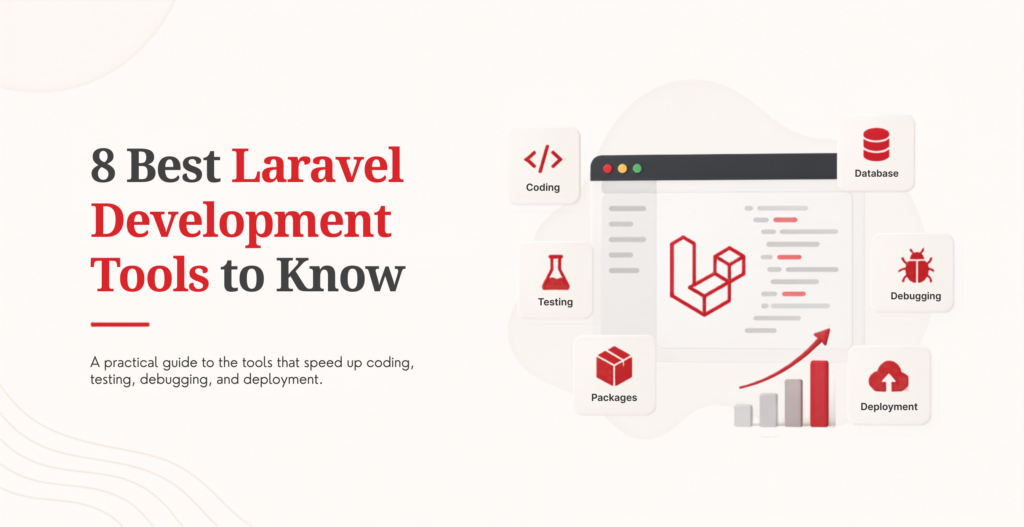
Laravel 13 shipped in March 2026 with PHP 8.3 as the new minimum, and the tooling around the framework has shifted just as much as the framework itself, mainly around how AI now fits into a Laravel workflow. Below are 8 tools worth having in a real Laravel project today, from the IDE you write code in to the AI coding agent reading your schema alongside you. None of these are exotic picks. They’re the tools that show up repeatedly across real Laravel projects once a team moves past the framework’s defaults and starts optimizing for how fast and how safely they can ship.
Below are 8 tools worth having in a real Laravel project
Table Of Contents
Table Of Contents
PHPStorm, With AI Assistant Built In
PHPStorm is still the best IDE choice for Laravel with smart code navigation, quick refactoring and built-in PHP formatting that just works with the conventions of the framework. JetBrains AI Assistant has been added since this list was last written, built right into the IDE, giving inline code suggestions and chat-based debugging help without leaving the editor. It’s a significant upgrade from the plain autocomplete this list used to describe.
Laravel Herd for Local Development
Setting up a local Laravel environment used to mean wrestling with Homestead or a hand-rolled Docker setup. Herd replaced most of that: install it, and PHP, Nginx, and DNS resolution for local .test domains are ready in minutes, with per-project PHP version switching built in. For a team onboarding a new developer, the difference between an afternoon of environment setup and a five-minute Herd install is real, not marginal.
Laravel Boost for AI Coding Agents That Know Your Codebase
Boost is a Composer package that gives AI coding assistants, Cursor, Claude Code, GitHub Copilot, direct access to your actual database schema, Tinker execution for instant validation, and version-aware documentation search across your installed Laravel packages, instead of having the AI guess at your conventions. It’s official, documented Laravel tooling now, not a side project. We cover what it does in full detail, including installation commands and how it pairs with the separate Laravel AI SDK, in our dedicated post on Laravel Boost and the Laravel AI SDK. On the builds we’ve run through it, the real time savings come from the agent reading real schema and conventions before suggesting anything, not from raw code generation speed.
Boost installs as a dev dependency through Composer, then runs an interactive setup that detects your IDE and publishes the right AI guideline files, Cursor rules, Claude.md, GitHub Copilot instructions, automatically. It’s free and open source, so the only ongoing cost is whatever your AI coding assistant already charges.
Laravel Pint for Automatic Code Style
Pint ships with Laravel and enforces consistent code formatting automatically, based on PHP-CS-Fixer under the hood, without a team needing to agree on a style guide manually or argue about it in code review. Run it as a pre-commit hook and style debates mostly disappear from pull requests, since the formatting is already decided before a human reviewer ever looks at the diff.
Telescope gives a detailed, real-time view of requests, queries, jobs, and exceptions through a dedicated dashboard at /telescope, useful for digging into what happened during a specific request. Debugbar is lighter weight, showing query counts and timing directly in the browser as you work. Most teams keep both installed in development: Debugbar for the quick glance while building a feature, Telescope for the deeper dive when something needs real investigation.
Neither belongs in a production environment without careful access control, since both expose real query and request data. Most teams gate them behind an environment check or a specific user permission before deploying, rather than disabling them entirely and losing that visibility when it matters most, during an actual production incident.
Laravel Pulse for Real-Time Performance Monitoring
Pulse is Laravel’s first-party application performance dashboard, tracking slow queries, job throughput, exception rates, and server load in production, without the setup overhead of a third-party APM tool. For teams that don’t need the full feature set of an enterprise monitoring platform, Pulse now covers most of what used to require a separate paid service.
It also supports custom recorders and cards, so a team can track application-specific metrics, active users on a given feature, queue depth for a specific job type, alongside the built-in ones, without needing to build a separate internal dashboard from scratch just to see numbers that matter to that particular product.
Laravel Forge and Vapor for Deployment
Forge remains the standard choice for automated server provisioning and deployment: SSL certificates, database backups, and zero-downtime deploys without hand-configuring a server from scratch. Vapor is the serverless alternative, built for teams that want Laravel running on AWS Lambda without managing servers at all. Which one fits depends mainly on traffic pattern: Forge for steady, predictable load, Vapor for workloads that spike hard and unpredictably.
Cost is the other real difference. Forge charges a flat monthly fee regardless of traffic, which is predictable for budgeting but can mean paying for server capacity that sits idle most of the time. Vapor bills based on actual usage, which suits a spiky workload well but can surprise a team that hasn’t modeled out what a traffic spike costs on a pay-per-use model.
Laravel Socialite for Social Authentication
Socialite still handles OAuth authentication against Google, Facebook, GitHub, LinkedIn, and similar providers through one consistent, expressive interface, saving a team from writing the same boilerplate OAuth flow for every provider a project needs to support. It’s a smaller tool than the others on this list, but it remains one of the fastest ways to cut real development time on any project that needs social login, often saving a full day of integration work per provider.
Building the Right Laravel Toolkit
None of these tools substitute for a well-planned build. They speed up a project that’s already scoped correctly and add little to one that isn’t. A strong toolchain layered on top of an unclear scope just means shipping the wrong thing faster. If you’re weighing what a Laravel project should cost before picking tools, our Laravel development cost guideand our roundup of real use cases for custom Laravel development are both good starting points.
Ready to scope a Laravel project with the right tools from day one? Hire a dedicated Laravel developer through KrishaWeb, or contact us to talk through what your specific build needs.
Frequently Asked Questions
Do I need Laravel 13 to use these tools?
Most of them work on Laravel 12 as well. Laravel Boost, Herd, Pint, Pulse, Telescope, Forge, and Socialite all support Laravel 12. The Laravel AI SDK specifically requires Laravel 13, since it needs PHP 8.3 as a minimum, but that’s a separate tool from Boost, which works on either version. Laravel 12 keeps receiving bug fixes for a while longer, so there’s no need to rush an upgrade just to use most of this list.
Is Laravel Herd better than Laravel Sail or Homestead?
For local development specifically, most teams find Herd faster to set up and lighter to run day to day, since it doesn’t require Docker. Sail remains a solid choice for teams that want their local environment to mirror a Docker-based production setup exactly. Homestead has largely fallen out of common use in favor of one of the other two.
Should every Laravel project use an AI coding assistant?
Not necessarily by default, but there’s little downside to trying one on a project with an existing, well-structured codebase. Tools like Boost work best when there’s real schema and real conventions for the AI to read, so the benefit scales with how established the codebase already is.
What’s the difference between Laravel Forge and Laravel Vapor?
Forge manages traditional servers you provision on a cloud host, giving you full control over the environment. Vapor runs your application serverlessly on AWS Lambda, scaling automatically with traffic and charging based on usage rather than a fixed server cost. Forge suits steady, predictable traffic; Vapor suits workloads with sharp, unpredictable spikes.
Do I still need a third-party monitoring tool if I’m using Laravel Pulse?
For many small to mid-sized applications, Pulse alone covers what’s needed: slow queries, exceptions, and job throughput in one dashboard. Larger applications with more complex infrastructure or compliance requirements may still want a dedicated APM tool with deeper alerting and historical analysis than Pulse currently provides.
Ready to Scale Your Agency?
Tell us what you are trying to deliver. Schedule a call to talk it through, or contact us with your project.
Lead of the Custom Development team at KrishaWeb, holds AWS certification and excels as a Team Leader. Renowned for his expertise in Laravel and React development. With expertise in cloud solutions, he leads with innovation and technical excellence.




 KrishaLabs
 KrishaStudio
 KrishaStore