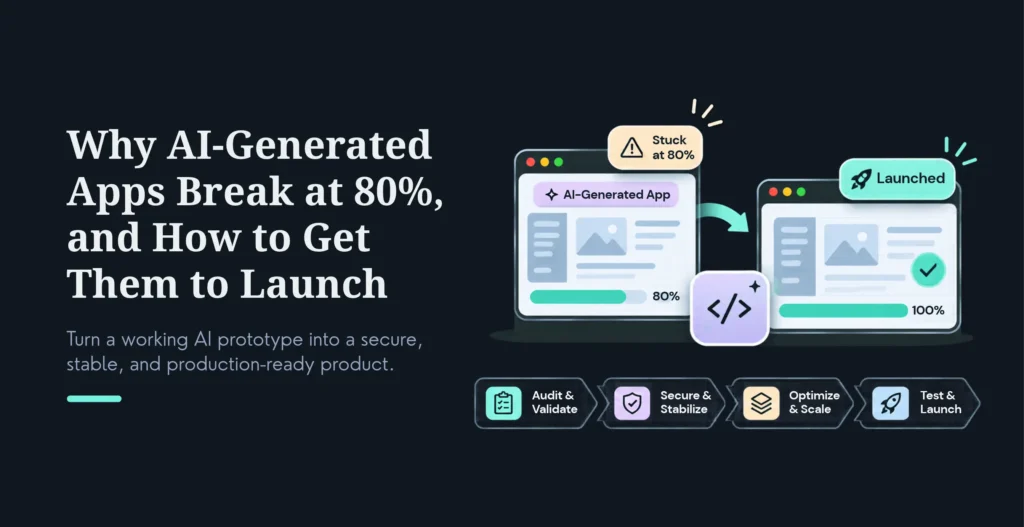
AI coding tools are genuinely miraculous at getting you most of the way to a working app, and genuinely unreliable at the part that matters most: the last stretch before real users arrive. You’ve probably lived it. The app demos perfectly, you start to extend it or hand it to users, and suddenly auth throws 500s, the deploy won’t go through, a change in one place breaks something unrelated, and another prompt only makes it worse. That’s the 80% wall, and it’s not bad luck. It’s structural, and it’s fixable.
AI-generated apps break at this point because the tools optimize for a demo that works on screen, not for real users, real data, and a second developer, so they produce the visible 70-80% (the UI, the happy path) and skip the invisible 20-30% that actually makes software safe to ship (security, data isolation, tests, and a real deployment pipeline). The evidence points the same way: one 2026 audit by Pagepro of 27 AI-generated Next.js apps built with v0, Cursor, and Bolt found 61% had exposed security vulnerabilities, 43% had duplicate logic, and 80% had broken deployment pipelines (a small sample, published by a firm that sells AI-app takeover work, so read it as an indicator, not a benchmark). The fix is a disciplined rescue, not more prompting: triage (freeze features, confirm it runs, map where money and data flow, scan for exposure), audit (a written, severity-rated findings list and an honest rescue-vs-rebuild verdict), stabilize (fix the data-exposure and breaking issues first), fix (refactor or rebuild the weak parts while keeping what works), and ship (last-mile testing, security, and a real pipeline). As planning ranges, an audit runs a few hundred to a few thousand dollars, a stabilization 2,500–15,000, and a full rescue 15,000–50,000, over days to a couple of months depending on how deep the problems go.
This is the diagnosis-and-rescue playbook for the founder or technical lead staring at an app that’s so close and won’t cross the line: why it breaks at 80%, exactly what breaks (including the load and scaling failures that only show up with traffic), the rescue path, the rescue-vs-rebuild call, real costs, and the launch checklist. Getting stuck here is one of the most common, and most fixable, ways AI builds fail. It’s the work our AI build rescue service does, and if your app has fully stopped working rather than stalled near the finish, our companion guide on what to do when a vibe-coded app stops working covers that scenario in depth.
Key Highlights
The 80% wall is structural, not bad luck. AI tools optimize for a working demo, so they nail the visible UI and happy path and skip the invisible last stretch: security, data isolation, tests, and deployment, the exact things production demands.
The audit data points the same way. Of 27 AI-generated Next.js apps (v0/Cursor/Bolt) audited by Pagepro, 61% had exposed security vulnerabilities, 43% had duplicate logic, and 80% had broken deployment pipelines. It is a small, vendor-published sample.
The fix is a rescue, not more prompting. Triage → audit → stabilize → fix → ship, in that order. Freeze features first; another broad prompt on a broken build makes diagnosis harder.
Rescue vs rebuild, the rule: if the core data model is sound and the product is validated, rescue; if the data structure is wrong or every change breaks something unrelated, rebuild. Audit first, decide second.
Fix the code before scaling the infrastructure. Autoscaling an app with in-memory state and local file storage just multiplies the breakage. Remove the single-instance assumptions first, then scale.
Cost (vendor-reported ranges): audit a few hundred to a few thousand; stabilization 2,500–15,000; full rescue 15,000–50,000; rebuild from ~$25,000. Get a scoped audit before committing to either path.
Table Of Contents
Table Of Contents
Why AI-Generated Apps Breaks at 80%
The 80% figure isn’t arbitrary, it’s the line where a demo meets reality. AI tools are optimized to produce something that looks and works correctly on screen, which gets you the interface, the navigation, and the happy-path flow fast, roughly the first 70-80% of the visible app. What they don’t reliably produce is the remaining, invisible 20-30%: real authentication that can’t be bypassed, data isolation so one user can’t read another’s records, tests that catch regressions, error handling and monitoring, and a deployment pipeline you can actually roll back. As one team that audits these apps put it, the tools get you most of the way to a working application very quickly, but the last stretch, security, architecture, testing, and reliable deployment, is what makes software safe for real users, and that’s the part AI rarely solves. So the app works right up until it has to survive real users, real data, and a second developer trying to change it, and then it doesn’t.
The data points the same way, with some honest limits. In Pagepro’s 2026 audit of 27 AI-generated Next.js apps, every one built by a real team using v0, Cursor, or Bolt, 61% had exposed security vulnerabilities, 43% had duplicate logic, and 80% had broken deployment pipelines. That sample is small and comes from a firm that sells takeover and rescue work, so the broader research matters more: Veracode’s 2026 report found about 44% of code-generation tasks introduced a known vulnerability, IOActive’s testing found 31.6% of samples fully exploitable, and Carnegie Mellon’s SusVibes benchmark of agent-written code on realistic tasks found only around a tenth of solutions both working and secure (about 10.5% in the preprint and 11.8% in the published version). Those studies tested models and agents without human review, so they measure how often code is generated with flaws, not how often flaws reach production. The deeper reason behind all of it is comprehension: the code was generated, not written, so nobody fully understands it, which is why every new fix tends to break something else and why another broad prompt rarely helps. The real problem at 80% isn’t that the code is hopeless. It’s that the load-bearing parts were never built, and nobody can see where.
What Actually Breaks
The failures cluster into a predictable set, which is what makes a systematic rescue possible. Authentication is first and worst: AI frequently generates client-side-only checks that a user can bypass, session handling that drops, and auth flows that throw 500s under real conditions, and when a custom domain gets added, hardcoded OAuth redirect URIs break. Secrets and API keys are routinely exposed, committed to the repo or shipped in the frontend bundle where anyone can read them, compounded by environment-variable mismatches (it works in dev because dev has the key; production doesn’t). Database access rules are the quiet catastrophe: on Supabase-backed apps especially, Row Level Security is often left off, so anyone with the app’s public key can read or delete other users’ data without hacking anything. Payments tend to be half-finished, a Stripe integration whose webhook is never verified or whose full lifecycle was never tested, so orders silently fail or get marked paid when they weren’t. And deployment is broken in most of these apps: no repeatable pipeline, no staging environment, and no rollback, so releases depend on one person’s laptop or a hosted builder’s defaults, and a bad deploy means live debugging instead of a clean revert.
Then there’s the category that doesn’t show up until traffic arrives, and that the 80% demo never exercises: load and scale. These are the failures that turn a working launch into an outage. SQLite left in production hangs under concurrent writes and throws “database locked” errors, the fix is migrating to Postgres. N+1 queries can make a dashboard that loads in 200ms with ten rows take, for example, twelve seconds with a thousand, the fix is eager loading and proper joins. Ephemeral file storage means uploaded files vanish after the next redeploy, they belong in S3 or Cloudflare R2. In-memory state (sessions, caches held in a single process) breaks the moment you run more than one instance, it has to move to a shared store like Redis. And synchronous AI calls with no timeout turn a provider slowdown into a full outage, they belong in a background queue with concurrency limits and a circuit breaker. These load failures are the reason “it worked when I tested it” and “it fell over on launch day” are both true, and they’re why the rescue has to address architecture, not just bugs.
The Rescue Path
The fix is a disciplined sequence, and the order matters because each step makes the next one safe. (This is the same core process as our deeper rescue guide, summarized here with the 80%-specific emphasis.) Triage first, and freeze features, stop adding AI-generated code to a broken build, because more prompting makes both the app and the diagnosis worse. Then do the immediate, non-destructive things: confirm the app still runs reproducibly from a clean checkout, map the blast radius (what’s in production, where money and personal data flow), run a security quick-scan, rotate every key and password, check that a database backup can actually be restored, move every account (repo, hosting, domain, API providers) into your company’s ownership, set spending limits, switch on basic error monitoring, and write down your five most critical user journeys. Leave refactoring until after the audit. Audit second: get a written, severity-rated findings list against the dozen things that break in AI apps (auth, authorization, secrets, validation, database rules, queries, payments, backups, logging, dependencies, deployment, privacy) and, crucially, an honest rescue-vs-rebuild verdict. This is a defined deliverable, not a vibe, and it’s what prevents both wasted rebuilds and doomed patches.
Stabilize third: fix the data-exposure and breaking issues before anything else, move secrets out of code and rotate exposed keys, close the access-control gaps, and add tests around money and permissions specifically, so the next AI-generated edit can’t silently undo a security fix. Our AI code security audit covers the security review. Fix fourth: refactor or rebuild the genuinely weak parts while keeping what works, remove the duplicated logic, give the code a structure a second developer can follow, and build the missing deployment pipeline with staging and a rollback path. If the code needs structural cleanup, see our restructure AI codeservice. Ship last: complete the last mile of testing, security, and performance, migrate SQLite to Postgres and fix the N+1 queries if traffic demands it, set up staging, backups, and monitoring, and deploy with clean, documented code you own, then resume building with a developer reviewing every change. For moving an AI-built prototype toward production, see our AI prototype to production service. The through-line: diagnose before you touch anything, fix the irreversible risks (data exposure) first, and don’t ship until the invisible 20% the AI skipped actually exists.
Rescue or Rebuild?
This is the decision the audit exists to answer, and getting it wrong is expensive either way. The rule of thumb is clean: if the core data model is sound and the product is validated, rescue; if the data structure itself is wrong, or every change breaks something unrelated, rebuild, with discipline this time. Rescue is right when the structure is fundamentally sound and the faults fit on a list, isolated problems in access control, validation, or specific features sitting on top of a reasonable foundation. Rebuild is right when the foundation itself is the problem: a tangled data model, auth that can’t be made safe, framework choices that fight you at every turn, or a codebase where fixing one thing reliably breaks two others. A useful middle framing some rescue teams use is keep / harden / rebuild: keep building if the structure is sound and problems are local; harden (secrets and security first, then tests, then pipeline and structure) if the product is right but the foundation isn’t safe to extend; rebuild, using the working app as the spec for a better one, only when fixing would cost more than replacing.
The one discipline that matters most here: audit first, decide second. The rescue-or-rebuild call should come out of a real assessment, not out of frustration at 11pm after the fifth broken fix. If three or more of the warning signs are present (every fix breaks something, nobody understands the code, paying users are affected), that’s a signal to get an audit before spending a dollar on a rewrite, not a signal to start rewriting. The honest version of this advice, which a good partner will give you, is to price both paths in hours, audit plus fix versus full rebuild, and compare, because the right answer depends on three things an audit reveals: how much already works, how tangled the broken parts are with the working parts, and how much of the original design intent can be reconstructed. Rebuilding salvageable code wastes months; patching a broken foundation wastes money. The audit tells you which mistake you’re about to make.
Cost, Timeline, and Getting to Launch
Treat these as vendor-reported planning ranges and scope a real quote. An audit and triage commonly runs a few hundred to a few thousand dollars over 2-5 days and is the right, low-risk first move, it tells you which path you’re on before you spend. A stabilization sprint (priority bug fixes, auth hardening, critical security patches) runs roughly 2,500–15,000 over 1-3 weeks. A full rescue and refactor (architecture cleanup, test coverage, de-risking for scale) runs roughly 15,000–50,000 over 3-8 weeks, and a full rebuild that keeps the core features but replaces the foundation runs from about $25,000, with large apps carrying heavy accumulated debt going considerably higher. At the fast end, some firms offer fixed-fee emergency triage for a single production bug (auth 500s, a silent Stripe webhook, a failing deploy) in 48 hours, and cheap async audits that return a severity-ranked PDF. The cost driver isn’t the app’s size, it’s how far the problems have spread and how tangled they are with the parts that work.
Getting to launch, finally, is a checklist, and the key sequencing rule is: fix the code before you scale the infrastructure, because autoscaling an app with in-memory state and local file storage just multiplies the breakage. So first remove the single-instance assumptions, move sessions and caches to Redis, uploads to S3 or R2, pool your database connections, migrate off SQLite, and fix N+1 queries. Then put the production scaffolding in place: a repeatable CI/CD pipeline that runs tests on every change (including AI-generated ones), a staging environment, backups you’ve actually test-restored, tests covering your five critical journeys plus money and permissions, and monitoring with alerts on error rate, latency, and database saturation. Then, and only then, scale: autoscale across at least two instances in multiple locations, load-test at 3-5x your expected peak (stubbing the LLM provider), test failover, and put caching, rate limits, a spend cap, and a circuit breaker in front of expensive AI calls. Run a dependency audit (npm audit / pip-audit) and fix criticals before anything else. That sequence, fix the foundations, add the scaffolding, then scale, is the difference between a launch that holds and one that becomes an incident.
Because AI tools optimize for a demo that works on screen, not for real users, real data, and a second developer. They reliably produce the visible 70-80%, the UI, navigation, and happy path, and skip the invisible 20-30% that makes software production-safe: real authentication, data isolation, tests, error handling, and a deployable pipeline. An audit of 27 AI-generated Next.js apps by Pagepro (a small, vendor-published sample) found 61% with exposed security vulnerabilities and 80% with broken deployment pipelines. So the app works until it meets reality, then the load-bearing parts that were never built give way.
What actually breaks in an AI-generated app?
A predictable cluster. Authentication (bypassable client-side checks, 500s, broken sessions). Exposed secrets and API keys (committed to the repo or shipped in the frontend). Missing database access rules (Row Level Security left off, so users can read others’ data). Untested payments (unverified Stripe webhooks, placeholder flows). Broken deployment (no repeatable pipeline, no staging, no rollback). And, once traffic arrives, load failures the demo never triggered: SQLite in production, N+1 queries, ephemeral file storage, in-memory state that breaks across instances, and synchronous AI calls with no timeout. The last group is why an app can pass your testing and still fall over on launch day.
How do I fix a broken AI-generated app?
Follow the sequence, don’t just prompt harder. Triage: freeze features, confirm it runs reproducibly, map where money and data flow, run a security scan, rotate keys, verify a backup restores, move all accounts into your ownership, and switch on error monitoring. Audit: get a written, severity-rated findings list and an honest rescue-vs-rebuild verdict. Stabilize: fix data-exposure and breaking issues first, and add tests around money and permissions. Fix: refactor or rebuild the weak parts while keeping what works, and build a real deployment pipeline. Ship: complete last-mile testing and security, then deploy clean, documented, owned code with a developer reviewing every change.
Should I rescue or rebuild?
Rescue if the core data model is sound, the product is validated, and the problems are isolated (access control, validation, specific features on a reasonable foundation). Rebuild if the data structure itself is wrong, every change breaks something unrelated, or the foundation (schema, auth, framework choices) is fundamentally broken. A useful middle option is keep/harden/rebuild. The critical discipline: audit first, decide second, make the call from a real assessment, not from frustration after a bad night of fixes. If several warning signs are present, get an audit before spending anything on a rewrite, and ideally price both paths (audit-plus-fix vs full rebuild) in hours before choosing.
How much does it cost to get a stalled AI app to launch?
Vendor-reported ranges: an audit and triage runs a few hundred to a few thousand dollars (2-5 days); a stabilization sprint 2,500–15,000 (1-3 weeks); a full rescue and refactor 15,000–50,000 (3-8 weeks); a full rebuild from about $25,000, higher for large apps with heavy accumulated debt. Some firms offer fixed-fee emergency triage for a single production bug in 48 hours, and low-cost async audits. The driver isn’t the app’s size, it’s how far the problems have spread and how entangled they are with the working parts, which is exactly what the initial audit measures, so start there before committing to a path.
What’s the single most important thing to fix first?
Data exposure, every time. Broken access control, exposed secrets, and missing database rules are the failures that leak customer data, and a leak is the one problem you can’t undo after launch. So in the stabilize step, authorization, secrets, and database rules come before performance, features, or polish. Right behind it: add tests around money and permissions specifically, so that once you’ve fixed a security gap, the next AI-generated change can’t silently reopen it. Everything else, deployment pipeline, load fixes, the missing 20%, matters, but data exposure is the irreversible risk, so it goes first.
Why does my app work in testing but fall over under real traffic?
Because the load failures are invisible until there’s concurrency. SQLite handles your single-user testing fine and then throws “database locked” errors under real writes. A dashboard query that’s instant with ten rows crawls with a thousand (an N+1 problem). In-memory sessions work on one instance and break the moment you scale to two. Uploaded files survive until the next redeploy wipes ephemeral storage. And a synchronous AI call is fine until the provider slows down and takes your whole app with it. Fixing these, Postgres, proper queries, Redis, S3, background queues, is a core part of getting from a working demo to a launch that holds.
When should I call in an expert versus keep trying myself?
Keep going yourself if it’s one isolated broken feature and you can reproduce, isolate, and test a fix. Call in help when the signs point to a structural problem: every small fix has broken something else for a couple of weeks, nobody fully understands the code, you have paying users affected, or the app stopped holding up the moment real users arrived. Also call when you simply need to know whether the code is worth building on, a paid technical assessment answers that definitively and is cheap relative to rebuilding the wrong thing. The rule of thumb: an hour of debugging with no progress, or three-plus structural warning signs, means it’s time for an audit.
Conclusion
The 80% wall feels like failure, but it’s actually the most normal and most fixable moment in an AI-built project. The tools did exactly what they’re good at, getting you a working-looking app fast, and stopped exactly where they always do, at the invisible work that makes software safe for real users. The audit data, 61% with exposed vulnerabilities and 80% with broken pipelines in one small sample, and the broader research on AI-generated code, isn’t a reason to distrust AI; it’s a map of precisely what you need to add to cross the line.
And the way across is a rescue, not another prompt. Freeze features, triage the irreversible risks, get a real audit with an honest rescue-or-rebuild verdict, fix data exposure first, build the deployment pipeline and tests the AI skipped, fix the load failures before you scale, and ship code you understand and own. Decide rescue versus rebuild from the assessment, not from frustration, and remember that most apps stuck at 80% are genuinely rescuable in weeks, with the rebuild reserved for when the foundation itself is wrong. The product you validated and most of the work are worth saving. You just need to build the last 20% the demo never required, and then you launch.
Stuck at 80% with an app that won’t cross the line?
Explore our AI Build Rescue service to see how we triage, audit, stabilize, and ship stalled AI-generated apps, data exposure fixed first, with an honest rescue-vs-rebuild verdict up front.
Book a consultation and send us the repo, we’ll assess where the last 20% broke and scope the path to launch.
Nirav Panchal
Lead – Custom Development
Lead of the Custom Development team at KrishaWeb, holds AWS certification and excels as a Team Leader. Renowned for his expertise in Laravel and React development. With expertise in cloud solutions, he leads with innovation and technical excellence.




 KrishaStudio
 KrishaStore