Ecommerce referral marketing rewards your existing customers for bringing you new ones. It works because a friend’s recommendation carries more weight than any ad you can buy. In a Journal of Marketing study that tracked about 10,000 bank customers for nearly three years, referred customers were worth at least 16% more than similar customers who arrived another way. They stayed longer, too.
That is the case for referrals. The harder part is running one that does not quietly lose money. This guide covers how a program works, which rewards to offer, how to launch step by step, and the math to check whether it is paying off.
What Is Ecommerce Referral Marketing?
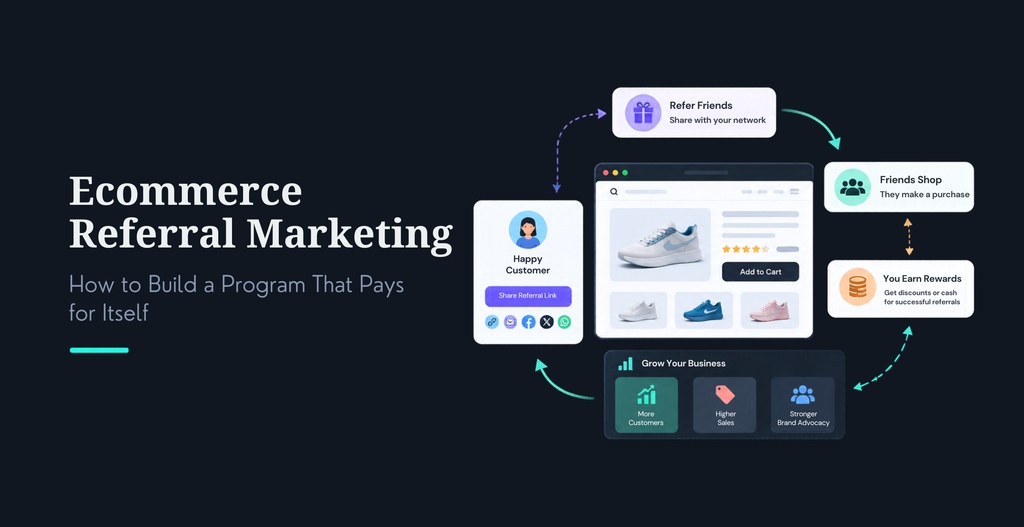
Ecommerce referral marketing is a customer acquisition strategy where an online store rewards existing customers for sending new shoppers to buy. Each customer gets a unique link or code. When a friend uses it and completes a first order, the store pays a reward, usually a discount, store credit, or points, to one or both people.
Picture a skincare brand that emails every buyer a personal link after delivery. The buyer shares it with a coworker. The coworker gets $15 off a first order. The buyer gets $15 in store credit once that order clears the return window. That loop is the whole idea. Everything else in this guide is about making it profitable and hard to abuse.
It differs from plain word of mouth in one way. You add structure and a reward, which means you can track it. Organic sharing still happens. A program just lets you see it, measure it, and repeat it.
How Does an Ecommerce Referral Program Work?
Five things have to happen for a referral to count.
A customer joins the program, usually after a purchase or from their account page.
The store gives them a unique link or code.
They share it by email, text, or social.
A friend clicks, shops, and the system ties the order back to the referrer.
The store checks the order is valid, then pays the reward.
Step four is where most programs break. Tracking relies on cookies, discount codes, or account matching, and each fails in its own way. A code survives when a friend switches from phone to laptop. A link might not. Most stores end up supporting both. A referral app on Shopify or WooCommerce usually handles the plumbing, but you still need to place a real test order before launch.
Why Does Referral Marketing Work for Online Stores?
Start with trust.Nielsen’s 2021 Trust in Advertising study put trust in recommendations from people you know at 88% of global respondents (89% in the U.S.), the top result among the sources it measured. A friend does not sound like an ad, and the shopper knows the friend has no reason to oversell.
The stronger evidence is about money. Schmitt, Skiera, and Van den Bulte (2011) found that referred customers brought higher contribution margins early on, higher retention, and a lifetime value at least 16% above comparable customers. The authors’ managerial summary puts the gap at nearly 25% against the bank’s regular acquisition programs. In the bank they studied, a reward of 25 euros against an average lifetime value difference of 40 euros produced a return of roughly 60% over six years.
One caveat. That study followed customers of a German bank, not an online store. The direction of the finding is useful. The exact numbers will not transfer to your catalog. The authors also found the margin advantage faded over time, while the retention advantage held, and that the gap varied by customer segment. So design matters. (A later paper from the same research group,in the Journal of Marketing Research in 2018, examines how referral programs turn social ties into customer value.)
Ecommerce Referral Marketing vs. Affiliate Marketing
The two get confused constantly. The difference is who does the promoting and how they are paid.
Referral Marketing
Affiliate Marketing
Who promotes
Existing customers
Creators, publishers, and partners
Typical reward
Discount, store credit, points, or a free gift
Cash commission on each sale
Relationship to the brand
Has bought and used the product
Often has never bought; may be paid to promote
Audience
Friends, family, coworkers
Followers, readers, subscribers
Tracking
Unique link or code per customer
Affiliate link with a cookie window and payout rules
Best for
Lower-cost, higher-trust first orders
Reach beyond your current customer base
Disclosure
Disclose the reward when the link is shared publicly
Disclose the commission on every promotion
Many stores run both. A skincare brand might give customers store credit for personal referrals and pay a commission to a skin-care blogger. These are different channels with different math. Mix their budgets and you cannot tell which one is working.
8 Ecommerce Referral Marketing Strategies That Increase Sales
Not every tactic suits every store. These eight are the ones that hold up across catalogs, ordered roughly from easiest to most involved.
1. Reward both sides
A one-sided reward feels like you are paid to pester a friend. A two-sided reward feels like a favor. The referrer is not pushing a sale, they are handing someone a deal. That framing is why two-sided offers dominate the programs that last.
2. Ask at the right moment
The best time is a few days after delivery, when the customer has the product in hand and still feels good about the purchase. A second good moment is right after a five-star review or a support chat that went well. Checkout is too early.
3. Give every customer a personal link or code
Put it on the account page, in the order confirmation, and in the post-delivery email. A personal code is also easier to say out loud, which matters when someone recommends you in person or over a call.
4. Use email and SMS to prompt sharing
Most customers never think about referring unless you ask. A short, well-timed message does more than a banner. Our guide to email marketing best practices covers timing and segmentation that apply directly here.
5. Connect referrals to loyalty
If you already run a points or tier program, let referrals earn points. It gives customers a reason to care about the reward and keeps the whole system in one place. The cost is extra setup, so it suits stores with repeat buyers.
6. Make sharing take one tap
Pre-write the message. Add a product image. Offer buttons for text, email, and the apps your customers use. Every extra step you remove raises the share rate, and the share rate is usually the weakest number in a new program.
7. Run a milestone campaign for launches
Tiered rewards work well before a launch or a restock. A shopper who is two referrals from a free product will push harder than one chasing a flat discount.
8. Test one change at a time
Change the reward size, the timing, or the copy, but not all three at once. Let each test run through a full purchase cycle. Our ecommerce conversion rate optimization tactics cover how to read the results without fooling yourself.
How Do You Create an Ecommerce Referral Program Step by Step?
We use a simple method for this and call it Give-Get-Gate. Give is what the friend receives. Get is what the referrer earns. Gate is the set of rules that keeps the program clean and profitable. Most failed programs got Give and Get right and skipped Gate.
Set one goal. Pick new customers, repeat orders, or a launch audience. A program built for everything is measured against nothing.
Work out what you can afford. Take your average gross profit on a first order. Keep the combined friend and referrer reward below that number. If an order earns $30 in gross profit, a $20 combined reward leaves room for software and fees.
Choose Give and Get. Match the reward to the product and the margin. The next section compares the options.
Write the Gate rules. New customers only. A minimum first-order value. No self-referral by email, address, card, or device. A cap on rewards per customer. Release the reward after the return window closes, so you never pay for an order that comes back.
Set up tracking. Create unique links and codes, then place a test order on desktop, mobile, and guest checkout. Confirm the reward fires only when it should.
Put it where customers will see it. Account page, order confirmation, post-delivery email, and a footer link. A hidden program gets no referrals.
Launch to your best customers first. Start with repeat buyers and reviewers. Fix what breaks, then open it to everyone and review the numbers at 90 days.
What Are the Best Ecommerce Referral Marketing Examples?
Plenty of “best referral program” lists recycle brands that no longer run one. Each store below was checked against its own referral page where one exists. Dropbox and Harry’s are older programs, so those rely on published accounts. Terms change often, so recheck the live page before you copy a number.
Brand
How the Program Works
What a Smaller Store Can Copy
Dropbox
Two-sided: extra storage for the referrer and the friend, placed inside the onboarding flow
Put the ask inside the first-use experience, not on a buried page
Harry’s
Prelaunch milestone campaign with free product at each tier
Tiers make the next reward feel close, which keeps people sharing
Thrive Causemetics
“Give $15, Get $15”: the friend gets $15 off a first order, the referrer earns $15 in points; no cap on referrals
A symmetric reward is easy to explain in one line
Dippin’ Daisy’s
$15 off for both; new customers only; the reward is void if the order is canceled before fulfillment
Plain terms prevent disputes and reduce support tickets
Treluxe
$5 off for both the friend and the referrer
A small reward is a fair place for a small store to start
Frank Body
Referrals live inside its Hotel Pink loyalty dashboard; tiers depend on lifetime spend
Fold referrals into loyalty if you already have repeat buyers
Dropbox is the famous one. According to co-founder Drew Houston’s 2010 Startup Lessons Learned talk, as reported by Viral Loops and Referral Rock, the company grew from about 100,000 registered users in September 2008 to about 4 million by December 2009. That is the 3,900% growth figure you see everywhere, and Houston has
said the program was modeled on PayPal’s. But Dropbox gave away cheap storage. A store that gives away margin cannot copy that part. Copy the placement instead.
Harry’s ran its referral campaign before the razors went on sale, with free product as the prize. Viral Loops reports it collected 100,000 email signups in a week. A prelaunch list is a different animal from a live store, but the lesson carries: show people how close the next reward is.
Which Referral Incentive Should You Offer?
For most stores, a two-sided discount or store credit is the best place to start. It is easy to explain, easy to budget, and it brings the friend back for a second order. Here is how the main options compare.
Incentive
How It Works
Best For
Watch Out For
Two-sided discount
Friend gets money off a first order; referrer gets the same on a later order
Most stores
Shoppers learn to wait for a code
Store credit
Referrer earns credit after the friend’s order clears the return window
Stores that want repeat purchases
Credit is a liability; check local rules on expiry
Cash or gift card
Paid out after a qualifying order
Stores that want repeat purchases
Attracts reward hunters; adds payout admin
Free gift or sample
A product at a set number of referrals
High-margin, high-order-value products
Shipping and stock cost
Points
Referrals earn loyalty points
Stores with a loyalty program
More complex to build and explain
Exclusive access
Early drops, events, or members-only items
Brands with a community
Hard to scale
How big should the reward be? Work backward from margin. If your average first order earns $30 in gross profit, a combined reward of $20 leaves room to break even after software and fees. Test two sizes against each other before you settle. A bigger reward brings more shares, but only up to the point where it eats the profit that justifies the program.
What Are the Best Ecommerce Referral Marketing Tools?
Pick the tool that fits your platform and your next twelve months. Pricing changes often, and some vendors charge a share of referred sales on top of a monthly fee, so confirm current plans on each vendor’s site.
Tool
Best For
Notes
ReferralCandy
Shopify brands that want referrals and affiliates in one place
Shopify-native with Klaviyo support; confirm whether pricing includes a percentage of referred sales
Smile.io
Stores that want loyalty and referrals together
Loyalty-first, with referrals as one module; has a free plan
Friendbuy
Mid-market direct-to-consumer brands that want to run tests
Built for larger, more tuned programs
Viral Loops
Launch and milestone campaigns
Templates for milestone-style programs like the Harry’s approach
Referral System for WooCommerce
WooCommerce stores
Plugin-based, installed inside your own store
Shopify and WooCommerce checks before you install anything
Ask four questions. Does the tool create discount codes your store can validate at checkout? Does it credit referrals from guest checkout? Does it hold rewards until returns and cancellations clear? Does it sync with your email platform? A tool that fails the second one will lose referrals from every shopper who skips account creation. If you need custom checkout logic or account-level tracking, that is where Shopify development services or WooCommerce development services start to matter, because off-the-shelf apps stop at the edge of their settings.
How to Measure Ecommerce Referral Marketing ROI
Clicks on a share button tell you little. Track customers and money. These are the five numbers to watch.
Metric
Formula
Participation rate
Customers who share a link / customers invited to the program
Referral conversion rate
Referred visitors who buy / referred visitors
Cost per referred customer
Total program cost / referred customers
Repeat rate
Referred customers who reorder / referred customers
ROI
(Referral profit – program cost) / program cost x 100
Define referral profit before you calculate. Here it means the gross profit on orders from referred customers. Program cost means every discount, every reward, plus software and setup. Count order value before the friend’s discount, then count the discount as a cost, so you never subtract it twice.
Here is a worked example. Every figure is hypothetical, so swap in your own.
Line
Figure
Referred first orders in 90 days
120
Average order value (before the friend’s discount)
$60
Gross margin
50%
Gross profit on first orders (120 x $60 x 50%)
$3,600
Friend discount (120 x $10)
$1,200
Referrer store credit (120 x $10)
$1,200
Software and setup
$800
Total program cost
$3,200
First-order ROI (($3,600 – $3,200) / $3,200)
12.5%
Repeat orders: 30% of 120 = 36 orders, gross profit at $60 x 50%
$1,080
ROI with repeat orders (($4,680 – $3,200) / $3,200)
46%
Cost per referred customer ($3,200 / 120)
$26.67
The first-order return is thin. That is normal. Most of the payoff arrives on the second and third order, which is why you should judge the program at 90 days, not after a week. Compare the $26.67 cost per referred customer with your blended paid acquisition cost. If referrals are not cheaper, change the reward or the audience.
What Mistakes Sink Ecommerce Referral Programs?
The most common is a reward set without checking margin. It makes the program look busy while it loses money. Close behind is complexity. If a shopper needs more than one sentence to explain the offer to a friend, they will not bother.
Hiding the program is the quiet killer. A link in the footer and nothing else will produce almost no shares. Put it in the account area and in the emails customers already open.
Fraud comes next. Self-referral, fake accounts, and reward farming appear fast once a program offers cash or credit. The Gate rules in the step-by-step section exist for this reason. Referral programs also collect friends’ email addresses, so privacy rules apply. Our note on protecting ecommerce customer data covers the basics.
Disclosure is the one people forget. When a customer posts a referral link publicly, the reward is a material connection between them and your brand. The FTC’s Endorsement Guides (16 CFR Part 255) say material connections should be disclosed clearly. Add a default line to the share text, such as “I earn a reward if you order.” This is not legal advice, so check with counsel for the markets you sell in.
Last, stores measure shares and never customers, and stores launch without testing. Both are cheap to fix.
Where Should You Start?
If you run a small store, keep it plain. Pick one two-sided offer sized from your margin. Choose one app. Launch to your best customers. Check the numbers at 90 days. Then decide whether to add tiers, loyalty points, or a second reward.
Help starts to pay off when the setup gets harder than an app can handle: custom checkout rules, subscriptions, multiple stores, or tracking that has to match your loyalty program. Ourecommerce development services cover that work, and our digital marketing team can pressure-test your reward math and your launch plan. If you want a second pair of eyes before you go live, talk to our team.
Is referral marketing effective for small ecommerce businesses?
Usually yes, because it needs little ad budget and works best when customers already like the product. The catch is volume. A store with few repeat buyers will see few referrals. Fix the product and the post-purchase experience first, then add the program. Start with one simple two-sided offer and measure it at 90 days before you add tiers or extra rewards.
How much should an ecommerce referral reward be?
Set it from margin, not from what competitors offer. Take your average gross profit on a first order, then keep the combined friend and referrer reward well below it so you still earn something after software and fees. Test two reward sizes against each other. In the worked example in this guide, a $20 combined reward against $30 of first-order profit left a thin but positive first-order return.
When should an online store ask customers for referrals?
Ask after the customer has received the product and had time to like it, usually a few days after delivery. Add a second prompt after a positive review or a good support interaction. Asking at checkout is early, because the shopper has not tried the product yet and has little to recommend.
How do Shopify stores track referral purchases?
Most stores use a referral app that gives each customer a unique link or discount code, then ties new orders back to that customer through the order and discount code data. Before launch, test a real order on desktop and mobile, and test guest checkout. Those two paths are where tracking most often breaks.
How can ecommerce brands prevent referral fraud?
Pay rewards only for new customers, and block matches on email, shipping address, payment method, and device. Release the reward after the return window closes, not at purchase. Cap rewards per customer per month and review any sudden spike by hand. Clear terms help too, because they give you a firm basis for declining a bad claim.
What is the difference between referral and affiliate marketing?
Referral marketing rewards existing customers, usually with discounts or store credit, when friends buy. Affiliate marketing pays creators, publishers, or partners a commission on sales they drive, and those partners often have never bought from you. Referrals run on trust between people who know each other. Affiliates run on reach. Many stores run both and track them separately.
Ready to Scale Your Agency?
Tell us what you are trying to deliver. Schedule a call to talk it through, or contact us with your project.




 KrishaLabs
 KrishaStudio
 KrishaStore