“AI-assisted development” gets used to mean everything from a developer accepting an autocomplete suggestion to an autonomous agent shipping a feature unsupervised, and that vagueness is a problem when you’re deciding whether, and how, to use it in your business. This guide defines it precisely, separates it from the terms it gets confused with, and gives you a clear framework for when it pays off and when it doesn’t.
AI-assisted development is the use of AI tools, from inline autocomplete (GitHub Copilot) to chat assistants (Cursor) to agentic coders (Claude Code, Devin), to help developers write, review, test, document, and maintain software, while a human engineer keeps ownership of architecture, review, and the final commit. The human stays in control; the AI produces drafts, alternatives, and first passes. It’s distinct from AI-native development (where AI drives more of the workflow and the human oversees) and from AI-powered software (where AI is a feature of the product itself, like a chatbot, not part of how the product gets built). The upside is real, IBM’s own measurement of its coding assistant, IBM Bob, in an internal rollout found roughly 10x ROI, driven largely by defects avoided, but so is the downside: AI-generated code ships security vulnerabilities and technical debt by default, which is why the teams that benefit treat governance (structured requirements, automated gates, senior human review before merge) as non-negotiable. It makes sense for repetitive patterns, boilerplate, first drafts, test generation, documentation, and code exploration; it does not safely replace human judgment on architecture, business logic, security, or final quality.
This is the foundational guide: a precise definition, the three-way distinction, what it covers across the development lifecycle, the honest benefits and risks, a decision framework for when it fits, and real pricing and ROI. It’s written for the business owner, product lead, or engineering leader deciding how AI should, and shouldn’t, touch how their software gets built. That disciplined, governed approach is exactly what AI-assisted development should mean.
Key Highlights
The definition: AI tools help developers write, review, test, document, and maintain code, while a human owns architecture, review, and the final commit. The human is in control; the AI assists.
The three-way distinction (the thing people get wrong): AI-assisted = the developer drives, AI helps. AI-native = AI drives more, the human oversees. AI-powered software = AI is a feature of the product, not part of how it’s built.
It spans a spectrum: inline completions (Copilot) → chat assistants (Cursor) → agentic coders (Claude Code, Devin) → AI in CI/CD. More autonomy means more speed and more governance required.
The upside is verified but conditional: IBM measured ~10x ROI on an internal rollout of its own coding assistant, mostly from defects avoided, but IBM itself says the method matters more than the number, and it was one program, not a guarantee.
The risks are real and documented: AI-generated code ships vulnerabilities by default, adds technical debt and duplication, and AI-coauthored PRs can carry more issues, which can erode ROI without quality control.
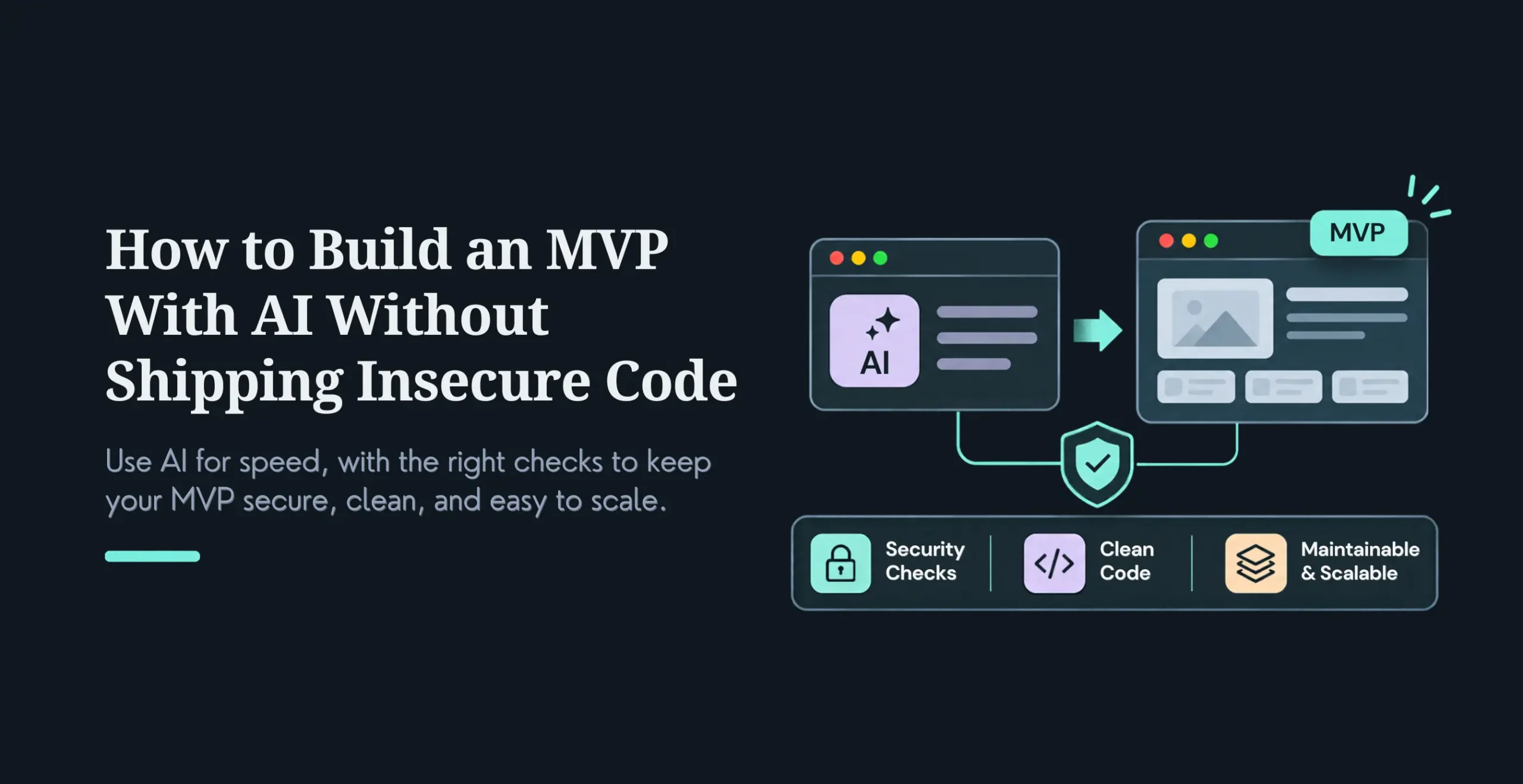
Governance is what separates value from mess: structured requirements before generation, automated gates (SAST, tests, linting) on every AI change, senior human review before merge, and a named engineer accountable for every production change.
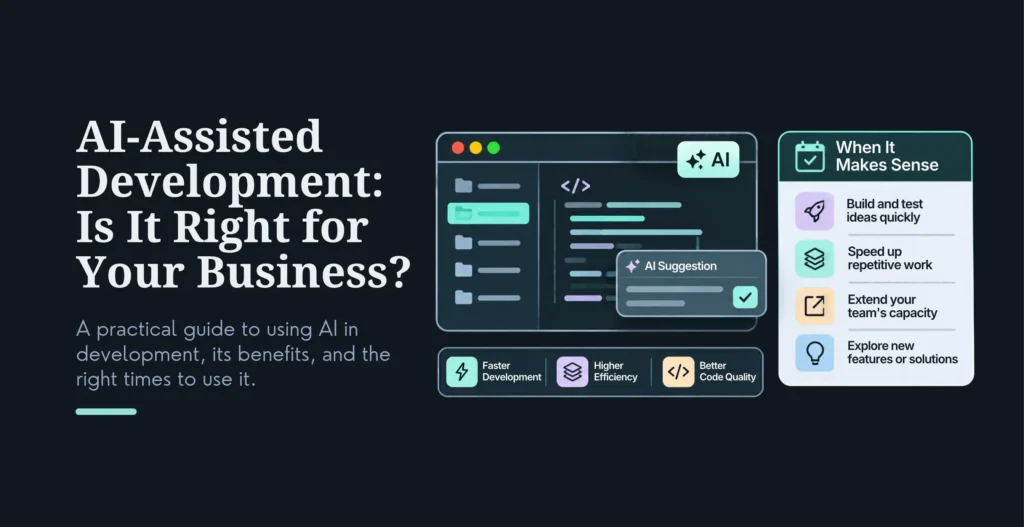
When it makes sense: boilerplate, first drafts, test generation, documentation, debugging, code exploration, and MVP/prototyping. When it doesn’t (unsupervised): architecture, business-logic correctness, security review, and final quality.
Table Of Contents
Table Of Contents
What AI-Assisted Development Is
At its core, AI-assisted development is a collaboration where AI handles routine coding work and a human stays in control of every meaningful decision. The developer defines the task, directs the process, reviews the output, and makes the final call; the AI produces candidate code, tests, documentation, or diagnoses. A useful one-line version: the engineer prompts, reviews, and commits, while the AI produces drafts and alternatives. The key word is assisted, the human retains ownership of design decisions and the final commit, which is exactly what separates it from fully autonomous coding.
The category emerged in 2021-2022 with OpenAI’s Codex and GitHub Copilot, and it has expanded far beyond autocomplete. Today it spans a clear spectrum of autonomy, and understanding where a tool sits on that spectrum tells you how much oversight it needs. At the simplest end are inline completions (Copilot, Codeium), predicting the next line as you type, ideal for boilerplate and repetitive patterns where intent is clear. Next are chat-based assistants (Cursor Chat, Copilot Chat), which answer questions about a codebase, explain unfamiliar code, and generate snippets on request, best for exploration and debugging. Then agentic coders (Claude Code, Devin, Cursor Composer, Windsurf), which read a codebase, plan changes across multiple files, run commands, and iterate, powerful for complex multi-file work, and the point at which governance stops being optional. And finally AI in CI/CD (automated PR review, test generation, regression flagging), which acts as a quality gate. The evolution, as one apt summary puts it, has been from “AI that suggests the next line” to “AI that ships the next feature”, and the further right you go on that spectrum, the more the human’s job shifts from writing code to governing it. Critically, AI-assisted development doesn’t mean you stop thinking; it means you think at a higher level, architecture, user experience, business logic, while the AI handles the mechanical translation of that intent into code.
AI-Assisted vs AI-Native vs AI-Powered Software
These three terms get used interchangeably and shouldn’t be, because they describe fundamentally different things, and conflating them leads to bad decisions. Here’s the clean distinction.
AI-assisted development is a way of building software: the human developer coordinates the workflow and brings AI into selected parts, the AI helps understand unfamiliar code, draft a function, generate tests, or investigate a failure, but the human owns the workflow, the decisions, and the result. AI-native development is also a way of building software, but with AI more central to the workflow: an agentic coder plans a feature, writes a multi-file implementation, runs the tests, and opens the pull request, with the human in an oversight role rather than driving each step. The difference is who drives, and it’s a spectrum, not a binary. AI-powered software is something else entirely: it’s a product that contains AI as a feature, a chatbot, a recommendation engine, image recognition built into the app your users actually use. (Building that kind of product is a different service from the one in this guide; see our custom AI development.) The crisp way to hold it: AI-assisted and AI-native are about how the software gets built; AI-powered is about what the software does.
AI-assisted
AI-native
AI-powered software
What it is
How software is built
How software is built
What the software does
Who drives
Human developer; AI assists
AI drives more; human oversees
N/A, it’s a product feature
Human role
Owns architecture, review, commit
Oversight and approval
Uses the product
Example
Copilot drafts a function, human reviews and commits
An agent plans, writes, tests, and opens a PR
A chatbot or recommendation engine in the app
For most businesses the practical path is to start with AI-assisted (keep control, integrate AI into existing workflows) and move toward AI-native selectively as governance matures, not to jump straight to autonomous agents because the demos look impressive.
What It Covers Across the Lifecycle
AI-assisted development isn’t only about writing code, it can touch nearly every stage of the software lifecycle, which is part of why it’s valuable and part of why it needs governance. On the input side, AI can help refine requirements and specifications, explore architecture approaches, and decompose tasks. In the build, it generates code from prompts and context, refactors existing code, and debugs by investigating failures. For quality, it generates test cases and suites and reviews pull requests, flagging issues before merge. It writes documentation from code. And in operations, it can validate deployments, check configurations, review infrastructure changes, assess release readiness, analyze CI/CD signals, support ongoing maintenance, and help with incident analysis.
But the boundary matters as much as the coverage, and this is the line a responsible team draws clearly: AI assists across all of those, but a human remains responsible for the decisions that carry real consequences, architecture, business-logic correctness, security, and final code quality, and a human engineer makes the final commit. The model produces a candidate (a function, a test suite, a migration, a review comment, an architecture proposal, a bug diagnosis); the engineer decides whether it’s right. That division, broad AI assistance under firm human ownership, is the entire operating model, and keeping it clear is what prevents AI-assisted development from quietly becoming unsupervised AI development.
The Benefits (and What They Depend On)
The benefits are genuine, and worth stating precisely rather than breathlessly. Faster delivery: the same team ships sooner because AI supports every stage, refining requirements, generating and debugging code, producing tests, writing docs, so throughput rises without adding headcount (IBM’s framework calls this “capacity creation” and describes it as often the largest source of value in AI-assisted development in general; in IBM’s own rollout, though, the largest single contribution came from defect losses avoided, see below). Higher productivity: developers become measurably more effective, and, importantly, their time shifts upward toward architecture, UX, and business logic while the AI handles mechanical translation. Better quality, when governed: with automated gates and human review in place, teams can deliver faster without sacrificing quality, security, or accountability, every high-stakes change still passing defined human oversight. And cost efficiency: both direct savings (less rework) and cost avoidance (fewer additional hires or contractor extensions), which compound across quarters.
The verified headline is IBM’s own measurement of an internal rollout: roughly 10x ROI on the tool’s annual cost per developer, with the single largest contribution coming from defects avoided, not raw speed. That’s a striking number, and the honest caveat, which IBM itself makes, is that the measurement method is more instructive than the number: it was one internal program, measured rigorously (pull requests weighted by type over matched 12-week windows), not a universal guarantee you’ll see 10x. It was also IBM measuring its own product, which is another reason to treat it as a method, not a benchmark. The benefits are real, but they’re conditional on doing the governance, which is exactly why the risks section below isn’t a disclaimer, it’s the other half of the same story.
The Risks, and Why Governance Is the Answer
The risks of AI-assisted development are well-documented, and ignoring them is how the ROI turns negative. The biggest is security: AI-generated code inherits vulnerabilities from its training data, improper input validation, hardcoded credentials, weak cryptography, injection flaws, and the large 2026 studies found a substantial share of it unsafe when generated without security prompting: in Veracode’s report, about 44% of code-generation tasks introduced a known vulnerability, and IOActive’s testing found 31.6% of samples fully exploitable. Both tested models without human review, so these are rates of generated flaws, not flaws reaching production. Agentic tools with system access add a new attack surface (prompt injection, CI/CD manipulation). The second is technical debt and maintainability: AI generates rather than consolidates, producing duplication, inconsistent standards across a codebase, and new defect patterns, and CodeRabbit’s December 2025 analysis of 470 open-source pull requests found AI-coauthored ones averaged about 1.7x more issues than human-only ones (10.83 versus 6.45 per PR). CodeRabbit sells code-review tooling and the sample is small, but the direction matches the other data. CodeRabbit report That is a quality cost that can erase the throughput gain if it reaches production. The third is overreliance: teams that treat AI output as correct reduce their review scrutiny, letting defects through, and over time, lean too heavily on AI and core engineering skills erode. And the fourth cluster is supply chain, IP, and ethics: AI suggesting non-existent or compromised packages, developers inadvertently pasting proprietary code into external models, and generated code that can embed bias or infringe IP.
None of this argues against AI-assisted development, it argues for governing it, and the governance is specific and achievable. Structure requirements before the AI generates anything. Put automated gates (static analysis, tests, linting, dependency scanning) on every AI-generated change, as blocking gates, not advisory reports. Require senior human review before merge, with extra scrutiny on authentication, authorization, and cryptography. And name an engineer accountable for every production change, so “the AI wrote it” is never an excuse. That governance layer is precisely what converts AI’s raw speed into shippable, maintainable software, and it’s the single clearest marker of a team (or a provider) that does this well versus one that’s just letting AI run. If code has already been shipped without it and is misbehaving, that’s recovery territory, a code security audit or build rescue is the path back. If the code needs structural cleanup rather than patches, see our restructure AI code service.
When It Makes Sense, and When It Doesn’t
The decision framework is clearer than the hype suggests, and it follows directly from the human-ownership boundary. AI-assisted development makes sense wherever you want to accelerate a well-bounded, verifiable task while keeping human control: generating boilerplate and repetitive patterns (inline completions excel here), exploring and understanding unfamiliar code (chat assistants), producing first drafts of functions, generating test cases and suites, writing documentation, debugging and refactoring, reviewing pull requests as a quality gate, and rapid MVP or prototype work, where AI-assisted builds now start at a fraction of pre-AI cost. These are the tasks where the AI’s output is either low-risk or easily verified, so the speed is nearly free. (For the shift in how websites and apps get built, see our piece on the impact of AI on web development.)
It does not safely replace human judgment on the decisions where being wrong is expensive: architecture, business-logic correctness, security review, and final code quality, all of which stay human-owned. And there are situations to be actively cautious: high-stakes or regulated changes without governance in place, letting inexperienced users approve third-party package installs (supply-chain risk), giving agents CI/CD access without controls, and pasting proprietary code into external models (IP exposure). The honest summary: use AI-assisted development to go faster on the mechanical and the verifiable, and keep humans firmly in charge of the consequential, that boundary is the whole art of doing it well. “Build fast with AI” and “keep engineering quality” are only in tension if you skip the governance; with it, you get both. If you are moving an AI-built prototype toward production, see our AI prototype to production service.
Treat pricing as vendor-reported 2026 planning ranges that vary with scope, and verify with a scoped quote. The clearest signal of AI’s impact is the drop versus pre-AI delivery: a single-workflow web app that ran 30K–50K with a traditional team now commonly runs ~8K–18K AI-assisted (in weeks, not months); a multi-workflow app with AI features ~18K–30K (vs 50K–90K); a full product with mobile and complex integrations ~30K–50K (vs 100K–150K). Focused MVPs start at a few thousand dollars, full web apps and SaaS run 25K–100K+, and agentic or enterprise builds scale into six figures. By engagement model, a fixed-price AI opportunity audit runs ~5K–10K, a prototype sprint ~$20K, and ongoing senior engineering commonly bills around $200/hour (with offshore senior rates materially lower). Budget ongoing costs the build price hides, too: LLM API usage, hosting, and maintenance.
On ROI, the useful unit isn’t hours saved, it’s cost-per-outcome, cost per task, per pull request, per resolved ticket, measured against your own pre-AI baseline. IBM’s verified ~10x figure is the benchmark to cite, with two honest framings attached: the largest contribution came from defects avoided (quality, not just speed), and the method matters more than the number, since the full cost picture includes human review time, rework, governance, infrastructure, and training, and ROI calculated on token spend alone captures a fraction of the real investment. The practical takeaway for a decision-maker: the upside is large and real, but it’s realized through disciplined measurement and governance, not automatically, so build the baseline first and judge AI-assisted development on cost-per-outcome and defect trends, not on a vendor’s headline multiplier. For the deeper build-vs-partner economics, our agency vs in-house cost breakdown runs the comparison.
Frequently Asked Questions
What is AI-assisted development?
It’s the use of AI tools, inline autocomplete (Copilot), chat assistants (Cursor), and agentic coders (Claude Code, Devin), to help developers write, review, test, document, and maintain software, while a human engineer keeps ownership of architecture, review, and the final commit. The human directs the work and makes the final call; the AI produces drafts, alternatives, tests, and diagnoses. The defining feature is that it’s assisted: the human stays in control, which is what separates it from fully autonomous coding.
How is AI-assisted development different from AI-native development and AI-powered software?
AI-assisted and AI-native both describe how software gets built; AI-powered describes what the software does. In AI-assisted development the human developer drives and the AI helps with selected parts. In AI-native development the AI drives more of the workflow (planning, multi-file implementation, opening PRs) while the human oversees. AI-powered software is a product with AI as a feature, a chatbot or recommendation engine your users interact with, which has nothing to do with the development process. Most teams should start AI-assisted and move toward AI-native selectively as governance matures.
What does AI-assisted development actually cover?
Nearly the whole lifecycle: refining requirements, exploring architecture, decomposing tasks, generating and refactoring code, debugging, generating tests, reviewing pull requests, writing documentation, validating deployments and reviewing infrastructure in CI/CD, and supporting maintenance and incident analysis. The boundary that matters: AI assists across all of it, but a human remains responsible for architecture, business-logic correctness, security, and final quality, and a human makes the final commit. The AI produces candidates; the engineer decides whether they’re right.
What are the benefits, and are they guaranteed?
Faster delivery (the same team ships more), higher productivity (developers shift toward higher-level work), better quality when governed, and cost efficiency (less rework, fewer extra hires). IBM measured roughly 10x ROI on an internal rollout of its own coding assistant, with the largest contribution from defects avoided, not raw speed. The honest caveat, which IBM itself makes, is that it was one program measured rigorously, and the measurement method matters more than the exact number. The benefits are real but conditional: they depend on doing the governance, without it, the quality cost of AI code can erase the gains.
What are the risks of AI-assisted development?
Four main ones. Security: AI-generated code inherits vulnerabilities from training data (weak input validation, hardcoded secrets, injection flaws), and a large share of ungoverned AI code is unsafe (about 44% of tasks introduced a known vulnerability in Veracode’s 2026 test). Technical debt: AI generates rather than consolidates, producing duplication and inconsistent standards, and AI-coauthored PRs can carry more defects. Overreliance: reduced review scrutiny lets defects through, and skills erode over time. And supply-chain/IP/ethics: hallucinated or compromised packages, proprietary-code leakage, and embedded bias. All are manageable with governance, structured requirements, automated gates, senior review, and named accountability.
When does AI-assisted development make sense, and when doesn’t it?
It makes sense for well-bounded, verifiable tasks: boilerplate and repetitive patterns, exploring unfamiliar code, first-draft functions, test generation, documentation, debugging, PR review, and MVP/prototyping. It does not safely replace human judgment on architecture, business-logic correctness, security review, or final code quality, those stay human-owned. Be especially cautious with high-stakes or regulated changes without governance, giving agents CI/CD access without controls, letting inexperienced users approve third-party packages, and pasting proprietary code into external models. The rule: go fast on the mechanical and verifiable; keep humans in charge of the consequential.
How do I keep AI-assisted development secure and maintainable?
Governance, and it’s specific. Structure requirements before the AI generates anything. Put automated gates, static analysis, tests, linting, dependency scanning, on every AI-generated change as blocking gates, not advisory reports. Require senior human review before merge, with extra scrutiny on authentication, authorization, and cryptography. Name an engineer accountable for every production change so “the AI wrote it” is never an excuse. And measure defect trends, not just throughput. That governance layer is what turns AI’s raw speed into shippable, maintainable software, and it’s the clearest marker of a team or provider that does this properly.
How much does AI-assisted development cost, and what ROI should I expect?
Vendor-reported ranges: single-workflow apps ~8K–18K (vs 30K–50K pre-AI), multi-workflow ~18K–30K, full products ~30K–50K; MVPs from a few thousand dollars, SaaS 25K–100K+, agentic/enterprise into six figures. By engagement, an audit ~5K–10K, a prototype sprint ~$20K, ongoing build around $200/hour. On ROI, measure cost-per-outcome (per task, PR, or ticket) against your pre-AI baseline rather than hours saved; IBM’s verified benchmark is ~10x, driven mainly by defects avoided, but the full cost picture (review time, rework, governance, infrastructure) means you should build the baseline and judge it on your own numbers.
How do I choose an AI-assisted development provider?
Vet for governance above all: evidence of structured requirements, automated gates on every AI change, senior human review before merge, and a named engineer accountable for every production change. Then seniority (AI-fluent senior engineers, not juniors supervising AI), verified client references, transparent pricing, documented delivery impact (speed and defect trends), security and compliance credentials for your industry, stack depth, timezone overlap, and a willingness to start with a small paid pilot. Ask directly how they measure defect trends and who owns production accountability, a provider who leads with speed metrics but can’t speak to quality governance is the one to avoid.
Conclusion
AI-assisted development is, stripped of the hype, a straightforward idea: AI handles the mechanical parts of building software while a human stays in control of the parts that matter. It’s not AI-native development (where AI drives) and it’s not AI-powered software (where AI is the product), it’s a way of working that, done well, makes a team meaningfully faster without surrendering engineering judgment. The verified upside is large, IBM’s ~10x ROI, driven by defects avoided, and the verified risks are equally real, because AI-generated code ships vulnerabilities and debt by default.
The reconciliation of those two facts is the whole point: the teams that capture the upside and avoid the downside are the ones that govern it, structured requirements, automated gates, senior review, and named accountability on every production change. Used that way, AI-assisted development makes sense for the mechanical and verifiable work (boilerplate, tests, docs, first drafts, exploration, MVPs) and stays firmly out of unsupervised control over architecture, business logic, security, and final quality. Build faster with AI, keep the quality, and stay in control, those three aren’t in tension, they’re what good AI-assisted development looks like.
Want to build software faster with AI without losing engineering quality?
Explore our AI-Assisted Development service to see how we integrate AI into delivery with the governance, structured requirements, automated gates, senior review, that keeps it secure, maintainable, and accountable.
Book a consultation to talk through where AI-assisted development fits your project, and where it shouldn’t.
Nirav Panchal
Lead – Custom Development
Lead of the Custom Development team at KrishaWeb, holds AWS certification and excels as a Team Leader. Renowned for his expertise in Laravel and React development. With expertise in cloud solutions, he leads with innovation and technical excellence.




 KrishaStudio
 KrishaStore