Webflow has grown from a “designer’s secret weapon” into a serious enterprise-ready platform, and in 2026, the big question most teams ask isn’t “Can Webflow handle our site?” but “How much should we actually budget for this?”
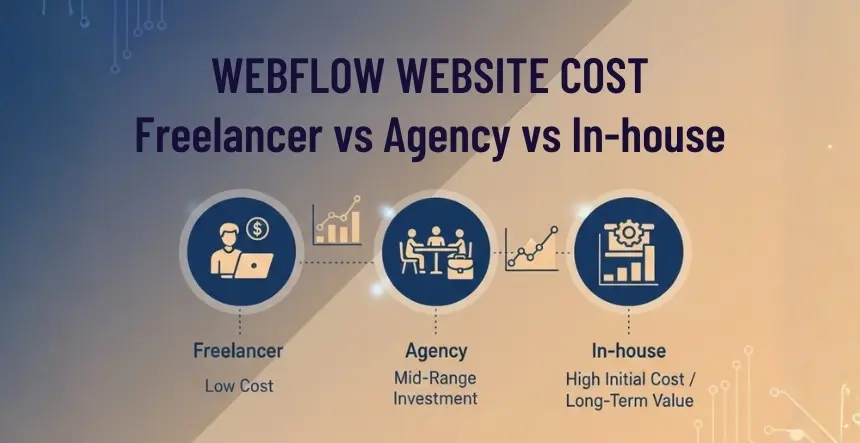
The honest answer: your Webflow website cost depends far more on who builds it (freelancer, agency, or in‑house team) than on Webflow’s subscription price alone. The same platform can cost $2,000 with a solo freelancer, $30,000+ with a mid-size agency, or six figures per year with an in‑house team.
This guide breaks down the real numbers, trade‑offs, and hidden costs so you can budget with confidence and choose the right path for your stage of growth.
1. Webflow Pricing in 2026: The Part Everyone Sees
Before you think about freelancers or agencies, you need to understand Webflow’s own pricing layers: Site Plans + Workspace Plans.
1.1 Webflow Site Plans (per website)
Site plans cover hosting, traffic, CMS, and eCommerce. In 2026, most guide groups them roughly like this:
Webflow Site Plan Type
Typical Use Case
Approx. Annual Cost (2026)
Notes
Basic
Simple brochure / static site
~$14–$18/month
No CMS, good for very small sites.
CMS
Blogs, marketing sites, case studies
~$23–$29/month
Most common choice for Webflow sites.
Business
Higher-traffic marketing sites
~$39–$49/month+
More traffic, form submissions, and support.
eCommerce
Online stores and product catalogs
Higher tier, varies
Adds product, checkout, and transaction limits.
These numbers are small compared to your build cost, but they set the baseline for your annual Webflow spend. (Source: Webflow)
1.2 Webflow Workspace Plans (for teams)
Workspace plans unlock collaboration, roles, and multi-project management, especially important if you’re running an in‑house Webflow team or agency. (Source: Webflow)
Workspace Plan
Ideal For
Approx. Cost / Seat / Month
Why It Matters
Starter/Free
Solopreneurs, testing
$0
Good for learning, not for serious teams.
Core
Small in‑house teams
~$19/seat (annual)
Adds more sites, permissions, and collaboration.
Growth
Larger in‑house/agency
~$49/seat (annual)
Designed for scaling teams and multiple sites.
So even if you max out Workspace and a Business site plan, your platform cost is still only a few hundred dollars per year. The real budget question is:
“How much should we invest in actually designing, building, and growing this Webflow site?”
That’s where freelancers, agencies, and in‑house teams come in.
2. Webflow Website Cost in 2026: Real Ranges
Multiple 2025–2026 pricing breakdowns and agency posts put Webflow website costs in these ranges:
2.1 Cost by Vendor Type
Who Builds It
Typical Project Range (2026)
Hourly Benchmark
Freelancer
~$1,800–$18,000
~$50–$90/hour
Small Studio
~$3,600–$36,000
~$75–$90/hour
Mid‑size Agency
~$7,200–$102,000
~$100–$200+/hour
Top/Enterprise
~$12,600–$178,500+
Often custom, premium
These are guidance ranges, but they highlight a key pattern:
Freelancers are the cheapest per project but are limited in capacity.
Agencies look expensive, but you’re buying a team plus process.
In‑house becomes cost‑effective only when you have constant web work.
2.2 Cost by Project Size
BRIX Templates and other Webflow-focused agencies give helpful breakdowns by site size:
Stability: your project doesn’t stop because one person is unavailable.
Pros
End‑to‑end coverage: from messaging to microcopy to automation.
Proven workflows, templates, and QA routines.
Better fit for growth-focused websites where performance and conversions matter.
Cons
Higher initial investment.
More structure and sometimes a longer lead time to start.
When an Agency Makes Sense
Your website directly influences revenue (demos, signups, deals, applications).
You want to reposition your brand or redesign with a conversion goal in mind.
You value ongoing support, CRO, and content expansion after launch.
If that’s where you are, KrishaWeb’s Webflow development solutions are built exactly for this. Strategy-led, performance-focused Webflow builds backed by a seasoned multi-disciplinary team.
3.3 In‑house Webflow Team: Control and Speed, at a Price
When Webflow launched more advanced Workspace plans, it became attractive as an internal design system and publishing engine.
But “we’ll just hire in‑house” comes with its own cost curve.
Realistic Cost Drivers
Salaries: a solid Webflow designer/dev will often cost $60,000–$100,000+/year fully loaded in many markets (or regional equivalent).
Additional roles: product owner, content, SEO, marketing ops.
These connections add dev time and testing effort, especially for more advanced flows.
5.4 Maintenance, Experiments, and Continuous Improvement
The highest‑performing Webflow sites aren’t “one and done.” They’re treated as products with ongoing optimisation:
A/B testing key pages.
Adding new sections and landing pages.
Rolling out new content types and campaigns.
Many agencies charge $2,000–$7,500/month retainers for 20–80 hours of ongoing Webflow work, CRO, and experimentation.
KrishaWeb, for example, offers retainers under our Webflow development services so clients can keep improving without spinning up a new project every time.
6. How to Choose the Right Path (Decision Framework)
If you’re unsure which route to pick, ask yourself these questions:
6.1 How Critical Is This Website to Revenue?
If it’s a core revenue driver (lead gen, self‑serve signup, demos), cutting corners usually costs more in lost opportunities than you save upfront.
If it’s a supporting asset (e.g., a simple brand presence), a freelancer or very small build might be enough.
6.2 Do You Have Internal Strategic Capacity?
If you already have a strong strategy, content, and marketing leadership, you can lean more on freelancers or in‑house.
If you need guidance on positioning, narrative, UX, and measurement, you’ll benefit from a more experienced Webflow agency.
6.3 What’s Your Time Horizon?
If this is a short‑term splash, optimise for speed and budget.
If this is a 3–5 year growth platform, optimise for architecture, scalability, and maintainability.
6.4 Do You Want to Trust a Partner or Build Everything Yourself?
Building internal capability is powerful, but slow and expensive.
Partnering with the right agency gives you a mature “web department” from day one, while keeping your headcount lean.
If you’re leaning toward an expert partner, KrishaWeb’s Webflow development services are built specifically for companies that want performance-driven, scalable Webflow sites—without having to hire a full in‑house team.
7. How KrishaWeb Approaches Webflow Website Costs (and ROI)
At KrishaWeb, we don’t look at Webflow as “a cheaper way to build websites.” We look at it as an accelerator for better digital experiences when used with the right strategy, UX, and engineering discipline.
A typical Webflow engagement with us includes:
Discovery & Strategy
Clarifying your ICP, value proposition, and success metrics.
Mapping your funnel and aligning the site structure to it.
Information Architecture & UX
Sitemaps and page-level UX flows.
Wireframes to validate content hierarchy before visual polish.
Visual Design & Components
Design system creation: typography, colors, grids, components.
High-fidelity page designs with real content, not lorem ipsum.
Webflow Build & CMS Architecture
Semantic structure, clean class naming, reusable components.
CMS collections are designed for easy publishing and future expansion.
Integrations & Tracking
CRM, automation, and analytics wiring.
Event tracking for key user actions.
Performance, Accessibility & QA
Responsive testing, Core Web Vitals checks, accessibility basics.
UAT support and launch readiness.
Post-launch Support & Growth
Retainers for ongoing updates, experiments, and CRO initiatives.
This lets you treat your Webflow site as a living growth asset, not just a redesigned brochure.
Final Thoughts: Budgeting for Your Growth-Oriented Website
Webflow will be able to support everything from simple startup sites to enterprise marketing platforms in 2026. Therefore, rather than asking, “What does a Webflow website cost?”, you should ask yourself: “What type of Webflow website am I creating, and for what purpose?”
Freelancers are good if you are building a quick and low-cost site that will have your strategy as the center of your focus.
Agencies will be a better fit if your web presence is the primary source of revenue for your business, so you will need a team of experts with a proven system to reach your goals.
An in-house team will likely be the best option if your organisation requires a high quantity of web pages on an ongoing basis and is willing to invest in personnel and processes.
Your partnership with a proven team will help you develop a Webflow site designed for performance and scalability. A great partner will also prevent you from making costly mistakes, as you won’t have to spend years trying out various design and development options on your own.KrishaWeb combines UX (user experience), development, strategy, and design within its Webflow Development Service offerings to ensure that the investment in Webflow delivers returns long after launch. If you are planning to do a Webflow project in 2026, please reach out to us! We would be more than happy to assist you in identifying accurate pricing for each type of Webflow Developer and in determining the best way to implement them within your business.
Frequently Asked Questions
What’s the lowest realistic budget for a professional Webflow site?
If you’re hiring a professional (rather than doing it yourself), you should expect to invest at least $2,000–$5,000 with a freelancer and around $5,000–$10,000+ with a small agency for a simple yet well-executed site. Anything significantly below that usually means corners are being cut somewhere.
Why do certain Webflow projects have prices of $50K+?
Typically, when you see larger budget estimates for Webflow projects, they generally include much more than just “designing a handful of pages.” In particular, projects can also include aspects that affect a company more broadly than directly related site items (e.g., business positioning and strategy, UX complexity, multiple content types/advanced integrations/localisation, extensive QA, and sometimes a complete rebranding). In many companies with significant growth (and changing business models), these sites serve as the main source of revenue and are thus reflected in cost, rather than just a digital brochure of what they produce.
Are Webflow projects always less expensive than WordPress or a custom build?
Not necessarily. Although Webflow can save time and reduce potential maintenance costs over its lifetime, if you invest properly with a sound strategy, design, and content development, the build price will be similar to that of high-end WordPress or custom solutions. The main benefits of Webflow are faster deployment, improved on-site interface control for marketers, and reduced reliance on development bottlenecks over time.
Will we be able to start small and grow incrementally over time with Webflow?
Absolutely, this is often a great approach. You might want to start with either a smaller business model for launching the site, as well as providing key areas to begin localised marketing first, then gradually add additional pages, sections, or features based on growth over time. Many of size (including KrishaWeb) strategically design their Webflow solutions based on this approach, facilitating investment at the same pace as new visitors, leads, and revenue increase.
How do I know if I’m overpaying for a Webflow site?
Instead of just looking at the top-line price, look at what’s actually included: Are you getting strategy, UX, copy, integrations, and QA—or just “some pages in Webflow”? Who’s on the team, and how experienced are they? Is the scope, timeline, and process clearly explained? If a high quote doesn’t clearly explain deliverables and outcomes, that’s a warning sign. If a low quote glosses over strategy, content, or QA, that’s a different kind of warning sign.
Does KrishaWeb only work on new Webflow sites, or can you improve an existing one?
We do both. A lot of clients come to us with a Webflow site that looks fine on the surface,e but isn’t performing. In those cases, we audit the structure, UX, performance, and funnel alignment, then gradually improve it through our Webflow development services retainers so you get better results without throwing everything away and starting from scratch.
Source:
This blog provides an in-depth look at estimated costs associated with your Webflow website in 2026, broken down accurately, by using realistic projections of price from various sources, including freelancers, agencies, and internally developed teams. Many of the costs that often go unnoticed but must be considered include the cost of content, the cost of branding, the cost of integration, and the cost of continuously optimising your site once it has been developed. The pricing information is based on trusted sources, including Amply, BRIX Templates, Creative Corner, Webyansh, Paddle Creative, The Web Factory, Themelooks, Mandy Web Design, and Broworks.
Nisarg Pandya
Project Manager
Experienced Project Manager and Scrum Master at KrishaWeb, delivers expertise in Scrum methodologies, Laravel, React.js, UX design, and project management, ensuring efficient project delivery and agile implementation.




 KrishaLabs
 KrishaStudio
 KrishaStore