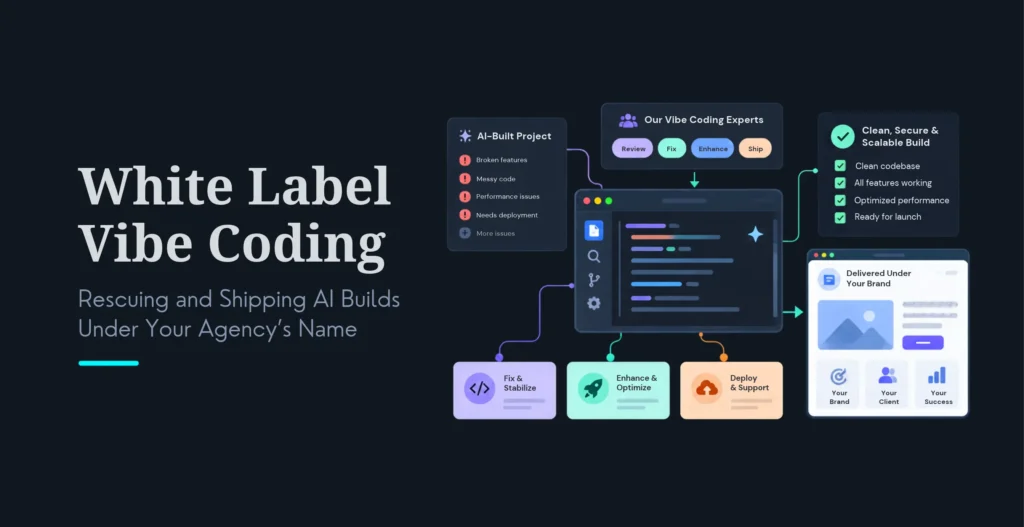
The move: Say yes to the broken-AI-build rescue, hand it to an invisible white label partner who audits, hardens, refactors, finishes, and ships it, under your brand. You keep the client and the margin.
Why the demand is real: Escape.tech’s October 2025 scan of 5,600 live vibe-coded apps found 2,000+ vulnerabilities, 400+ exposed secrets, and 175 personal-data exposures, all in production. Other studies and incidents point the same way.
The 7 failures to fix: Exposed API keys, fake (client-side-only) authentication, zero error handling, race conditions, broken payments, unvalidated inputs, and unmaintainable code. They’re predictable, which makes them systematically fixable.
The runbook: Audit → harden → refactor → finish → ship. Start every engagement with a written audit before quoting the fix.
Pricing (vendor-reported ranges): Rescues roughly 3,000–25,000+; full rebuilds 25,000–50,000 over 4-8 weeks; white label retainers commonly a few hundred to a few thousand dollars a month. Verify with your partner.
The invisibility rule: Fully white-labeled deliverables, partner off every client call, clean IP transfer, backed by an NDA, with delivery run through your own tools.
Rescue vs rebuild: Rescue when the architecture is salvageable and issues are fixable incrementally; rebuild when the foundation (architecture, data model, core logic) is fundamentally broken.
The email is becoming a genre: “We built this app with Lovable (or Bolt, or v0, or Cursor). It demoed beautifully. Now it’s breaking with real users, can you fix it?” For an agency, that’s a high-value rescue job walking in the door, if you can say yes. Most can’t, because hardening AI-generated code takes senior engineers they don’t have on the bench. White label vibe coding is how you say yes anyway, rescue the build, and ship it under your own name.
White label vibe coding is when a specialist partner audits, hardens, refactors, and finishes an AI-generated codebase behind the scenes, invisible to your client, and you ship it under your agency’s brand. You keep the client, the pricing, and the margin; the partner supplies the senior engineering the rescue actually needs. And rescues are needed: in October 2025, security firm Escape.tech scanned 5,600 live, publicly deployed vibe-coded apps (drawn mostly from apps listed on Lovable’s public launch showcase, so not a random sample) and found over 2,000 high-impact vulnerabilities, 400+ exposed secrets (API keys, tokens), and 175 instances of exposed personal data, including medical records and bank account numbers. Every one was in a live production system, and Escape describes its methodology as deliberately conservative. That’s your market.
This guide is a rescue-and-ship playbook: the seven failures that break vibe-coded apps, the audit-to-ship runbook, honest pricing, how the partner stays invisible, and when to rescue versus rebuild. It’s written for the agency owner or technical lead with a broken AI build on their desk right now. Not being able to take these jobs is one of the bottlenecks that stall agency growth, and the AI coding wave is only making them more common, part of AI’s broader reshaping of web development.
That rescue-and-ship work is exactly what our vibe coding services are built for, and this playbook will help you run it with any partner.
Table Of Contents
Table Of Contents
The Scenario: A Broken AI Build Lands on Your Desk
The vibe-coding tools (Lovable, Bolt, v0, Replit, Cursor, Base44) are genuinely good at producing something that works in a demo. They’re bad at everything that keeps it working in production: security, error handling, data integrity, maintainability. So the pattern is consistent, a non-engineer or a junior team ships an impressive prototype, it hits real users, and it falls over. Then it lands on an agency’s desk.
Agencies hesitate for one reason: hardening AI-generated code is senior-engineer work, and senior engineers are expensive and often fully booked. White label vibe coding removes that constraint. A specialist partner does the rescue, audit, harden, refactor, finish, behind the scenes, and you ship it under your brand. You carry the client relationship and the margin; they carry the technical risk and the deep security expertise the job demands. The first move in these conversations is never a blind quote, it’s a quick audit, because “fix our app” can mean anything from a two-day secrets cleanup to a four-week rebuild, and you can’t price it until you’ve looked.
What Breaks: The Seven Failures
The failures in vibe-coded apps are specific and predictable, which is exactly why they’re systematically fixable. Seven recur:
1. Exposed API keys
AI tools routinely hardcode secrets, Stripe keys, database credentials, admin tokens, directly into frontend JavaScript, where anyone with browser dev tools can read and steal them. Escape found 400+ secrets sitting in frontend bundles across those 5,600 apps. This is the single most dangerous and most common failure.
2. Fake authentication
The login looks real but enforces access only on the client side, so anyone who edits a cookie or a local-storage value walks in. AI reliably generates authentication (logging users in) while forgetting authorization (checking what they’re allowed to touch), the root of most access-control holes.
3. Zero error handling
AI-generated code skips input validation and swallows exceptions, so one component throws and the whole app goes white, or worse, the error is silently discarded and the user just never gets what they asked for.
4. Race conditions
Concurrent requests corrupt data because there are no transactions or locks.
5. Broken payments
Stripe integrations with unverified webhooks and no error handling, money logic that fails quietly.
6. Unvalidated inputs
No sanitization, string-concatenated SQL (injection risk), and CORS configured to allow everything.
7. Unmaintainable code
The same logic duplicated across files with slightly different behavior in each, no structure, no tests, impossible for a second engineer to safely extend.
The scale isn’t anecdotal. Beyond Escape’s production scan, Wiz disclosed in early February 2026 that Moltbook, a social network for AI agents whose founder said he wrote none of its code, had left a Supabase key in client-side JavaScript with row-level security off, exposing about 1.5 million API tokens and 35,000 email addresses. In December 2025, Tenzai gave five AI coding tools (Cursor, Claude Code, OpenAI Codex, Replit, and Devin) identical prompts to build three apps each and found 69 vulnerabilities across the 15 apps: all five tools introduced a server-side request forgery flaw in the app that had a URL-fetching feature, and none of the 15 apps had CSRF protection. Carnegie Mellon’s SusVibes benchmark, published at ICML 2026, found that the best coding-agent setup produced working code for 57% of 186 real-world feature requests, but only 11.8% were both working and secure (an earlier preprint of the paper reported 61% and 10.5%). Estimates of how many apps are affected vary by method: a Q1 2026 audit by Kingbird Solutions of 200+ vibe-coded apps reported 91.5% with at least one flaw, but that is a small vendor audit, not a population rate. The takeaway for you: this isn’t a rare edge case. It’s common enough to be a steady, high-value rescue pipeline.
A rescue is a structured pass, not a vibe. Five stages.
Audit first, always
Before quoting the fix, your partner produces a written audit: are secrets hardcoded or shipped in client bundles? Does every endpoint check what a user may touch (object-level authorization, tenant isolation), not just who they are? What’s the state of error handling, input validation, rate limiting, logging, race conditions, payment flows, and data integrity? And how bad is the code structure? The output is a prioritized issue list, which is also what you quote against. Many rescue shops offer this as a cheap or free first step precisely because it de-risks everything after.
Harden
Fix the security holes, the part that actually protects the client. Move secrets to a secrets manager and rotate the exposed keys. Replace client-side auth with real server-side authorization and row-level security. Add error handling, logging, input validation, and rate limiting. Fix CORS, and replace string-concatenated SQL with parameterized queries. This stage is where the Escape-style vulnerabilities get closed.
Refactor
Untangle the architecture, consolidate the duplicated logic, add the tests that never existed, and document it, the goal is a repo a second engineer can safely work on, which is what makes the app a durable asset rather than a one-off.
Finish
Complete the half-built features, fix the broken business-logic flows and UX gaps, add the missing integrations, and make sure the data stays intact. Vibe-coded apps are usually 70% done and 100% fragile; this closes the gap.
Ship
Deploy to production, set up monitoring so you catch what the demo never surfaced, and provide ongoing support. The app now survives real users, real load, and real attackers, which is the whole point.
Pricing
Rescue pricing isn’t fully standardized, so treat these as vendor-reported planning ranges and scope against the audit. Three shapes dominate. A build audit is cheap and fast, often a flat few hundred dollars (or free), delivered in days, and it’s how you (and the client) learn what you’re dealing with before committing. A rescue (audit plus targeted hardening and refactoring) commonly runs roughly 3,000–25,000+ depending on codebase size and severity, with standard cleanups often in the 4,000–15,000 band and enterprise work above $20,000. A full rebuild, when the foundation is too broken to patch, typically runs 25,000–50,000 over 4-8 weeks.
For agencies doing this repeatedly, a white label retainer (a block of senior engineering hours per month, fully white-labeled, with a dedicated engineer and PM, security review, and clean IP transfer) is the efficient model, these commonly run from a few hundred to a few thousand dollars a month depending on the hours. Whatever the shape, mark up the partner’s delivery cost, and price the audit low to win the engagement, then the rescue against the findings. One honest caveat for rescues specifically: scope is genuinely hard to predict before the audit, so quote the audit first and the fix second, never a blind fixed price on an unseen codebase, that’s how rescue margins evaporate. For the deeper build-vs-partner economics, our agency vs in-house cost breakdown runs the numbers, and the mechanics overlap with outsourcing development work generally.
How It Stays Invisible to Clients
Invisibility is the promise. The partner stays fully behind your brand, no logos, no mention, no direct client contact, while you keep the relationship, the pricing, and the markup. They do the audit, hardening, refactor, finish, and ship; you’re the face on every call and your name is on every deliverable, and you get clean IP transfer on all of it.
To make it hold in a code engagement specifically, the same AI-build discipline applies: decide whose name appears in the repository, the commits, the deployment dashboards, and the documentation, a partner’s handle surfacing in a Git history is the classic leak on a rescue. Run delivery through your own Slack or Discord and your own project tools so the work feels in-house rather than bolted on, give access by role and revoke it when the job ends, and back the whole arrangement with a written NDA and non-solicitation. The client should experience one competent engineering team, yours, from the first audit to the final deploy.
Choosing a Partner, and When to Rebuild Instead
Vet a vibe-coding rescue partner on both the usual white-label criteria and the security-specific ones, because this is the highest-stakes white label work there is: a missed vulnerability ships under your name. The non-negotiables: a signed NDA and non-solicitation, demonstrable rescue experience across the actual tools (Lovable, Bolt, v0, Replit, Cursor, Base44), genuine security expertise (they should be able to name the seven failures and how they fix each), a documented audit-to-ship process with senior review, clean IP transfer (and for code, work-for-hire assignment from every engineer on it), references from other agencies, and a willingness to prove it on a small paid trial. The questions that cut through: What’s your rescue process? What vulnerabilities do you typically find, and how do you fix auth versus authorization? Who owns the IP, and does every engineer sign work-for-hire? What’s your engineer churn (a partner losing 40%+ a year will swap your lead mid-rescue)? And what’s the named escalation path, a person, not a Slack channel? Walk away from anyone vague on security, vague on IP, or unwilling to start with an audit. Apply the scrutiny a client uses when choosing an agency; you’re making the same bet on someone else’s craft.
On rescue versus rebuild: rescue when the architecture is fundamentally sound and the problems, exposed secrets, weak auth, missing validation, mostly-correct business logic, can be fixed incrementally; it’s faster and cheaper (3K–25K+ versus 25K–50K+). Rebuild when the foundation itself is broken, when the architecture, data model, or core logic is wrong, or when security issues are so pervasive they can’t be patched one by one. The audit is what tells you which, which is exactly why you never skip it. When in doubt, a competent partner will tell you honestly, an incremental rescue on a fundamentally broken foundation just ships a prettier version of the same failure.
It’s when a specialist partner audits, hardens, refactors, and finishes an AI-generated codebase (built with tools like Lovable, Bolt, v0, Replit, or Cursor) behind the scenes, and you ship it under your agency’s name. The partner stays invisible, no logos, no mention, no direct client contact, with clean IP transfer, while you keep the client relationship, the pricing, and the margin. It lets an agency take on broken-AI-build rescues without having senior security-capable engineers on staff.
My client arrived with a broken AI build. How do I rescue it?
Start with an audit (don’t quote a blind fix), then run the rescue runbook: audit → harden → refactor → finish → ship. If you lack the senior engineering to do it, partner with a white label vibe-coding specialist who does it invisibly while you ship under your brand. The audit tells you the real scope and whether to rescue incrementally or rebuild, which protects both your quote and your margin. Many rescue shops offer a cheap or free initial audit precisely because it de-risks the engagement.
What actually breaks in vibe-coded apps?
Seven failures recur: exposed API keys (hardcoded in frontend code), fake authentication (client-side-only checks that are trivially bypassed), zero error handling, race conditions, broken payments (unverified webhooks), unvalidated inputs (SQL injection, open CORS), and unmaintainable code (duplicated logic, no tests). The scale is documented: Escape.tech’s scan of 5,600 live vibe-coded apps found 2,000+ vulnerabilities, 400+ exposed secrets, and 175 personal-data exposures, and other studies and incidents, including Tenzai’s test of five AI coding tools and the Moltbook breach, show the same patterns.
How do I fix a vibe-coded app, step by step?
Audit (catalog secrets, authorization gaps, missing validation, race conditions, payment and data-integrity issues, and code structure), harden (move and rotate secrets, add server-side authorization and row-level security, add error handling and rate limiting, fix CORS and SQL injection), refactor (untangle architecture, remove duplication, add tests and docs so a second engineer can work on it), finish (complete half-built features, fix broken flows and UX, add integrations), and ship (deploy, monitor, support). Harden is the stage that actually protects the client, so never skip it.
How much does a vibe-code rescue cost?
Vendor-reported planning ranges: a build audit is cheap or free (days); a rescue runs roughly 3,000–25,000+ depending on codebase size and severity (standard cleanups often 4,000–15,000, enterprise above $20,000); and a full rebuild runs 25,000–50,000 over 4-8 weeks. Agencies doing this regularly often use a white label retainer (a monthly block of senior hours, fully white-labeled) running from a few hundred to a few thousand dollars a month. Quote the audit first and the fix against its findings, never a blind fixed price.
How does white label vibe coding stay invisible to my client?
The partner stays fully behind your brand, no logos, no mention, no direct client contact, while you keep the relationship, pricing, and markup and receive clean IP transfer. For a code rescue specifically, decide whose name appears in the repo, commits, deployment dashboards, and docs (a partner handle in Git history is the classic leak), run delivery through your own Slack and project tools, give access by role and revoke it at the end, and back it with an NDA and non-solicitation. The client should see one engineering team, yours, start to finish.
How do I choose a white label vibe-coding partner?
Vet for security expertise above all, since a missed vulnerability ships under your name. Require a signed NDA and non-solicitation, demonstrable rescue experience across the real tools, a documented audit-to-ship process with senior review, clean IP transfer with work-for-hire from every engineer, agency references, and a willingness to start with a paid trial or audit. Ask how they handle auth versus authorization, who owns the IP, their engineer churn, and their named escalation path. Walk away from anyone vague on security or IP, or unwilling to audit before quoting.
When should I rescue versus rebuild?
Rescue when the architecture is fundamentally sound and the problems, exposed secrets, weak auth, missing validation, mostly-correct business logic, can be fixed incrementally; it’s faster and cheaper. Rebuild when the foundation itself is broken (wrong architecture, data model, or core logic) or when security issues are so pervasive they can’t be patched one by one. The audit is what decides it, which is why you never skip it. A competent partner will tell you honestly, patching a fundamentally broken foundation just ships a prettier version of the same failure.
Conclusion
The vibe-coding wave created a steady supply of broken AI builds, and a steady supply of clients who need someone senior to rescue them. That’s an opportunity, not a headache, if you can say yes. White label vibe coding lets you say yes: rescue the build, harden it against the exact failures the research documents, and ship it under your own brand, while a specialist supplies the engineering invisibly and you keep the client and the margin.
The playbook is disciplined and repeatable. Audit before you quote, because scope on an unseen AI codebase is unknowable until you look. Run the five-stage runbook, audit, harden, refactor, finish, ship, with hardening as the non-negotiable core. Price the audit low and the rescue against its findings. Keep the partner invisible with full white-labeling, clean IP, and delivery through your own tools. And vet that partner for security expertise harder than anything else, because their missed vulnerability becomes your reputation. Do that, and every “it demoed fine but it’s breaking now” email becomes high-margin rescue revenue instead of a job you have to turn away.
Got a client’s broken AI build on your desk right now?
Explore our White Label Vibe Coding Services to see how we audit, harden, and ship AI builds under your brand, fully white-labeled, with security review, NDA, and clean IP transfer standard.
Book a consultation and send us the repo, we’ll scope the rescue and tell you honestly whether to fix or rebuild.
Nirav Panchal
Lead – Custom Development
Lead of the Custom Development team at KrishaWeb, holds AWS certification and excels as a Team Leader. Renowned for his expertise in Laravel and React development. With expertise in cloud solutions, he leads with innovation and technical excellence.




 KrishaLabs
 KrishaStudio
 KrishaStore