Every agency owner who’s weighed hiring a front-end developer has done some version of this math, usually using the salary number, and usually getting it wrong. The salary is only part of what an in-house hire actually costs, and the comparison most people run quietly ignores the one variable that decides the whole thing: utilization. Here’s the real 2026 math, with the full cost on both sides.
A white label front-end developer runs roughly 2,500–5,000/month for a dedicated resource (about 30K–60K/year), or an hourly rate from ~18–45 (India) up to ~125–300 (US) depending on geography and seniority. An in-house mid-level US front-end developer costs 100K–155K in salary alone, and the true all-in cost, once you add benefits (about $0.43 per $1 of wages, per BLS, and that already includes employer payroll taxes), software, equipment, training, management overhead, and recruitment, is roughly 143K–222K a year before those other costs. On a full-year basis, white label typically lands 50-75% cheaper. But the headline number isn’t the real answer, the real answer is a break-even: below roughly 950-1,200 productive hours of need per year, buying (white label) is cheaper; above ~1,500 steady hours, building (in-house) starts to make sense; and if your demand swings more than 2x between your busiest and quietest months, a full-time salary is structurally inefficient no matter the rate. One caveat on the middle number: it holds against Western white-label rates, not offshore ones; see the break-even section.
This is the finance-grade version of the decision: the full cost breakdown on both sides, white-label rates by geography and model, the break-even framework, when each option actually wins, and the margins you can run. It’s written for the agency owner or finance lead who needs the real numbers, not the brochure ones. Front-end capacity is one of the bottlenecks that stall agency growth, and the right call here is the difference between scaling profitably and carrying dead weight. It’s the model behind our own white label web design and development.
Key Highlights
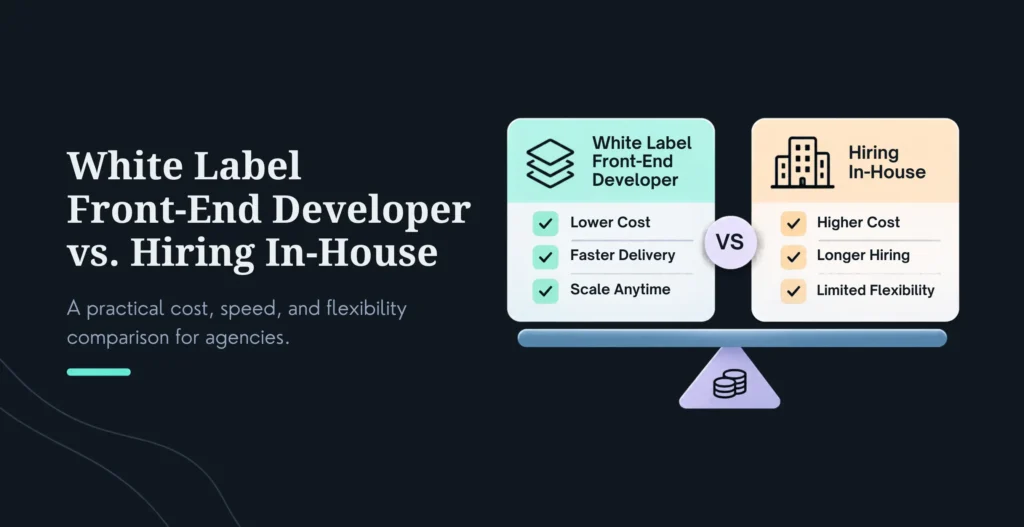
The honest headline: white label ~30K–60K/year for a dedicated developer vs an in-house hire at roughly 143K–222K once benefits are added to salary (before software, equipment, management and recruitment), roughly 50-75% cheaper over a full year.
Salary is only part of it: the real in-house cost adds benefits (~30% of total compensation, BLS, every $1 of wages costs ~$0.43 more in benefits, including employer payroll taxes), plus software, equipment, training, management time, and recruitment.
Bench time is the silent margin killer: a salaried developer costs the same in a dead month; a white-label partner bills only for work done. Utilization, not the hourly rate, is what actually decides which is cheaper.
The break-even rule: under ~950-1,200 productive hours/year → white label wins; ~1,500+ steady hours/year → in-house can win; demand swinging >2x month-to-month → a full-time salary is structurally inefficient. The 1,500-hour rule compares against Western white-label rates; offshore partners stay cheaper at any utilization.
White-label rates by geography (hourly, vendor-reported): India ~18–45, Eastern Europe ~65–90, Latin America ~75–100, UK/AU ~110–150, US ~125–300. Dedicated monthly ~2,500–5,000.
White label wins for: overflow, specialized or occasional platform needs, testing a new service, and variable demand, you pay only against revenue and offload turnover and coverage risk.
In-house wins when: development is core to your identity, demand is steady and predictable enough to keep the hire busy, or you need total process control. Most agencies land on a hybrid.
Your margin: reselling white-label work at a 30-100% markup is standard, a 50-70% gross margin (billing ~2-3x partner cost) is the common target.
Table Of Contents
Table Of Contents
The Real Cost Comparison
Start with the number most comparisons stop at, and then fix it. An in-house mid-level front-end developer in the US costs roughly 100K–155K in salary. That’s the brochure number. The real number is what it costs your business to employ that person, and it’s substantially higher.
Per the US Bureau of Labor Statistics’ latest Employer Costs for Employee Compensation data (June 2026), benefits make up about 30% of total compensation for private-industry workers ($14.07 of $46.89 an hour), and for full-time workers the share is 31.5%. In plain terms, for every $1 you pay in wages, you spend roughly $0.43 more on benefits (about $0.46 for full-time workers). BLS counts legally required employer costs such as payroll taxes inside benefits, so they are already in that number. And there is plenty else: software and tool licenses, equipment, training, the management time to lead and review the person, and the recruitment and onboarding cost to hire them in the first place (recruiter fees, plus weeks of reduced output while they ramp). Apply the BLS ratio to a 100K–155K salary and salary-plus-benefits alone comes to roughly 143K–222K a year, before any of those other costs. Expressed monthly, independent analyses put a fully-loaded US developer around $15,000/month once employer costs are included.
Against that, a white label front-end developer is a variable cost. A dedicated resource runs roughly 2,500–5,000/month (30K–60K/year); hourly rates span a wide geographic range (below). The structural difference matters more than the sticker price: the in-house hire is a fixed cost you pay every month whether or not there’s billable work, while the white-label resource is paid only against revenue, with the partner absorbing turnover, sick leave, vacation coverage, recruitment, equipment, and management. Across a full year of real operation, agencies that run this comparison honestly typically find white label costs 50-75% less than the equivalent in-house capacity (on paper, 30K–60K against 143K–222K is 58-86% less). But “typically” is doing real work in that sentence, because the true answer depends entirely on how busy you’d actually keep the hire, which is the whole point of the break-even framework later in this piece.
Where the In-House Money Actually Goes
It’s worth seeing the full in-house stack laid out, because the gap between “salary” and “real cost” is exactly where agencies miscalculate. Salary is the base: roughly 75K–120K for a junior, 100K–155K for a mid-level, and 125K–195K for a senior US front-end developer. On top of that sits the benefits load (~30% of total compensation, higher for full-time roles), which covers health insurance, retirement contributions, and paid leave, and the legally-required employer costs like payroll taxes. Then the operating costs that have nothing to do with the paycheck: software and SaaS licenses (IDEs, design tools, hosting, monitoring), a laptop and peripherals, and ongoing training and conferences to keep skills current. For a React-specific breakdown, see our guide to the cost of hiring ReactJS developers.
And then the two costs agencies forget entirely. The first is management overhead, a developer needs someone to turn client needs into tasks, review the work, run 1:1s, and handle the inevitable people-management, and that someone’s time is real money. The second, and the biggest hidden one, is bench time: the hours between projects when the salaried developer is paid in full but producing nothing billable. In a quiet month, that in-house hire costs you exactly the same as in a flat-out month, while a white-label partner or freelancer simply doesn’t bill for hours you don’t use. This is the silent margin killer, and it’s why the real comparison was never white-label-rate versus in-house-salary. It’s white-label-rate versus in-house-cost-divided-by-actual-billable-hours. A developer you keep 50% utilized costs you double per productive hour, and suddenly the “expensive” white-label rate looks cheap.
White-Label Rates by Geography and Model
White-label pricing varies by where the talent is and how you engage it; treat these as vendor-reported 2026 planning ranges and verify against a real quote. By geography, hourly rates cluster predictably: India roughly 18–45/hour (the most-used source for Western agencies), Eastern Europe ~65–90 (strong technical quality, partial UK overlap), Latin America ~75–100 (good US timezone overlap), UK and Australia ~110–150 (near-domestic quality), and US domestic ~125–300 (a wide range by seniority and stack). The spread is the opportunity: a senior developer at $30/hour from a strong offshore partner doing work you bill at Western rates is the entire economic engine of white label.
By engagement model, you have real flexibility an in-house hire can’t give you. A small retainer (~500–1,000/month) covers basic maintenance and minor work; a mid-tier retainer (~1,000–5,000/month) covers active development with a PM included; a dedicated full-time developer runs ~2,500–5,000/month; and project-based pricing lets you buy outcomes rather than time (a brochure build from a few hundred to a few thousand dollars, a standard CMS build from a few thousand, ecommerce and custom app work higher). The key structural point for a finance lead: every one of these is a cost you can turn on, scale, or turn off as demand moves, which is exactly what you cannot do with a salary. Choose the retainer or project model for variable demand, and reserve the dedicated model for when you have steady, predictable work, which is precisely the break-even question.
The Break-Even: Which Actually Wins
Here’s the framework that turns this from a rate comparison into a decision. It rests on three questions.
First: how many productive development hours did you genuinely need over the last 12 months? Count honestly, including maintenance and bug-fixing, not just new builds. The rule of thumb: below roughly 950-1,200 productive hours a year, buying (white label) is cheaper than building, because you’d be paying a full salary to keep someone busy a fraction of the time. Above ~1,500 steady productive hours, an in-house hire starts to pay for itself on pure cost. Between 1,200 and 1,500 is the genuinely ambiguous zone where the other two questions decide it. One honest limit on those thresholds: they are a vendor’s rule of thumb, and they only work against Western white-label rates. A fully loaded US hire at 143K–222K costs roughly 69–107 per hour even at a full 2,080 productive hours, which is still more than the 18–45 an hour an offshore partner charges. Against offshore rates, in-house does not win on pure cost at any utilization, so the case for in-house rests on control, domain depth, retention, and communication overlap, not on the rate.
Second: how big is the swing between your busiest and quietest month? If demand fluctuates by more than a factor of 2, a full-time salary is structurally inefficient, you either overpay for idle capacity in slow months or you’re underwater in busy ones. Variable demand is the single strongest argument for the variable-cost model. Third: how broad is the skill set you actually need? One developer can’t be equally strong at WordPress, Webflow, Shopify, headless React, and DevOps, so if your work spans multiple technologies, white label gives you access to a whole team’s breadth for less than one specialist’s salary; if you need deep expertise in one stack permanently, an in-house hire concentrates it.
The honest answer for many agencies is a hybrid: keep a routine, predictable base of work in-house (where utilization is guaranteed), and send the peaks, the specialized work, and the overflow to a white-label partner. That caps your fixed cost at the level you can reliably keep busy and converts everything above it into a variable cost, which is the most capital-efficient structure for a business with uneven demand, which describes almost every agency. If you want the parallel version of this math for the broader build-vs-partner question, our agency vs in-house cost breakdown runs it, and freelancer vs agency covers the third option in the mix. If you want capacity that works as an extension of your own team rather than a fully branded handoff, see our IT staff augmentation option.
When Each Option Genuinely Wins
Cut through to the decision. White label wins when you have overflow beyond in-house capacity, when you need specialized or occasional platform expertise (Shopify Plus, headless, a one-off integration) you can’t justify hiring for, when you’re testing a new service line before committing headcount, and whenever demand is variable, in all of these you pay only against revenue, launch new capability in days rather than months, access breadth you could never staff, and offload turnover and coverage risk, usually at 50-75% below the cost of building it. In-house wins when development is the literal core of your agency’s identity and you want to own that expertise and institutional knowledge, when demand is steady and predictable enough that bench time isn’t a risk, and when you need total control over process and the team. In-house buys you full ownership of people and process, but it comes bundled with the recruitment, retention, tooling, and management responsibility that white label absorbs.
The comparison in one line each: white label is a variable cost with broad stack coverage, fast onboarding, minimal management overhead, and risk the partner carries; in-house is a fixed cost with narrower but deeper coverage, months-long onboarding, full management overhead, and risk you carry. Neither is universally right, which is why the break-even above, not a blanket preference, should drive the call. And a reminder from the cost section: whichever you choose, the number that actually determines the economics is utilization, so decide based on the hours you’ll genuinely use, not the rate on the invoice.
For an agency, white label isn’t only a cost decision, it’s a margin one, because you resell the work. The standard is a 30-100% markup on the partner’s cost, scaled to how much value you add, strategy, design direction, project management, client relationship, QA. A near pass-through where you add little justifies the low end; a full-service engagement where you own strategy and the client relationship justifies the high end. Expressed as margin, the common target is a 50-70% gross margin, which means billing the client roughly 2-3x the partner’s cost. Two honest caveats a finance lead will appreciate: that gross figure is before your own management and QA time, which is real and should be priced in, so net margin runs lower; and the margin only holds if you price from the client’s outcome and your own risk, not mechanically from the partner’s hourly rate. Priced right, white label’s variable-cost structure doesn’t just cost less than in-house, it protects margin precisely in the slow months when a fixed salary would be eroding it.
Frequently Asked Questions
White label front-end developer vs in-house: which is actually cheaper?
Over a full year, white label is typically 50-75% cheaper. A white-label dedicated developer runs ~2,500–5,000/month (30K–60K/year); an in-house mid-level US hire costs 100K–155K in salary alone and roughly 143K–222K once benefits (~30% of total compensation, including payroll taxes) are added, before software, equipment, management, and recruitment. But the real deciding factor isn’t the rate, it’s utilization: white label converts a fixed cost into a variable one you pay only against revenue, so the bigger your bench time would be, the more white label wins.
How much does a white-label front-end developer cost in 2026?
Vendor-reported ranges. Hourly: ~18–45 (India), ~65–90 (Eastern Europe), ~75–100 (Latin America), ~110–150 (UK/Australia), ~125–300 (US). By model: a small maintenance retainer ~500–1,000/month, a mid-tier active-development retainer ~1,000–5,000/month, a dedicated full-time developer ~2,500–5,000/month, or project-based pricing (a few hundred dollars for a landing page up to five figures for custom app work). The flexibility is the point, each is a cost you can scale or switch off as demand moves, which a salary can’t do.
How much does an in-house front-end developer really cost?
Salary is only the base: roughly 75K–120K (junior), 100K–155K (mid-level), 125K–195K (senior) in the US. The true cost adds benefits (BLS puts these at ~30% of total compensation, higher for full-time roles, so ~$0.43 more per $1 of wages, payroll taxes included), software, equipment, training, management overhead, and recruitment/onboarding. Salary plus benefits alone puts a mid-level US developer at roughly 143K–222K a year, around $15,000/month once all employer costs are included in independent analyses. And that’s before bench time, which you pay in full during any month without enough billable work.
What is bench time and why does it dominate this decision?
Bench time is the hours between projects when a salaried developer is paid but producing nothing billable, it’s the silent margin killer. A full-time hire costs the same in a dead month as a flat-out one; a white-label partner simply doesn’t bill for hours you don’t use. This is why the honest comparison isn’t white-label-rate vs in-house-salary, it’s white-label-rate vs in-house-cost-per-productive-hour. A developer you keep only 50% utilized costs double per useful hour, which can flip an “expensive” in-house hire into the pricier option even at a high white-label rate.
When should I hire in-house instead of using white label?
Hire in-house when development is core to your agency’s identity and you want to own the expertise, when demand is steady and predictable enough to keep the person genuinely busy (roughly 1,500+ productive hours a year), and when you need total control over process and team. The break-even math: below ~950-1,200 productive hours/year, white label is cheaper; above ~1,500 steady hours, in-house can pay for itself (against Western white-label rates); and if demand swings more than 2x month-to-month, a full-time salary is structurally inefficient regardless. When in doubt, count the hours you actually used last year.
Can I combine both with a hybrid model?
Yes, and it’s what most agencies should do. Keep a routine, predictable base of work in-house, where you can guarantee utilization, and push the peaks, the specialized work, and the overflow to a white-label partner. That caps your fixed cost at the level you can reliably keep busy and turns everything above it into a variable cost that only fires when there’s revenue attached. For a business with uneven demand (almost every agency), it’s the most capital-efficient structure: you get the control of in-house on your steady base and the flexibility of white label on the volatile top.
What margin can I make reselling white-label work?
The standard markup is 30-100% on the partner’s cost, scaled to how much value you add (strategy, design, PM, client relationship, QA). As margin, the common target is 50-70% gross, billing the client roughly 2-3x the partner’s cost. Two caveats: that’s gross, not net, your own management and QA time is a real cost that pulls it down, so price it in; and you should price from the client’s outcome and your risk, not mechanically off the partner’s rate. White label’s variable cost also protects margin in slow months, when a fixed salary would be eroding it.
What’s the single number that decides white label vs in-house?
Productive hours per year. Everything else, rate, geography, seniority, flows from it. Below ~950-1,200 genuinely productive hours of annual need, buying (white label) is cheaper because you’d be paying a full salary for part-time use. Above ~1,500 steady hours, building (in-house) starts to pay off. In the 1,200-1,500 zone, two tiebreakers decide it: demand fluctuation (a >2x swing favors white label’s variable cost) and skill breadth (needing multiple stacks favors white label’s team breadth). Count your real hours from the last 12 months before you decide anything.
Conclusion
The white label versus in-house decision isn’t really about the hourly rate, and the agencies that get it wrong are the ones who compare a white-label rate to an in-house salary and stop there. The honest comparison puts the full, loaded cost of an employee (salary is only part of it once benefits, tools, management, and especially bench time are counted) against a variable cost you pay only when there’s revenue attached. On that basis, white label runs 50-75% cheaper across a normal year, and the gap widens the more your demand fluctuates.
But the number that actually decides it is utilization. Count the productive hours you genuinely needed last year: under ~1,200 and the math clearly favors white label; over ~1,500 and steady, an in-house hire earns its keep; in between, let demand fluctuation and skill breadth break the tie, and consider the hybrid that most well-run agencies land on. Build the base you can keep busy, buy the rest. Do that, and front-end capacity stops being a fixed drag on your margin and becomes a cost that scales with your revenue, which is exactly what it should be.
Deciding between a white-label partner and an in-house hire?
Explore our White Label Web Design & Development to see how we give agencies senior front-end capacity on a variable-cost basis, under your brand, with no bench time, recruitment, or management overhead.
Book a consultation and we’ll run your actual numbers, your hours, your demand pattern, your mix, and tell you honestly whether to build, buy, or do both.
Parth Pandya
Founder & CEO
Founder & CEO of KrishaWeb, leads an Enterprise Web Agency. With contributions to WordPress and organization of WordCamps, he pioneers innovation and community engagement in the digital realm.




 KrishaStudio
 KrishaStore