“The biggest mistake teams make in 2026 is still choosing a tech stack based on what they know rather than what the project needs. The two are not always the same, and the gap between them shows up in performance benchmarks, maintenance costs, and the inability to add AI features the business will eventually want.
Table Of Contents
Table Of Contents
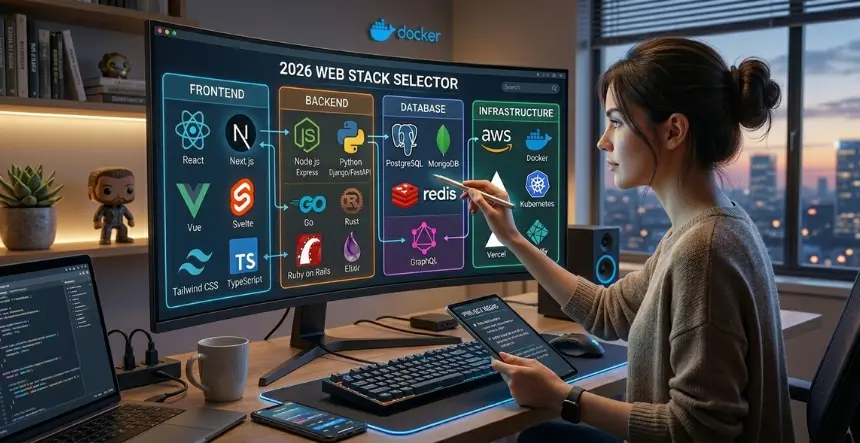
The technology stack for website development is the decision that shapes everything else on a project. It determines how fast your site loads, how easily your team can ship new features, how much it costs to maintain over three years, and whether you can add AI features your business will need without rebuilding from scratch.
A wrong stack choice is not always visible immediately. It shows up six months in when your load time has crept to 4 seconds, or 18 months in when the feature your product team wants requires rebuilding the frontend or when the developer who built it leaves and the next person cannot understand the codebase. The cost of the wrong choice compounds.
This guide is for CTOs, tech leads, and founders evaluating a new build or a migration. It covers the current front-end and back-end technology landscape in 2026, the popular stacks and when to use each, the new AI-native stack category that every business with AI on the roadmap needs to understand, and a practical decision framework to help you choose confidently.
Key benchmark: 40% of visitors abandon a website that takes longer than 3 seconds to load. The technology stack you choose determines whether that 3-second threshold is achievable or a constant struggle. (Source: BrowserStack / industry research)
What Is a Technology Stack and Why Does It Matter More Than Ever in 2026?
A technology stack is the complete set of programming languages, frameworks, libraries, databases, and tools used to build and run a web application. It has two primary layers: the front end, which handles everything users see and interact with, and the back end, which handles server logic, databases, authentication, and APIs.
In 2023, a solid tech stack choice was mainly a performance and scalability question. In 2026, it is also an AI readiness question. According to McKinsey’s 2026 survey, 65% of companies now use AI regularly. The businesses building new digital products without considering how their stack supports AI integration are making the same mistake businesses made 10 years ago by building mobile-unfriendly sites: they will pay three to five times more to fix it later than they would have spent getting it right from the start.
The stack also has direct commercial consequences. The global application development software market is projected to reach $1.7 trillion by 2034. The businesses that build on well-chosen, maintainable stacks are able to ship faster, hire more easily, and integrate new capabilities without rebuilding. The ones that cut corners in stack selection pay for it across the entire product lifecycle.
The Front-End Technology Stack in 2026
The front-end stack handles everything the user sees and interacts with in their browser or app. The core languages have not changed: HTML structures the content, CSS handles visual presentation, and JavaScript adds interactivity. What has changed dramatically is the framework and tooling layer built on top of them.
Core front-end languages
HTML5: Semantic HTML with proper heading hierarchy, ARIA attributes for accessibility, and schema markup are now table-stakes for both SEO and AI readability. Sites that use HTML as a plain content structure without semantic meaning rank lower and are harder for AI systems to interpret.
CSS: Utility-first CSS with Tailwind CSS has become the dominant approach for production applications in 2026. CSS Modules and styled-components remain in use, but Tailwind’s developer velocity advantage and design system integration have made it the default for new builds.
TypeScript: TypeScript is no longer optional for serious projects. The 2025 Stack Overflow Developer Survey shows TypeScript adoption above 70% among professional developers. It catches real bugs before they reach production and makes codebases significantly easier to maintain as teams grow.
Front-end frameworks in 2026
Framework
Market Position
Best For
2026 Notes
React 18/19
Most widely adopted — 43.5% of developers (Stack Overflow 2025)
Blogs, documentation sites, marketing sites, and content-heavy pages
Islands architecture. Sends zero JS by default. Best performance for mostly-static content.
The Back-End Technology Stack in 2026
The back end handles your server logic, business rules, database operations, authentication, and API layer. The choice of back-end language and framework determines how fast your team can build, how securely the application handles data, and how easily it integrates with AI services, third-party tools, and future features.
Back-end languages and frameworks
Language / Framework
Primary Strength
Best For
2026 Position
Node.js / TypeScript
JavaScript on the server. Shares language with the frontend.
Real-time apps, APIs, microservices, and teams already using TypeScript
Express.js, Fastify, and NestJS are the main framework options. Shared type definitions across the frontend and backend is a real productivity advantage.
Laravel 11 with PHP 8.3 is a strong, readable, maintainable choice. Excellent documentation. Large developer pool. Still one of the fastest stacks to build production-grade applications in.
Python / Django / FastAPI
AI and ML integration. Excellent library ecosystem.
Python’s dominance in AI and ML makes it the default back-end language when the application needs direct integration with TensorFlow, PyTorch, LangChain, or other AI libraries.
Ruby on Rails 7
Convention over configuration. Fast to market.
SaaS MVPs, content platforms, startups that need to ship fast
Rails 7 with Hotwire and Turbo brings modern interactivity without complex frontend stacks. The fastest path from zero to production-quality SaaS.
Almost always paired with another database for caching and performance. Not a standalone primary database.
Supabase (PostgreSQL)
Managed PostgreSQL + Auth + Realtime
Startups, MVPs, teams that want Firebase-like features with SQL
Growing fastest among developer-friendly full-stack database options in 2026.
Vector databases (Pinecone, Weaviate)
Semantic / AI search
AI applications, semantic search, RAG architectures
New essential category in 2026 for any application integrating LLM-powered features.
Popular Tech Stacks in 2026 and When to Use Each
Established stack combinations have been battle-tested across thousands of applications. Here are the ones that dominate in 2026, with an honest assessment of when each is the right choice.
MERN Stack (MongoDB, Express, React, Node.js)
One of the most popular full-stack JavaScript combinations. Shares JavaScript across the entire application, which reduces context switching and allows code sharing between frontend and backend. MongoDB’s flexible schema works well for applications where data structure evolves quickly.
Best for: Real-time applications, social platforms, content-heavy apps with evolving data structures
Replaces React with Angular for teams that prefer a more opinionated, full-featured frontend framework. Angular’s built-in TypeScript, dependency injection, and strong module system suit large enterprise teams.
Best for: Enterprise applications with large teams, Google ecosystem, projects requiring strict architectural conventions
Not ideal for: Small teams, startups, projects that prioritise developer velocity over structure
Next.js Full Stack (Next.js + TypeScript + PostgreSQL / Supabase)
The most widely recommended stack for new production applications in 2026. Next.js 15 with the App Router handles both frontend and much of the backend logic through server components and server actions. PostgreSQL or Supabase provides a robust data layer. TypeScript is the default throughout.
Best for: SaaS products, marketing sites, eCommerce, AI-integrated applications, any new product where performance and maintainability both matter
Not ideal for: Teams with no React experience, or applications that need deep server-side logic beyond what Next.js server actions handle
LAMP Stack (Linux, Apache, MySQL, PHP)
The original web stack that still powers a significant portion of the web, including WordPress. Mature, stable, well-understood, and supported by virtually every hosting provider. Laravel brings modern PHP development into 2026 with excellent tooling, a large ecosystem, and remarkable developer velocity.
Best for: Content management systems, WordPress-based sites, B2B web applications, agencies building client sites at speed
Not ideal for: Real-time features requiring WebSockets, applications that need JavaScript throughout the stack
Django + React
Python’s Django framework handles the backend API and data layer, with React managing the frontend. This separation is particularly valuable when the application needs Python’s AI and data science ecosystem on the back end while maintaining a modern React frontend experience.
Best for: AI-integrated applications, data platforms, machine learning-backed products, analytics dashboards
Not ideal for: Teams without Python backend experience, simple content sites that do not need AI capabilities
JAMstack (JavaScript, APIs, Markup)
An architecture approach rather than a specific stack: pre-built markup served from a CDN, JavaScript handling dynamic behaviour, and APIs handling all server-side operations. Sites built on this approach using Astro, Next.js static generation, or Gatsby consistently achieve the best Core Web Vitals scores.
Best for: Marketing sites, documentation, content sites, any site where performance is the primary concern
Not ideal for: Highly dynamic applications with real-time data requirements that cannot be cached
The AI-Native Stack: The New Category Every Project Needs to Consider
In 2023, AI was an optional add-on that a few forward-thinking businesses were experimenting with. In 2026, 65% of organisations use AI regularly and 84% of eCommerce businesses rank it as their top strategic priority. For any new digital product where AI features are on a 12-month roadmap, the technology stack decision needs to account for AI integration from the start.
An AI-native stack is not a single combination of tools. It is a technology stack designed with AI integration as a first-class concern from the architecture layer up.
Core components of an AI-native stack
Backend: Python with FastAPI or Django for direct integration with TensorFlow, PyTorch, and LangChain. Or Node.js with the Vercel AI SDK for teams working primarily in JavaScript.
Frontend: Next.js 15 with server components and streaming for progressive rendering of AI-generated content without blocking the user interface.
AI orchestration: LangChain for connecting large language models to your application’s data and tools. LlamaIndex for RAG (Retrieval Augmented Generation) architectures that ground AI responses in your specific content.
Vector database: Pinecone, Weaviate, or pgvector (PostgreSQL extension) for semantic search and embedding storage. This is the component that allows your AI to search your content by meaning rather than keywords.
LLM provider: OpenAI (GPT-4o), Anthropic (Claude), or Google (Gemini) accessed via API. The architecture should be provider-agnostic so you can switch models as the landscape evolves.
Building AI features onto a stack that was not designed for them costs three to five times more than building AI readiness into the architecture from the start. The same principle applies to tech stacks that applied to website structure: get it right once, or pay to retrofit it later.
How to Choose a Technology Stack: 7 Criteria That Actually Matter
These seven criteria consistently separate good tech stack decisions from ones that create expensive problems later. They are listed in order of importance, not alphabetically.
1. Project requirements and feature complexity
Start with what the application actually needs to do, not what technology you are familiar with. A real-time stock trading platform needs different tools than a marketing site or a SaaS content management application. Define your core features, data relationships, performance requirements, and expected user flows before evaluating any specific technology.
A useful shortcut: if your application has complex relational data and business logic, start with a relational database (PostgreSQL) and a mature backend framework (Laravel, Rails, Django). If your application is primarily content delivery with low dynamic data requirements, JAMstack or Next.js static generation likely fits best.
2. AI readiness
In 2026, this criterion has moved up the list significantly. Any application where AI features such as personalisation, semantic search, content generation, or chatbot integration are on a 12-month roadmap needs a stack that supports clean AI integration at the architecture level. Python’s back end is the strongest choice for deep AI integration. Node.js with the Vercel AI SDK or LangChain.js is a strong choice for teams working primarily in JavaScript.
The question to ask: will your application need to connect to an LLM API, build vector embeddings from your content, or deliver personalised experiences based on user behaviour? If yes, your tech stack choice should account for this now, not after the initial build.
3. Scalability requirements
Two types of scalability matter for web applications. Vertical scaling adds resources to existing servers. Horizontal scaling adds new servers to distribute load. Modern cloud-native stacks on AWS, Google Cloud, or Vercel handle horizontal scaling automatically for the frontend. The back-end database and server logic are where scaling decisions matter most.
For most applications, PostgreSQL with good query optimisation, connection pooling, and read replicas handles scaling to millions of users. The point where you need to consider microservices architecture or distributed systems is far beyond where most applications ever reach.
4. Team expertise and talent availability
A technology that your team knows well ships three to five times faster than one they are learning. This is not an argument for always choosing the familiar over the better. It is an argument for being honest about the learning curve cost and factoring it into your timeline and budget.
It is also an argument for choosing technologies with large talent pools. A Laravel or React project can hire from a larger pool of experienced developers than a project built on a niche framework with limited community support. Hiring difficulty becomes a real operational problem as teams grow.
5. Performance and Core Web Vitals compliance
Google uses Core Web Vitals as ranking factors. LCP under 2.5 seconds, INP under 200 milliseconds, and CLS under 0.1 are the benchmarks. These are not just technical targets. They are commercial requirements: 40% of users abandon sites that take more than 3 seconds to load, and every second of improvement correlates with measurable conversion improvements.
The tech stack determines what is structurally possible on performance. A WordPress site with 40 plugins running server-side PHP on every request has a structural performance ceiling. A Next.js application with static generation and CDN delivery has a fundamentally different performance baseline. The choice of stack is the choice of performance ceiling.
6. Security and compliance requirements
Security requirements vary significantly by industry. Healthcare applications need HIPAA compliance. Financial applications need PCI DSS. Any application handling EU user data needs GDPR compliance. Choosing a technology stack that has native support for these requirements, or a strong ecosystem of compliance-focused packages, reduces the cost and complexity of meeting them.
Practical guidance: Django and Rails have strong built-in protection against common vulnerabilities including SQL injection, XSS, and CSRF. Laravel has a similarly strong security foundation. Node.js applications require more deliberate security configuration but have mature packages available. Regardless of stack, choose technologies that receive regular security updates and have active maintenance communities.
7. Total cost of ownership over three years
The initial development cost is usually the smallest part of a project’s three-year cost. Factor in hosting costs, maintenance, developer availability and salary ranges for your chosen technologies, the cost of upgrading through major versions, and the cost of onboarding new developers who were not part of the original build.
Open-source frameworks (Laravel, Next.js, Django, Rails) reduce licensing costs. Technologies with large talent pools reduce hiring costs. Technologies with stable, backwards-compatible release cycles reduce upgrade costs. Choosing an obscure framework because it solves one problem elegantly often creates a higher three-year total cost than a mainstream choice that solves the same problem adequately.
Tech Stack Decision Table by Project Type
This table maps common project types to the recommended technology stack in 2026. It is a starting point, not a prescription. Your team’s expertise and specific requirements always take priority over a general recommendation.
Project Type
Recommended Stack
Why
Avoid
SaaS product
Next.js 15 + TypeScript + PostgreSQL / Supabase
App Router handles full-stack needs. TypeScript across the stack. Supabase adds auth, realtime, and storage.
LAMP if real-time features matter. MongoDB if data is highly relational.
Marketing / content site
Next.js + Tailwind + Contentful or Sanity (headless CMS)
Static generation + CDN = best Core Web Vitals. Headless CMS for content team independence.
Full WordPress if performance is a priority. Pure SPA if SEO matters.
eCommerce
Next.js + Shopify Hydrogen or custom headless on WooCommerce
Next.js frontend + headless commerce API = fast pages, flexible checkout, Core Web Vitals compliance.
Theme-based Shopify if custom frontend is needed. PHP without caching for high-traffic stores.
Node.js event loop handles concurrent connections efficiently. Redis for pub/sub and session state.
Laravel without Reverb for WebSocket-heavy features. PHP-only stacks for real-time chat or live data.
MVP / startup
Next.js + Supabase or Ruby on Rails 7 + PostgreSQL
Next.js + Supabase is fastest to production. Rails is fastest for teams with Ruby experience.
Over-engineered microservices architecture at MVP stage. Premature optimisation before product fit.
Common Tech Stack Mistakes and How to Avoid Them
Copying your competitor’s tech stack
Your competitor’s requirements, team composition, and business model are not identical to yours. Their stack was chosen for their constraints, not yours. A fintech company running Go microservices made that choice because of their specific scale and reliability requirements. Copying it for a 10-person startup building a content platform is architectural cargo-culting.
Choosing based on personal preference rather than project fit
The framework you love is not always the framework the project needs. A developer who knows and loves Angular will advocate for Angular regardless of project size. A Python advocate will suggest Django even when a simple PHP application would deliver faster with lower cost. Separate the question of what you know from the question of what the project requires.
Ignoring AI readiness in the architecture decision
This is the 2026-specific mistake. Building a product on a stack that was not designed for AI integration and then discovering that adding a chatbot, a personalisation layer, or a semantic search feature requires rebuilding significant infrastructure is a preventable cost. Evaluate AI requirements at architecture time, not when the product team asks for them.
Under-investing in the database choice
Teams spend significant time choosing between React and Vue and comparatively little time on their database architecture. The database is where performance problems, scaling problems, and data integrity problems most often originate. PostgreSQL with proper indexing, query optimisation, and connection pooling solves the data layer for the vast majority of applications. Make the database decision deliberately rather than defaulting to whatever the tutorial used.
Not prototyping before committing
Before locking in a technology stack for a large project, build a small proof of concept that exercises the application’s most complex features. A proof of concept that takes two weeks can save months of work by revealing integration problems, performance issues, or developer experience problems before they are embedded in a production codebase.
Building a new web application or evaluating a migration? KrishaWeb has been making technology stack decisions for SaaS products, eCommerce platforms, and enterprise web applications development solutions since 2008. Talk to our technical team and we will assess your specific requirements and recommend a stack that fits your project, your team, and your 12-month roadmap.
Frequently Asked Questions
What is a technology stack in web development?
A technology stack is the complete combination of programming languages, frameworks, libraries, databases, and tools used to build and run a web application. It has two primary layers: the front-end stack that handles what users see and interact with and the back-end stack that handles server logic, databases, and APIs. The choice of stack determines how fast the application loads, how easily it scales, and how much it costs to maintain and extend over time.
What is the best technology stack for website development in 2026?
There is no single best stack — the right choice depends on your project type, team expertise, and requirements. For most new SaaS applications and product websites, Next.js 15 with TypeScript and PostgreSQL or Supabase is the most recommended combination in 2026 because it handles full-stack development with strong performance, TypeScript throughout, and straightforward AI integration. For content sites, Next.js with a headless CMS delivers the best Core Web Vitals. For AI-integrated applications, combining Next.js with a Python FastAPI backend and LangChain is the current standard.
What is the MERN stack and when should I use it?
MERN stands for MongoDB, Express, React, and Node.js. It is a full-stack JavaScript combination that allows a single language across the entire application. It works well for real-time applications, social platforms, and content-heavy applications with evolving data structures. It is less appropriate for applications with complex relational data, financial systems requiring strict data integrity, or applications where TypeScript consistency across all layers is important, since MongoDB’s schema flexibility can make TypeScript definitions inconsistent.
How important is AI readiness when choosing a tech stack?
In 2026, very important. 65% of companies now use AI regularly, and this number is growing. For any application where AI features such as personalization, semantic search, chatbot integration, or content automation are on a 12-month roadmap, the technology stack needs to support clean AI integration at the architecture level. Python’s back end provides the strongest AI integration capabilities. Next.js with server components supports progressive rendering of AI-generated content. Adding vector database support from the start is significantly cheaper than retrofitting it later.
What is the difference between frontend and backend technology stacks?
The front-end stack handles what users see and interact with in their browser: HTML structure, CSS styling, and JavaScript frameworks like React, Vue, or SvelteKit. The back-end stack handles server logic, database operations, authentication, and APIs: languages like Node.js, PHP, Python, or Ruby combined with databases like PostgreSQL or MongoDB. A full-stack application combines both layers. Some modern frameworks like Next.js blur this boundary by handling both frontend rendering and server-side logic in a single codebase.
How do I choose between React and Vue for my frontend?
React has the larger ecosystem, more job postings, and better long-term hiring prospects. It is the stronger choice when your team has JavaScript expertise, when you expect to hire frontend developers over the next year, or when your application has complex state management requirements. Vue is the stronger choice for teams with existing Vue experience, for progressive enhancement of traditional server-rendered applications, and in markets like China and Southeast Asia where Vue has higher adoption. In 2026, Next.js (which is built on React) has become so dominant for production applications that the question is increasingly React or not-React, rather than React versus Vue.
How much does the wrong tech stack choice cost?
The cost varies by project size, but the pattern is consistent: the wrong stack choice compounds over time. A startup that builds on a poorly chosen stack might spend the equivalent of three to six months of development time rebuilding foundational infrastructure 18 months after launch. An enterprise project on a stack that does not support AI integration might spend two to three times the original development budget to retrofit AI readiness two years later. The upfront research cost of making a good stack decision is a fraction of the cost of fixing a bad one.
Conclusion
Choosing the right technology stack for website development in 2026 is not primarily a technical decision. It is a business decision with technical constraints. The stack you choose determines your performance ceiling, your development velocity, your hiring options, your maintenance costs, and your ability to add the features your business will need over the next three years.
The addition that makes 2026 different from previous years is AI. Any business with digital products on a growth roadmap needs to evaluate AI readiness as part of the stack decision, not as an afterthought. The cost of getting this right at architecture time is a fraction of the cost of retrofitting it later.
KrishaWeb’s web development team has been making these decisions on production projects since 2008. We build on Next.js, Laravel, React, Python, and WordPress depending on what each project actually needs. If you are evaluating a new build or a migration and want an honest technical assessment of which stack fits your requirements, our team is available for a no-pitch consultation.
Ready to talk through your technology stack options? Our technical team has delivered 2,400+ projects across SaaS, eCommerce, and enterprise. Get a free technical consultation — no pitch, just honest advice.
Girish Panchal
Technical Architect
A Technical Architect, proficient in WordPress, Drupal, Laravel, and DevOps tasks, crafts robust IT solutions with a blend of expertise and versatility in web development and infrastructure management.




 KrishaLabs
 KrishaStudio
 KrishaStore